Operations with Whole Numbers
Addition
Definition Addition
Addition is joining groups together to find the total, or sum. The plus sign (\(+\)) tells us to add.
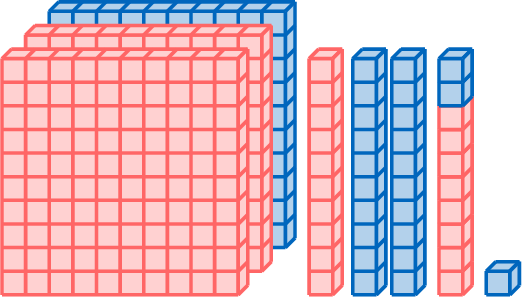
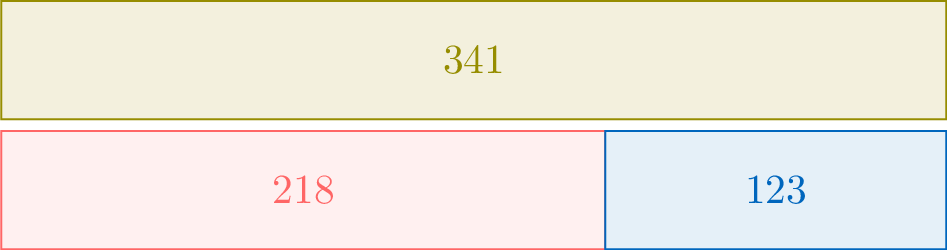
We can show "\(\textcolor{colordef}{\text{two hundred eighteen}}\) plus \(\text{\textcolor{colorprop}{one hundred twenty-three}}\) equals \(\text{\textcolor{olive}{three hundred forty-one}}\)" in many ways:
We can show "\(\textcolor{colordef}{\text{two hundred eighteen}}\) plus \(\text{\textcolor{colorprop}{one hundred twenty-three}}\) equals \(\text{\textcolor{olive}{three hundred forty-one}}\)" in many ways:
- With numbers: $$\textcolor{colordef}{218} + \textcolor{colorprop}{123} = \textcolor{olive}{341}$$
- With cubes:
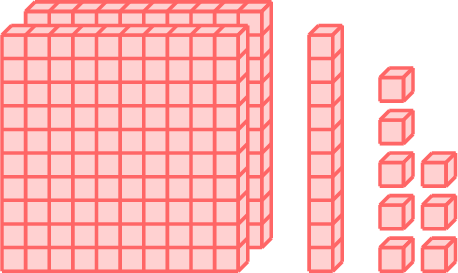 \(+\)
\(+\)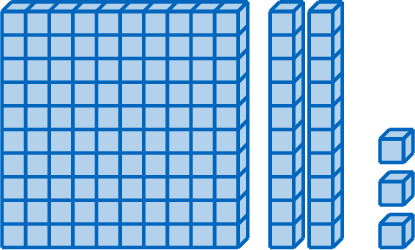 \(=\)
\(=\)
- With a column addition:
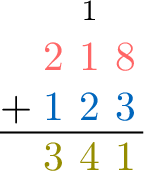
- With a part-whole model:
Method Column Addition with Regrouping
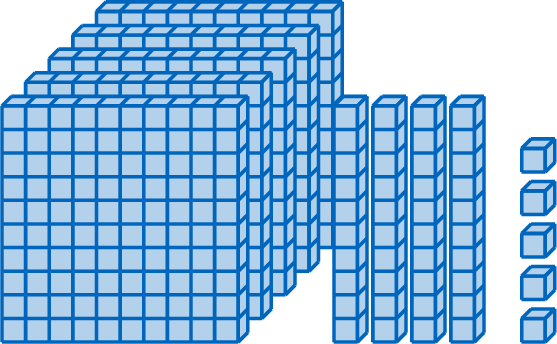
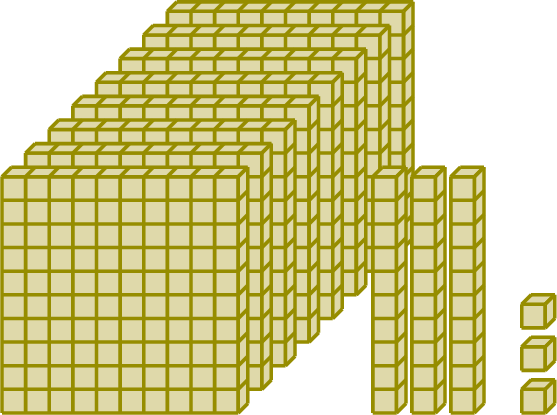
Let's calculate: $$\textcolor{colordef}{288} + \textcolor{colorprop}{545}$$ 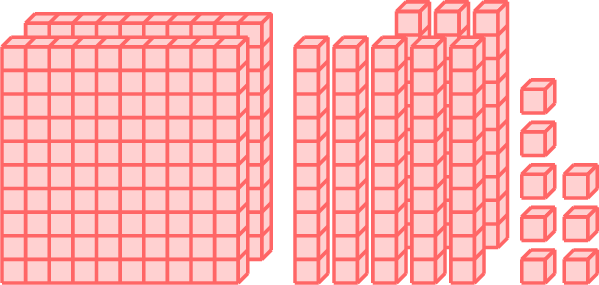 \(+\)
\(+\)  \(=\)
\(=\) 
- Step 1: Line up the numbers by place value.
Write the numbers one on top of the other. Make sure the ones, tens, and hundreds are in straight columns.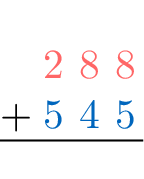
- Step 2: Add the ones. $$\textcolor{colordef}{8} \text{ ones} + \textcolor{colorprop}{5} \text{ ones} = 13 \text{ ones}$$ 13 ones is the same as 1 ten and 3 ones. We write the \(\textcolor{olive}{3}\) in the ones place and carry the 1 ten over to the tens column.
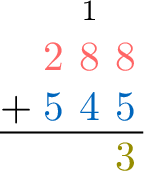
- Step 3: Add the tens. $$1 \text{ ten (carried)} + \textcolor{colordef}{8} \text{ tens} + \textcolor{colorprop}{4} \text{ tens} = 13 \text{ tens}$$ 13 tens is the same as 1 hundred and 3 tens. We write the \textcolor{olive}{3} in the tens place and carry the 1 hundred over.
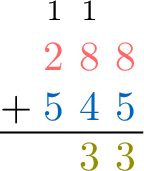
- Step 4: Add the hundreds. $$1 \text{ hundred (carried)} + \textcolor{colordef}{2} \text{ hundreds} + \textcolor{colorprop}{5} \text{ hundreds} = \textcolor{olive}{8} \text{ hundreds}$$ Write the \(\textcolor{olive}{8}\) in the hundreds place.
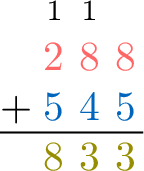
- The Result: $$\textcolor{colordef}{288} + \textcolor{colorprop}{545} = \textcolor{olive}{833}$$
\(+\) \(=\)
Example
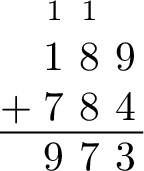
Calculate \(189+784\)
Subtraction
Definition Subtraction
Subtraction means taking an amount away from a group to find out what is left. This result is called the difference. The minus sign (\(-\)) tells us to subtract.
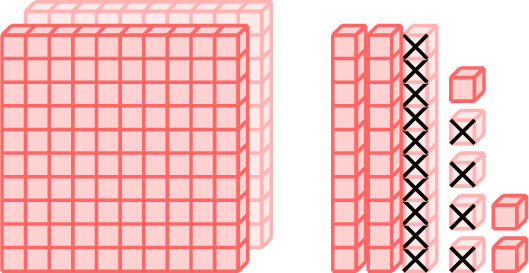
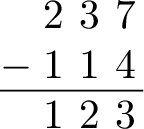
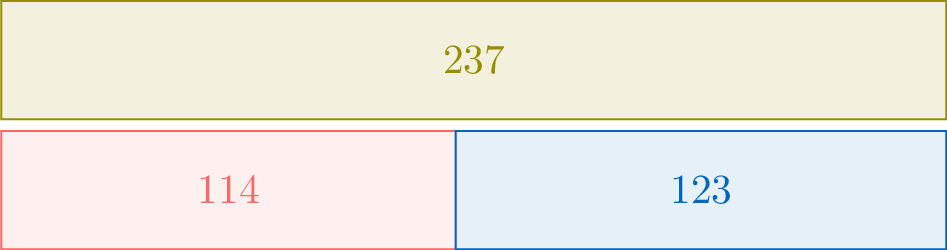
We can show "two hundred thirty-seven minus one hundred fourteen equals one hundred twenty-three" in different ways:
We can show "two hundred thirty-seven minus one hundred fourteen equals one hundred twenty-three" in different ways:
- With Numbers: $$237 - 114 = 123$$
- With Cubes:
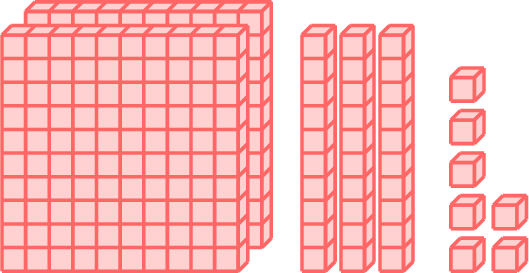 \(-\)
\(-\) 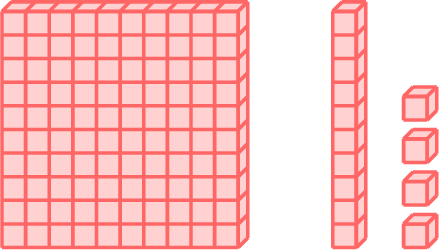 \(=\)
\(=\)
- With Column Subtraction:
- With a Part-Whole Model:
Method Subtraction by Compensation
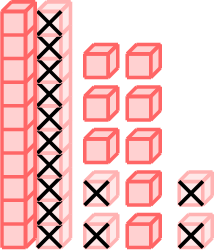
Let's calculate:\(32 - 14\) 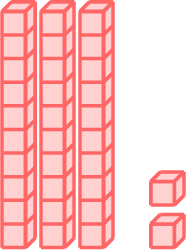 \(-\)
\(-\) 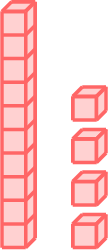 \(=\)
\(=\) 
- Step 1: Set up the subtraction.
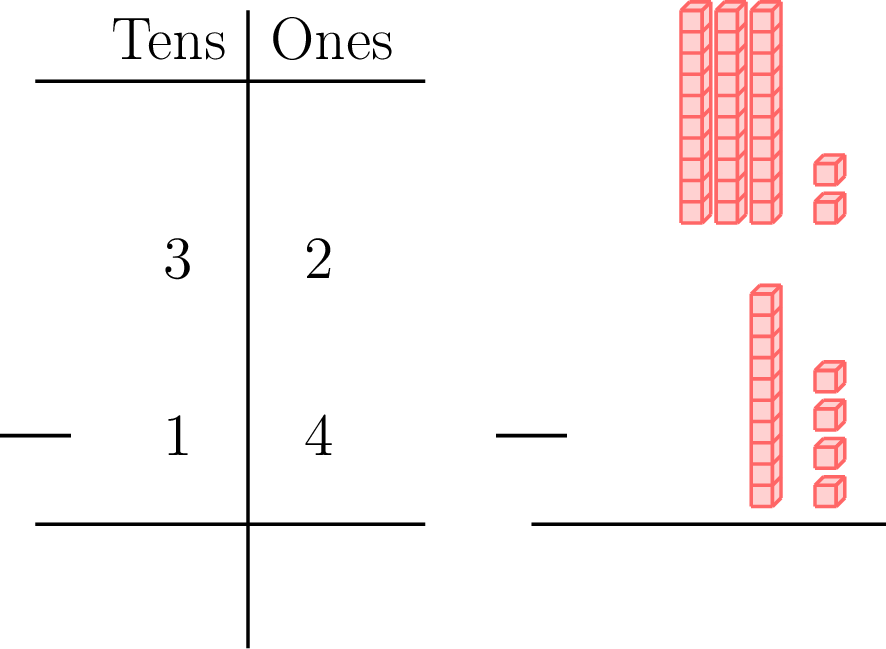
- Step 2: Check the ones place. We need to do \(2 - 4\), but we don't have enough ones.
- Step 3: Compensate. Add 10 to both numbers (10 ones to the top; 1 ten to the bottom)
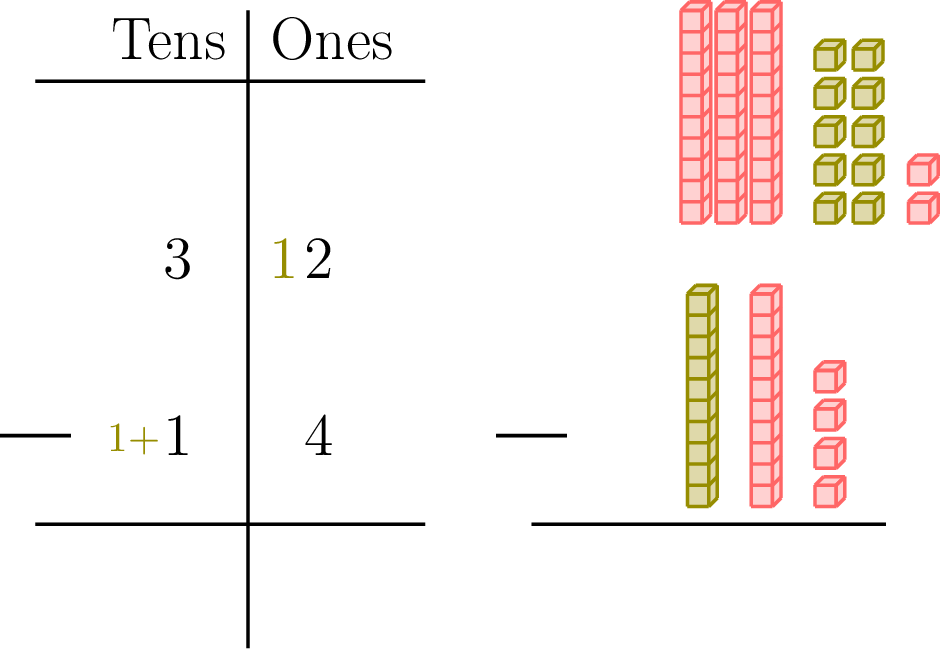
- Step 4: Subtract the ones. Now it's easy: $$12 \text{ ones} - 4 \text{ ones} = 8 \text{ ones}$$
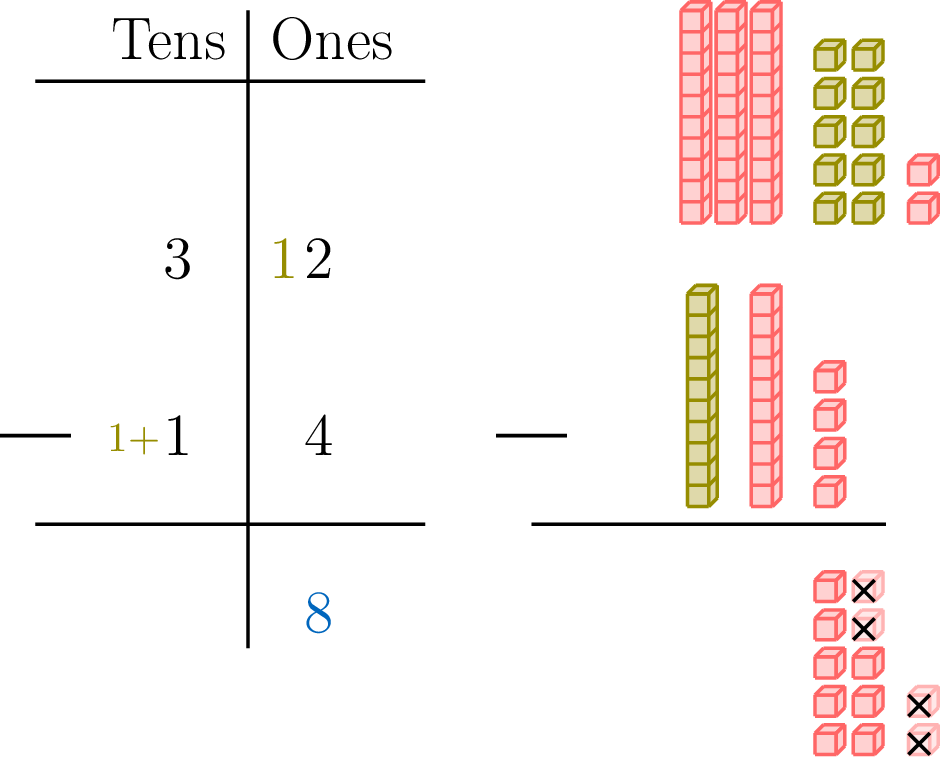
- Step 5: Subtract the tens.$$3 \text{ tens (from 32)} - 1 \text{ ten (from 14)} - 1 \text{ ten (compensated)} = 1 \text{ ten}$$
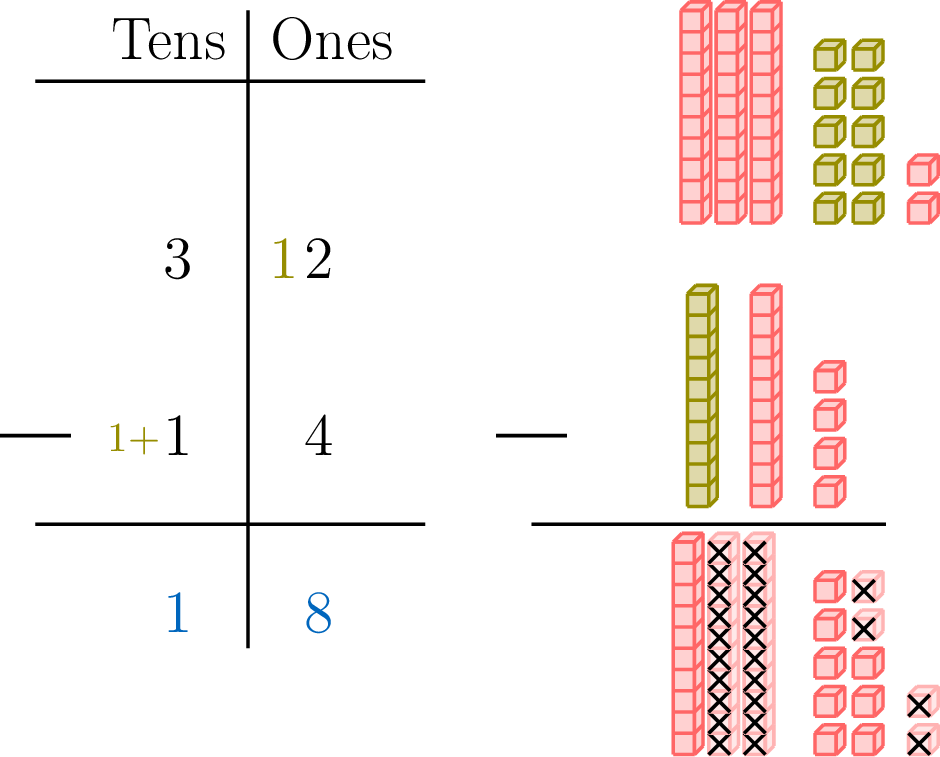
- Result: The difference is 1 ten and 8 ones. So, $$32 - 14 = 18$$
\(-\) \(=\)
Example
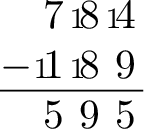
Calculate \(784 - 189\)
Multiplication
Definition Multiplication
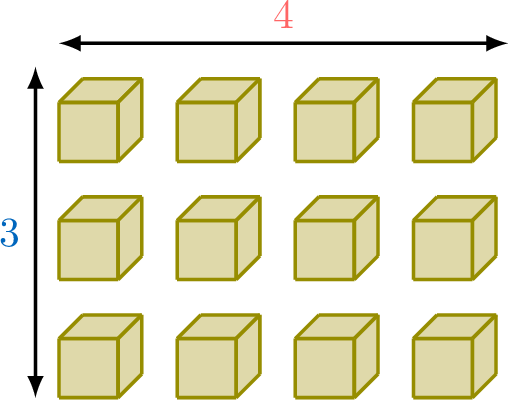
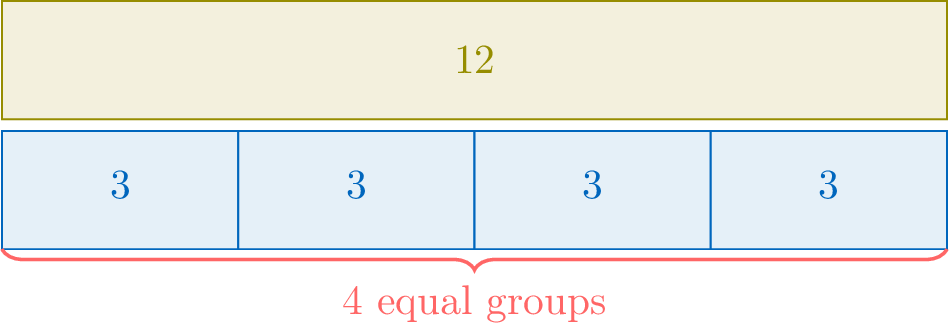
Multiplication is a fast way to show repeated addition. We can show the idea of "four times three equals twelve" in many different ways:
- With Numbers: $$\textcolor{colordef}{4}\times \textcolor{colorprop}{3}=\textcolor{olive}{12}$$
- In Groups: $$\textcolor{colordef}{4}\text{ groups of }\textcolor{colorprop}{3}=\textcolor{olive}{12}$$
- As Repeated Addition: $$\textcolor{colorprop}{3}+\textcolor{colorprop}{3}+\textcolor{colorprop}{3}+\textcolor{colorprop}{3}=\textcolor{olive}{12}$$
- With Cubes:
- With a Part-Whole Model:
Method Column Multiplication by a Two-Digit Number
To calculate \(23 \times 37\):
- Step 1: Align the numbers vertically by place value.
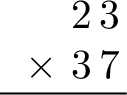
- Step 2: Multiply by the ones digit. Multiply the top number (\(\textcolor{colordef}{23}\)) by the ones digit of the bottom number (\(\textcolor{colordef}{7}\)): \(\textcolor{colordef}{23}\times\textcolor{colordef}{7}=\textcolor{colorprop}{161}\).
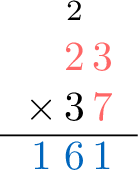
- Step 3: Multiply by the tens digit.
- First, place a placeholder \(\textcolor{olive}{0}\) in the ones column of the second row. This is because we are now multiplying by the tens digit (\(\textcolor{colordef}{3}\), which represents 30). This placeholder shifts our answer one place to the left.
- Next, multiply the top number (23) by the tens digit (\(\textcolor{colordef}{3}\)). Calculate \(\textcolor{colordef}{23}\times\textcolor{colordef}{3}=\textcolor{colorprop}{69}\) and write it to the left of the placeholder.
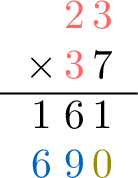
- Step 4: Sum the partial products. Add the results from Step 2 and Step 3: \(\textcolor{colordef}{161}+\textcolor{colordef}{690}=\textcolor{colorprop}{851}\)
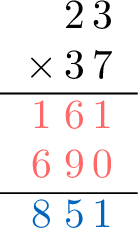
- Result: \(23 \times 37 = 851\).
Example
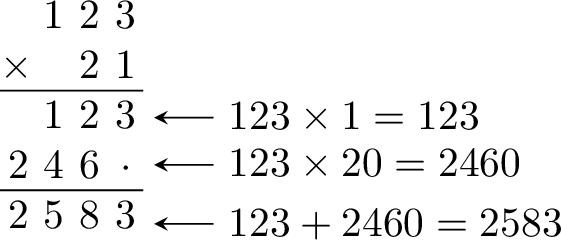
Calculate \(123 \times 21\)
Division
Definition Division
Division is the inverse operation of multiplication. It is the process of determining how many times one number is contained within another.
The components of a division expression are formally named:
The components of a division expression are formally named:
- The dividend: the number that is being divided.
- The divisor: the number by which the dividend is divided.
- The quotient: the result of the division.
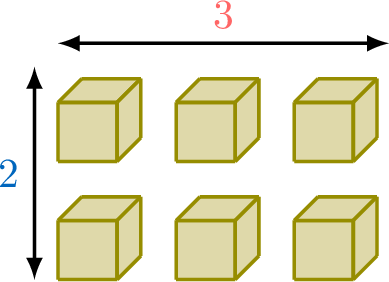
- Numerical Form: $$\textcolor{olive}{6}\div \textcolor{colordef}{3}=\textcolor{colorprop}{2}$$
- Word Form:
Six divided by three equals two. - Grid Model:
Definition Euclidean Division
Euclidean Division is the process of dividing one integer (the dividend) by another (the divisor) when the division is not exact. This process yields an integer quotient and a remainder.
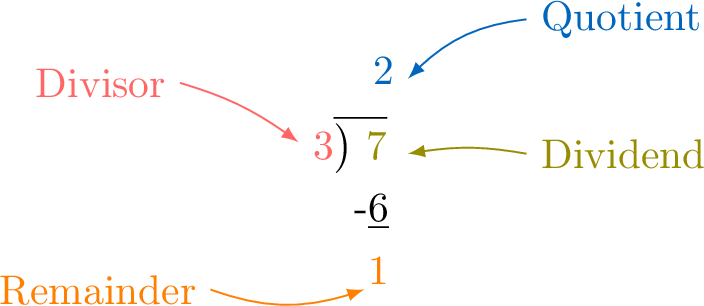
The components of a Euclidean division expression are formally named:
The components of a Euclidean division expression are formally named:
- The dividend: the number that is being divided.
- The divisor: the number by which the dividend is divided.
- The quotient: the whole number of times the divisor fits into the dividend.
- The remainder: the amount left over after the division.
- The remainder is always smaller than the divisor. (If it isn’t, you can still make another group!)
- If the remainder is \(0\), the division is exact (no remainder).
- Word Form:
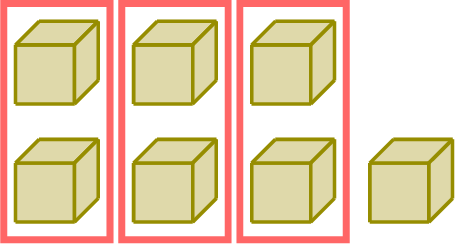
Seven divided by three equals two, with a remainder of \(\textcolor{orange}{\text{one}}\) - Division Sentence:$$\underbrace{\textcolor{olive}{7}}_{\textcolor{olive}{\text{Dividend}}} \div \underbrace{\textcolor{colordef}{3}}_{\textcolor{colordef}{\text{Divisor}}} = \divionRemainder{\underbrace{\textcolor{colorprop}{2}}_{\textcolor{colorprop}{\text{Quotient}}}}{\underbrace{\textcolor{orange}{1}}_{\textcolor{orange}{\text{Remainder}}}}$$
- Euclidean Identity:$$\underbrace{\textcolor{olive}{7}}_{\textcolor{olive}{\text{Dividend}}}= (\underbrace{\textcolor{colordef}{3}}_{\textcolor{colordef}{\text{Divisor}}} \times \underbrace{\textcolor{colorprop}{2}}_{\textcolor{colorprop}{\text{Quotient}}}) +\underbrace{\textcolor{orange}{1}}_{\textcolor{orange}{\text{Remainder}}}$$
- Group Model:
- Long Division Algorithm:
Method The Long Division Algorithm: Multi-Steps
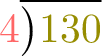
To divide with a remainder, like \(\textcolor{olive}{130} \div \textcolor{colordef}{4}\), follow these steps:
- Set up: Write the dividend (\(\textcolor{olive}{130}\)) inside the bracket and the divisor (\(\textcolor{colordef}{4}\)) outside.
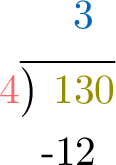
- Divide the first part (13): “How many times does \(4\) go into \(13\)?”$$\textcolor{colordef}{4}\times \textcolor{colorprop}{3}=\boxed{12}\ (\le \textcolor{olive}{13}),\qquad\textcolor{colordef}{4}\times \textcolor{colorprop}{4}=\cancel{16}\ (> \textcolor{olive}{13}).$$Write \(\textcolor{colorprop}{3}\) above and \(12\) under \(13\); then subtract.
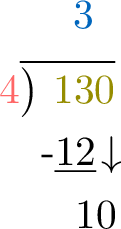
- Subtract and Bring down the next digit: \(\textcolor{olive}{13}-12=\textcolor{orange}{1}\); bring down \(0\) to make \(\textcolor{olive}{10}\).
- Divide the new number (10): “How many times does \(4\) go into \(10\)?”$$\textcolor{colordef}{4}\times \textcolor{colorprop}{2}=\boxed{8}\ (\le \textcolor{olive}{10}),\qquad\textcolor{colordef}{4}\times \textcolor{colorprop}{3}=\cancel{12}\ (> \textcolor{olive}{10}).$$Write \(\textcolor{colorprop}{2}\) above, put \(8\) under \(10\), and subtract to get the remainder.
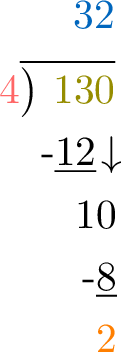
- Final answer: \(\textcolor{olive}{130} \div \textcolor{colordef}{4}= \divionRemainder{\textcolor{colorprop}{32}}{\textcolor{orange}{2}}\), and\(\textcolor{olive}{130}=\textcolor{colordef}{4}\times\textcolor{colorprop}{32}+\textcolor{orange}{2}\).
Example
Calculate \(125 \div 4\)
Using long division,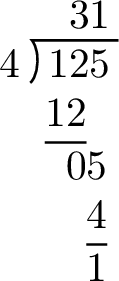
Order of Operations
Method Order of operations
To evaluate an expression, we follow these steps in order:
- Parentheses (): Always solve what's inside parentheses first.
- Multiplication (\(\times\)) and Division (\(\div\)): Do them next, working from left to right.
- Addition (+) and Subtraction (-): Do them last, also working from left to right.
Example
Calculate \(4+2 \times 3\)
We follow the order:$$\begin{aligned}4+2 \times 3 & = 4 +6&&\text{(Do the multiplication } 2 \times 3)\\
& = 10&&\text{(Do the addition } 4 + 6)\end{aligned}$$
Solving Problems
Method A Procedure for Solving Word Problems
To solve a word problem systematically, the following five-step procedure can be applied:
- Understand the Goal: Read the problem carefully to identify the main question and the information provided.
- Plan the Steps: Determine the sequence of mathematical operations required to reach the solution.
- Write the Expression: Translate the planned steps into a single mathematical expression, using parentheses where necessary to ensure the correct order of operations.
- Calculate the Solution: Evaluate the expression to find the numerical answer.
- State the Conclusion: Write a final sentence that directly answers the question asked in the problem.
Example
Hugo is planning his birthday party and needs to purchase a cake and juice.The items on his list are:
- Cakes: 2 cakes at a cost of \(\dollar\)10 each.
- Juice: 4 cans of juice at a cost of \(\dollar\)3 each.
We will apply the five-step procedure to solve Hugo's problem.
- 1. Understand the Goal: We need to calculate the total cost of the cakes and juice, and then compare that total to Hugo's budget of \(\dollar\)30.
- 2. Plan the Steps:
- Calculate the cost of the cakes (multiplication).
- Calculate the cost of the juice (multiplication).
- Add the two costs together to find the total cost (addition).
- Compare the total cost to \(\dollar\)30.
- 3. Write the Expression: The total cost can be represented as: $$ (2 \times 10) + (4 \times 3) $$
- 4. Calculate the Solution: $$\begin{aligned}[t] \text{Total cost} &= (2 \times 10) + (4 \times 3) \\ &= 20 + 12 \\ &= 32 \end{aligned}$$
- 5. State the Conclusion: The total cost is \(\dollar\)32. Since \(\dollar\)32 is greater than \(\dollar\)30, Hugo cannot afford to buy everything.