Three-Dimensional Shapes
Three-Dimensional Shapes
Definition Solid Geometry
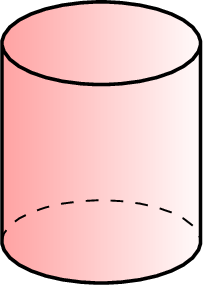
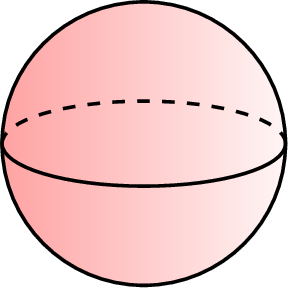
In solid geometry, we study three-dimensional (3D) shapes, such as cubes, cylinders, and spheres. The diagrams below show some examples of these shapes.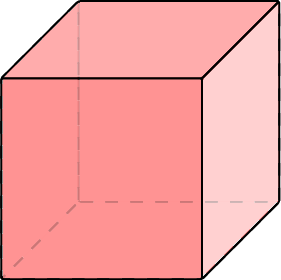 \(\quad\)
 \(\quad\)
  \(\quad\)
\(\quad\)\(\quad\) \(\quad\)
Definition Surface
A surface is the outside of a three-dimensional (3D) shape. It is the part of the shape you can touch.
Definition Face
A face is a flat surface on a three-dimensional shape.
Definition Edge
An edge is a straight line where two faces meet.
Definition Vertex
A vertex is a corner of a three-dimensional shape. It is a point where two or more edges meet.
Example
This box-shaped solid has many faces, edges, and vertices. One example of each is shown.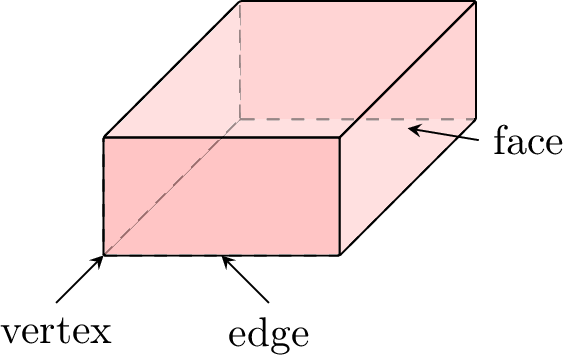
Drawing Three-Dimensional Shapes
Method Drawing 3D Shapes
When we draw 3D (three-dimensional) shapes on paper, we can only see the front of the shape. Some edges are behind and cannot be seen. These are called hidden edges. To show that an edge is hidden but still part of the shape, we draw it with dashed lines. Solid lines show the edges we can see.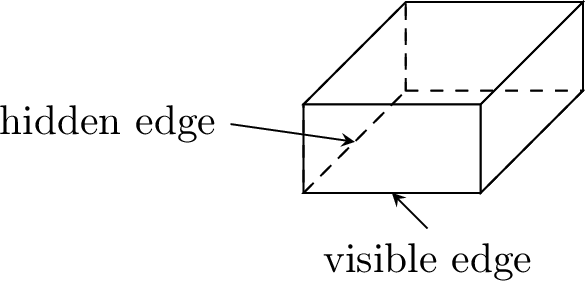
Classification
Definition Classification
We can sort three-dimensional (3D) shapes by counting their faces, edges, and vertices. Some examples are shown in the table below.
| Name | Shape | Faces | Edges | Vertices |
| Cube | 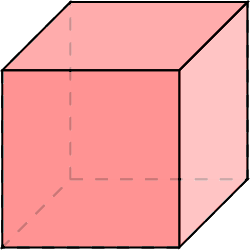 | 6 (flat faces) | 12 | 8 |
| Sphere | | 1 (curved surface) | 0 | 0 |
| Square Pyramid | 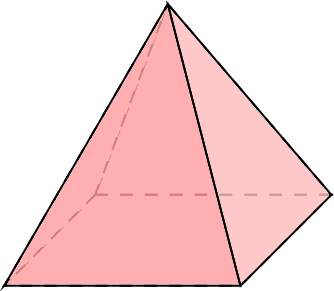 | 5 (flat faces) | 8 | 5 |
| Cylinder | 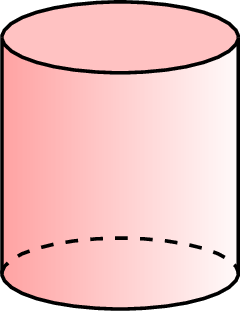 | 3 (1 curved, 2 flat faces) | 0 | 0 |
Multi-View Projection
Definition Multi-view Projection
A multi-view projection is a way to show a 3D shape using several 2D drawings. Each drawing shows how the shape looks from a different side, such as the front, the right side, or the top. These views help us understand the shape more clearly.
Example
Draw the front, right, and top views of this solid.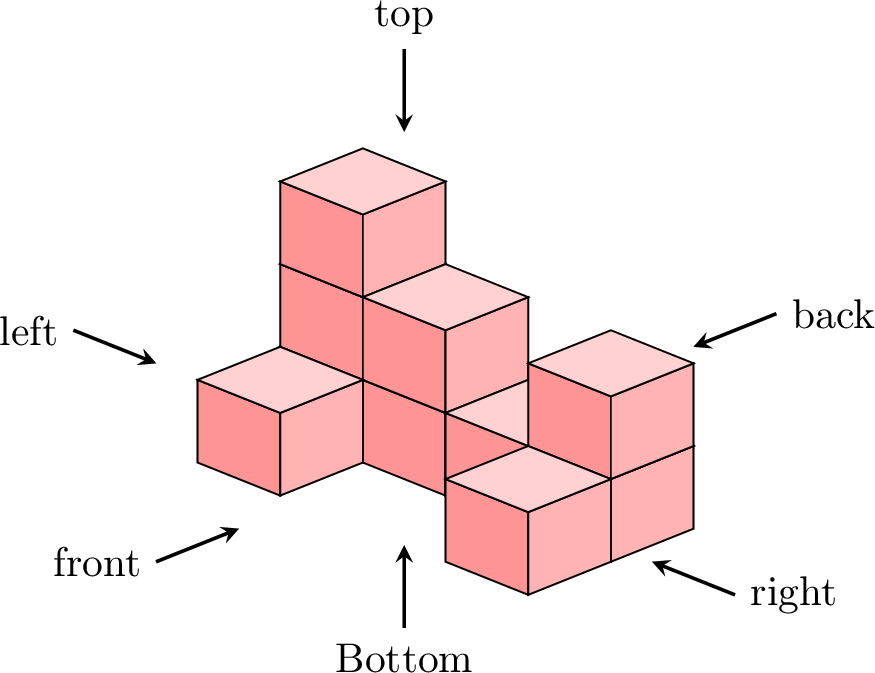
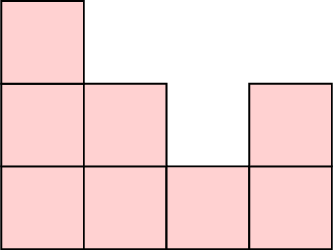
- Front view:\quad
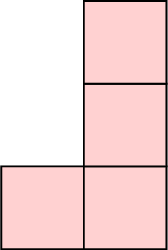
- Right view:\quad
- Top view:\quad