Weight
What is a Weight?
Definition Weight
Weight tells us how heavy something is. When we compare two objects, the heavier one has more weight and the lighter one has less weight. For example, a big book is heavier than a teddy bear.
Definition Balance Scale
A balance scale is a tool used to compare or measure the weight of two objects. It has two sides. The heavier side goes down and the lighter side goes up. If both sides are level, the two objects have the same weight.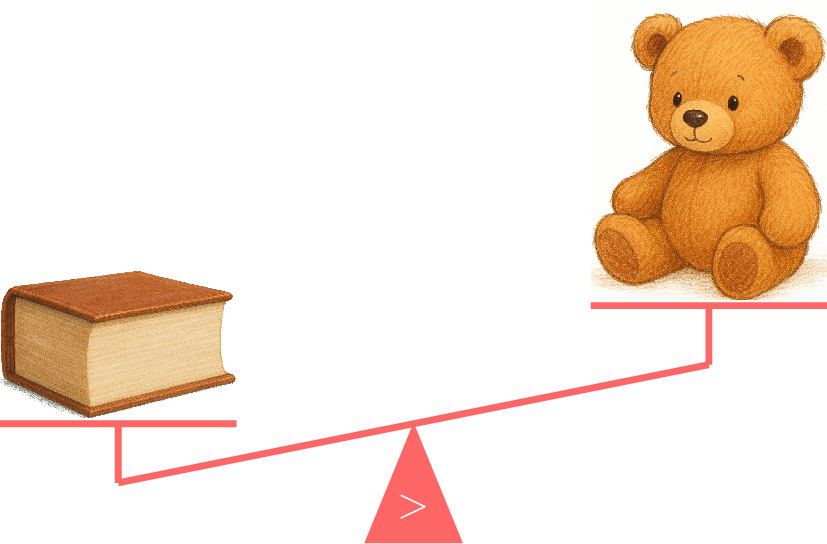
Weight Units
We could use marbles to measure weight, but what if your marbles are bigger than your friend's marbles? You would get different answers! To make sure everyone's measurements are the same, we use standard units. The standard units for weight are the gram and the kilogram.
Definition Units of Weight
- Gram (\(\mathrm{g}\)) — A small unit of weight. We use grams to weigh light objects, like a small candy or a paper clip.

- Kilogram (\(\mathrm{kg}\)) — A bigger unit of weight. We use kilograms to weigh heavier objects, like a big book or a school bag.
Conversion of Weight Units
Definition Conversion of Weight Units
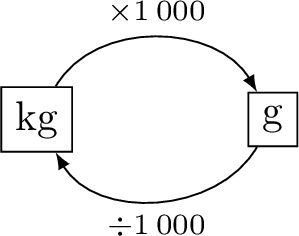
One kilogram is equal to 1 000 grams. This means kilograms are a bigger unit and grams are a smaller unit.
- \(1 \, \text{kg} = 1\,000 \, \text{g}\)
Method Converting with Multiplication or Division
- To convert from a bigger unit to a smaller one (kg \(\to\) g), you multiply by \(1\,000\).
Example: \(3 \,\text{kg} = 3 \times 1\,000 \,\text{g} = 3\,000 \,\text{g}\). - To convert from a smaller unit to a bigger one (g \(\to\) kg), you divide by \(1\,000\).
Example: \(2\,500 \,\text{g} = 2\,500 \div 1\,000 = 2.5 \,\text{kg}\).
Method Converting Using a Place Value Table
Convert 2 kilograms to grams.
- Draw the metric place value table. Each unit has its own column.
\(\mathrm{kg}\) \(\quad\;\) \(\quad\;\) \(\;\mathrm{g}\;\) - Place the ones digit of your number in the starting unit's column. Here, place the 2 in the kg column.
\(\mathrm{kg}\) \(\quad\;\) \(\quad\;\) \(\;\mathrm{g}\;\) 2 - Fill with zeros in each column until you reach the column of the target unit. We want to convert to grams (g).
\(\mathrm{kg}\) \(\quad\;\) \(\quad\;\) \(\;\mathrm{g}\;\) 2 0 0 0 - Read the number to find the converted value.
\(2 \,\text{kg} = 2\,000 \,\text{g}\).