Length
Standard Units of Length
We can measure length in many ways, for example with our footsteps or with paper clips. But everyone's footsteps and paper clips are different sizes! How can we share our measurements if we all use different units?
To solve this, people all around the world agreed to use the same units. We call these standard units. One very common standard unit for length is the meter.
To solve this, people all around the world agreed to use the same units. We call these standard units. One very common standard unit for length is the meter.
Definition Length
Length is the distance from one point to another. It tells us how long something is or how far it goes.
Definition Units of Length
We use different units for measuring small and large things.
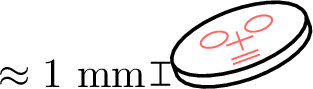
- Millimeter \(\left(\mathrm{mm}\right)\): A very small unit of length, about the thickness of a coin.
- Centimeter \(\left(\mathrm{cm}\right)\): A small unit of length, about the width of your finger.

- Meter \(\left(\mathrm{m}\right)\): A longer unit of length, about the height of a 6-year-old girl.

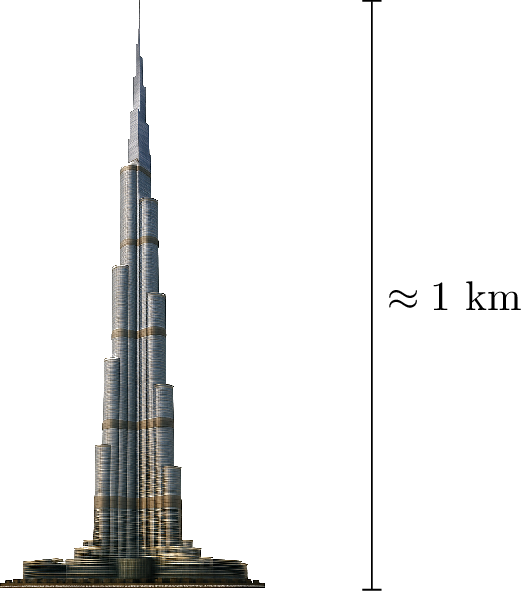
- Kilometer \(\left(\mathrm{km}\right)\): A very large unit of length, used for long distances, like the distance between towns. It is about the height of the Burj Khalifa in Dubai, United Arab Emirates.
Conversion of Length Units
Definition Conversion of Length Units
Here are some useful metric conversions:
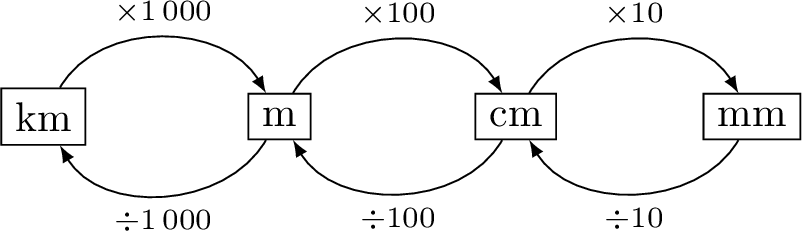
- \(1~\text{km}=1\,000~\text{m}\)
- \(1~\text{m}=100~\text{cm}\)
- \(1~\text{cm}=10~\text{mm}\)
Method Converting with Multiplication or Division
- Use multiplication when you go from a bigger unit to a smaller one (e.g., \(\mathrm{m} \to \mathrm{cm}\)).
- Use division when you go from a smaller unit to a bigger one (e.g., \(\mathrm{cm} \to \mathrm{m}\)).
Method Converting Using a Table
To convert units, we can use a metric conversion table. Let’s convert \(4\) meters to centimeters.
- Draw the metric table. Each unit gets one column.
\(\mathrm{km}\) \(\quad\;\) \(\quad\;\) \(\mathrm{m}\) \(\quad\;\) \(\mathrm{cm}\) \(\mathrm{mm}\) - Write the number in the starting unit’s column. Here, we put the 4 in the meters (m) column.
\(\mathrm{km}\) \(\quad\;\) \(\quad\;\) \(\mathrm{m}\) \(\quad\;\) \(\mathrm{cm}\) \(\mathrm{mm}\) 4 - Fill the columns to the right with zeros until the last digit is in the target unit’s column. We want to reach centimeters (cm).
\(\mathrm{km}\) \(\quad\;\) \(\quad\;\) \(\mathrm{m}\) \(\quad\;\) \(\mathrm{cm}\) \(\mathrm{mm}\) 4 0 0 - Read the new number. The last digit is now in the centimeters column.
\(4~\mathrm{m} = 400~\mathrm{cm}.\)