Natural Logarithm Function
Definition and Link with Exponential
The exponential function is continuous and strictly increasing from \(\mathbb{R}\) to \((0, +\infty)\). By the bijection theorem, for any strictly positive real number \(x\), there exists a unique real number \(y\) such that \(e^y = x\). This unique solution \(y\) is called the natural logarithm of \(x\) and is denoted by \(\ln(x)\).
Definition Natural Logarithm
The natural logarithm function, denoted by \(\ln\), is the function defined on \((0, +\infty)\) which associates each real number \(x > 0\) with the unique solution of the equation \(e^y = x\) where \(y\) is the unknown. We write:$$ y = \ln(x) $$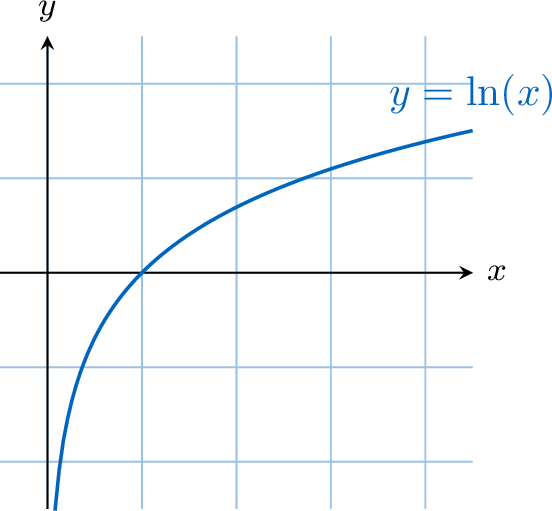
Proposition Reciprocity
For all \(x > 0\) and any real \(y\):
\(\ln(1) = 0\) (since \(e^0 = 1\)) and \(\ln(e) = 1\) (since \(e^1 = e\))
- \(e^y = x \iff y = \ln(x)\)
- \(e^{\ln(x)} = x\)
- \(\ln(e^y) = y\)
\(\ln(1) = 0\) (since \(e^0 = 1\)) and \(\ln(e) = 1\) (since \(e^1 = e\))
Proposition Symmetry
The graphs of the exponential and natural logarithm functions are symmetric with respect to the line \(y = x\).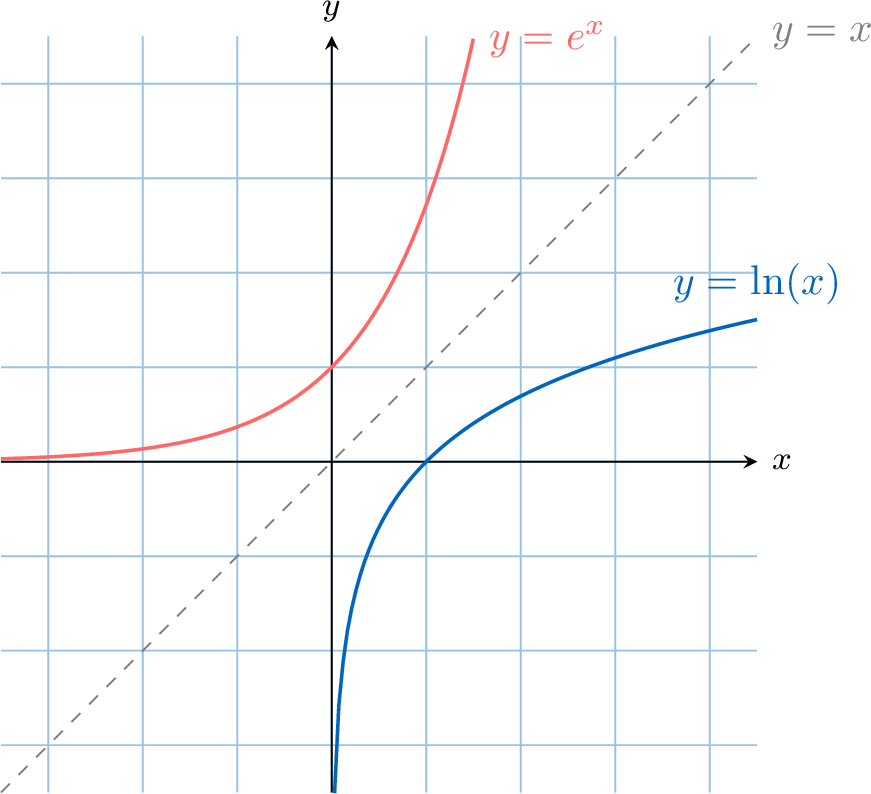
Algebraic Properties
Proposition Functional Relation
For all strictly positive real numbers \(a\) and \(b\):$$\ln(a \times b) = \ln(a) + \ln(b)$$
Proposition Other Algebraic Rules
For all \(a > 0\), \(b > 0\) and any integer \(n\):
- Inverse: \(\ln\left(\frac{1}{b}\right) = -\ln(b)\)
- Quotient: \(\ln\left(\frac{a}{b}\right) = \ln(a) - \ln(b)\)
- Power: \(\ln(a^n) = n\ln(a)\)
- Square Root: \(\ln(\sqrt{a}) = \frac{1}{2}\ln(a)\)
Study of the Function
Proposition Derivative and Continuity
The function \(\ln\) is differentiable and continuous on \((0, +\infty)\). For all \(x > 0\):$$\ln'(x) = \frac{1}{x}$$Since \(1/x > 0\) on its domain, the natural logarithm is strictly increasing on \(]0, +\infty[\).
Proposition Limits and Asymptote
The natural logarithm has the following end behaviors:
- \(\displaystyle\lim_{x \to +\infty} \ln(x) = +\infty\)
- \(\displaystyle\lim_{x \to 0^+} \ln(x) = -\infty\)
Proposition Derivative of \(\ln(u(x))\)
Let \(u\) be a differentiable and strictly positive function on an interval \(I\). The function \(f(x) = \ln(u(x))\) is differentiable on \(I\) and:$$\textcolor{colorprop}{(\ln(u(x)))' = \frac{u'(x)}{u(x)}}$$