Sequences
Patterns are all around us! When numbers are arranged in a pattern, we call it a sequence. A sequence is a list of numbers, called terms, that follows a specific rule.
Our job is to be pattern detectives and find the rule for each sequence. Once we know the rule, we can figure out what any term in the sequence will be. In this chapter, we will explore two important types of sequences: arithmetic sequences, which grow by adding or subtracting a number, and geometric sequences, which grow by multiplying or dividing by a number.
Our job is to be pattern detectives and find the rule for each sequence. Once we know the rule, we can figure out what any term in the sequence will be. In this chapter, we will explore two important types of sequences: arithmetic sequences, which grow by adding or subtracting a number, and geometric sequences, which grow by multiplying or dividing by a number.
Numerical Sequence
Definition Numerical Sequence
A numerical sequence is a list of numbers that follows a specific rule.
- The first number is called the 1\(^{\text{st}}\) term.
- The second number is called the 2\(^{\text{nd}}\) term.
- The third number is called the 3\(^{\text{rd}}\) term.
- And so on.
Example
What is the 6\(^{\text{th}}\) term of this sequence?
| \(n\) | 1 | 2 | 3 | 4 | 5 | 6 |
| \(n^{\text{th}}\) term | 3 | 5 | 7 | 9 | 11 | 13 |
The 6\(^{\text{th}}\) term is \(13\).
Arithmetic and Geometric Sequences
Definition Arithmetic Sequence
An arithmetic sequence is a list of numbers where the same number is added or subtracted each time to get the next number.
The difference between two consecutive terms (two numbers that are next to each other in the sequence) is called the common difference.
The difference between two consecutive terms (two numbers that are next to each other in the sequence) is called the common difference.
Example
What is the 6\(^{\text{th}}\) term of this sequence?
| \(n\) | 1 | 2 | 3 | 4 | 5 | 6 |
| \(n^{\text{th}}\) term | 3 | 5 | 7 | 9 | 11 | ? |
The 6\(^{\text{th}}\) term is \(13\), because each term increases by \(2\).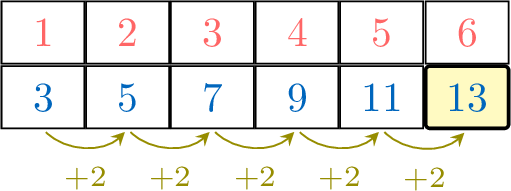
Definition Geometric Sequence
A geometric sequence is a list of numbers where the same number is multiplied or divided each time to get the next number.
The ratio of two consecutive terms is called the common ratio.
The ratio of two consecutive terms is called the common ratio.
Example
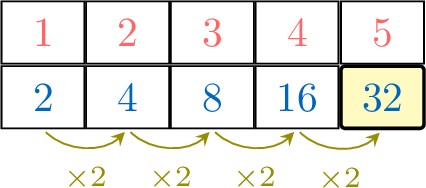
What is the 5\(^{\text{th}}\) term of this sequence?
| \(n\) | 1 | 2 | 3 | 4 | 5 |
| \(n^{\text{th}}\) term | 2 | 4 | 8 | 16 | ? |
The 5\(^{\text{th}}\) term is \(32\), because each term is multiplied by \(2\).