Area Formulas
Area of a Rectangle or a Square
Counting every single square to find the area can take a long time. Let’s see if there is a shortcut.
Consider a rectangle that is 5 units long and 3 units wide.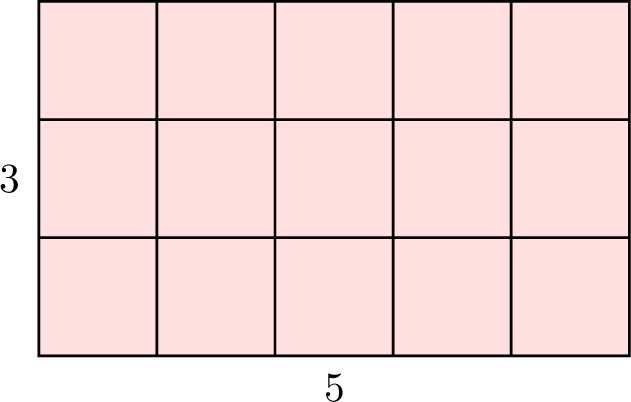
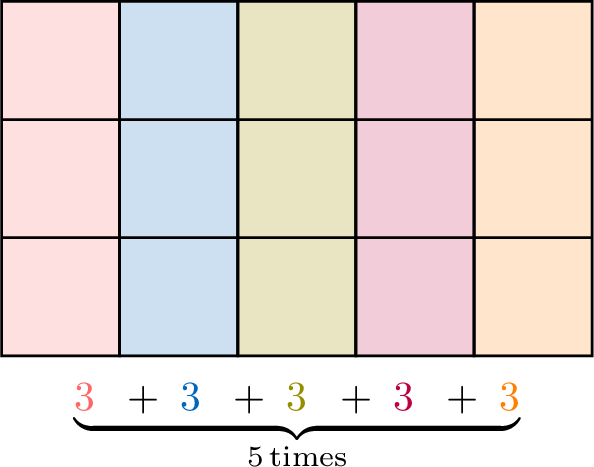
This shows that we can find the area of a rectangle by simply multiplying its length by its width.
Consider a rectangle that is 5 units long and 3 units wide.
This shows that we can find the area of a rectangle by simply multiplying its length by its width.
Proposition Area Formulas
To find the area of a rectangle, multiply its length by its width.To find the area of a square, multiply the side length by itself.
| Shape | Diagram | Area Formula |
| Rectangle | 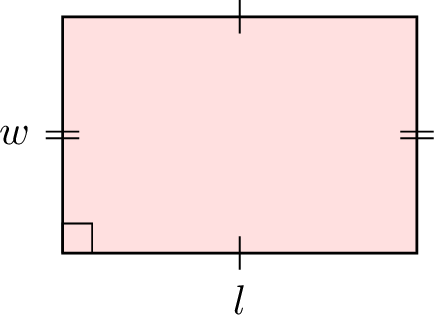 | \(A = l \times w\) |
| Square | 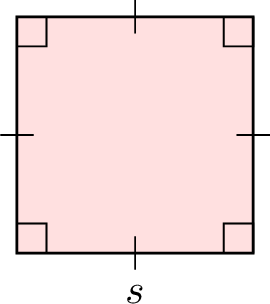 | \(A = s \times s\) |
Example
Find the area of the rectangle: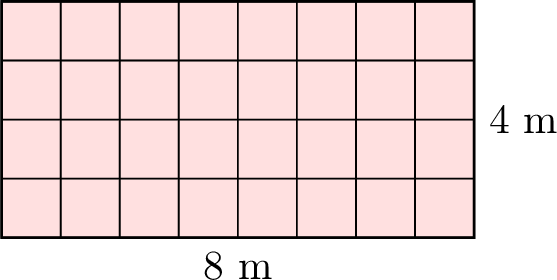
This is a rectangle with length \(l = 8\) m and width \(w = 4\) m. Using the formula for the area of a rectangle:$$\begin{aligned}[t]A &= l \times w \\
&= 8 \times 4 \\
&= 32 \, \mathrm{m}^2\end{aligned}$$The area is \(32\) square meters (we read \(32\,\mathrm{m}^2\) as “32 square meters”).
Area of a Triangle
To find the area of a triangle, we can cut it along its height to form two smaller triangles, then rearrange them to make a rectangle. Let’s see how this works step by step with the triangle below: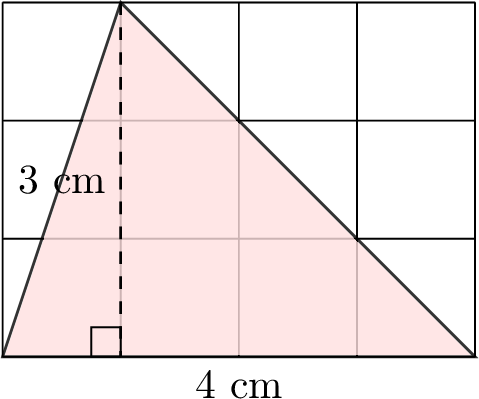
- Cut the triangle along the height \(CH\) to form two smaller triangles. Rotate and rearrange these two triangles to form a rectangle:
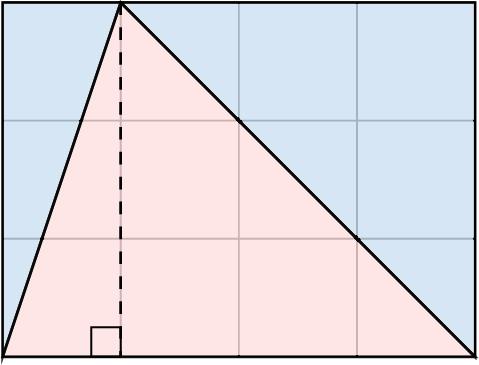
- The area of the rectangle is the length multiplied by the height: \(4 \times 3 = 12 \,\text{cm}^2\). Since the area of the rectangle is equal to twice the area of the original triangle, the area of the triangle is half the area of the rectangle:$$\begin{aligned}A_\triangle &= \dfrac{\text{base} \times \text{height}}{2}\\ &= \dfrac{4 \times 3}{2}\\ &= 6 \,\text{cm}^2 .\end{aligned}$$
Proposition Area of a Triangle
The area of a triangle is found by multiplying the base by the height and dividing by 2:$$\text{Area of a triangle} = \dfrac{\text{base} \times \text{height}}{2}$$$$A = \dfrac{b \times h}{2}$$where \(b\) is the length of the base and \(h\) is the corresponding height.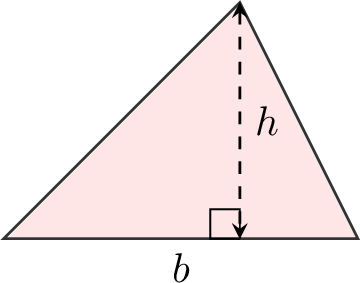
Example
Find the area of the triangle: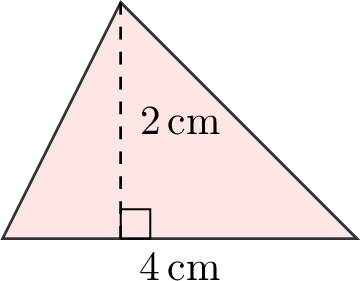
$$\begin{aligned}[t]A &= \dfrac{b \times h}{2} \\
&= \dfrac{4 \times 2}{2} \\
&= 4 \, \text{cm}^2\end{aligned}$$So, the area of the triangle is \(4 \,\text{cm}^2\).
Area of a Parallelogram
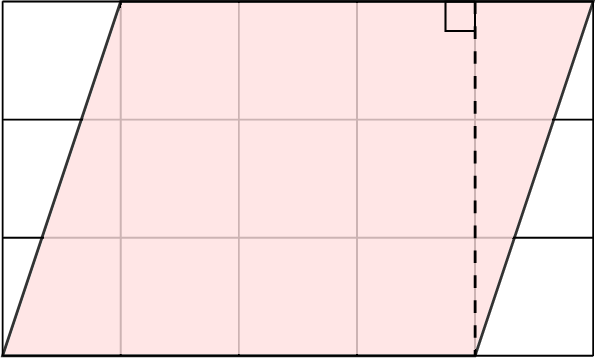
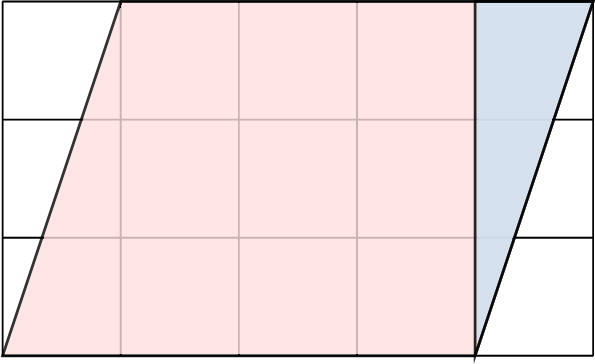
We can discover the formula for the area of a parallelogram by rearranging it into a rectangle.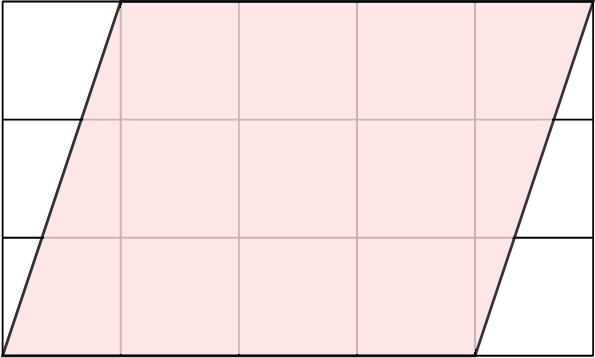
- Draw the height, which is a line from the top side to the bottom side that is perpendicular to the base:
- Cut the triangle on the right side:
- Move the triangle to the left side to form a rectangle:
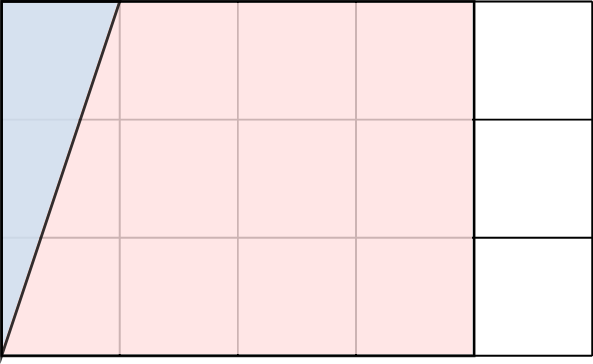
- Now we have a rectangle with a length (base) of \(4\) cm and a height of \(3\) cm. The area of the parallelogram is the same as the area of this rectangle, which is the base times the height: \(4 \times 3 = 12 \, \text{cm}^2\).
Proposition Area of a Parallelogram
The area of a parallelogram is found by multiplying the base by the height:$$\text{Area of a parallelogram} = \text{base} \times \text{height}$$$$A = b \times h,$$where \(b\) is the base and \(h\) is the height.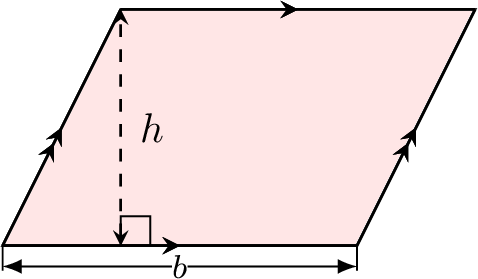
Example
Find the area of the parallelogram: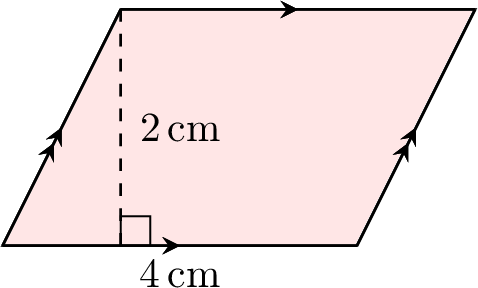
$$\begin{aligned}[t]A &= b \times h \\
&= 4 \times 2 \\
&= 8 \, \text{cm}^2\end{aligned}$$So, the area of the parallelogram is \(8 \,\text{cm}^2\).
Area of a Circle
To find the area of a circle, we can divide it into smaller parts and rearrange them to approximate a parallelogram. Let’s see how this works step by step:
- Divide the circle into 12 equal parts, like slices of a pie:
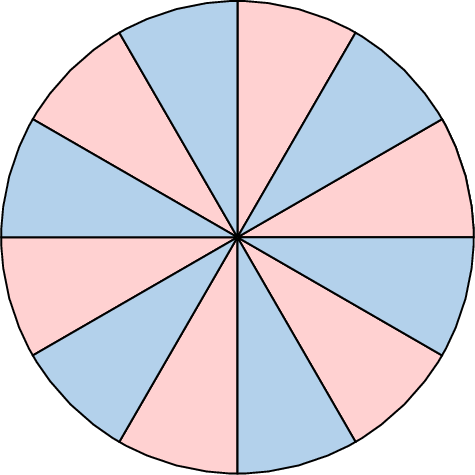
- Imagine cutting these 12 parts from the circle.
- Rearrange the parts by alternating them to form a shape that looks like a parallelogram:
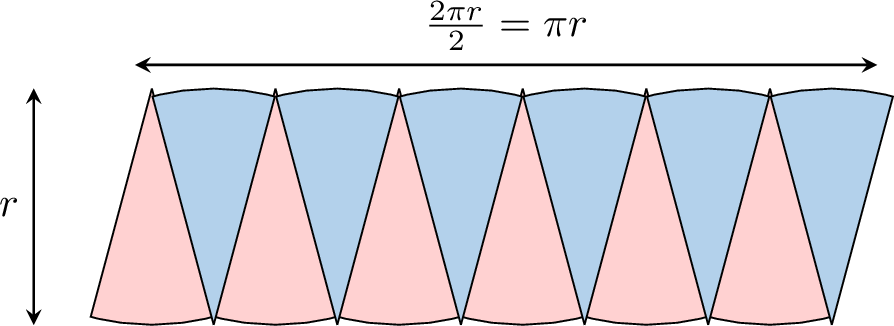
- The base of the parallelogram is approximately half the circumference of the circle (\(\pi r\)), and its height is approximately the radius (\(r\)). So, the area of the circle is the area of the parallelogram:$$\begin{aligned}A_\text{circle} &= (\pi r) \times r \\ &= \pi \times r \times r \\ &= \pi r^2.\end{aligned}$$We read this as “pi \(r\) squared”.
Proposition Area of a Circle
The area of a circle is found by multiplying pi by the radius squared:$$\text{Area of a circle} = \pi \times \text{radius} \times \text{radius} $$$$A = \pi r \times r = \pi r^2$$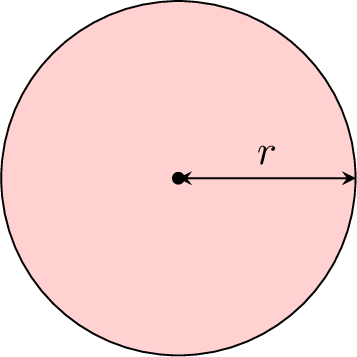
Example
Find the area of the circle: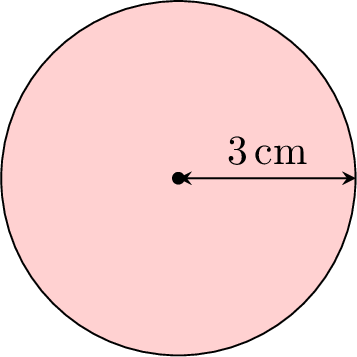
$$\begin{aligned}[t]A &= \pi \times r \times r \\
&= \pi \times 3 \times 3 \\
&= 9\pi \\
&\approx 28.3 \, \text{cm}^2 \quad (\text{using } \pi \approx 3.14)\end{aligned}$$
Area Formulas
Proposition Area Formulas
Here are the area formulas for some common shapes.
| Name | Shape | Area |
| Rectangle | 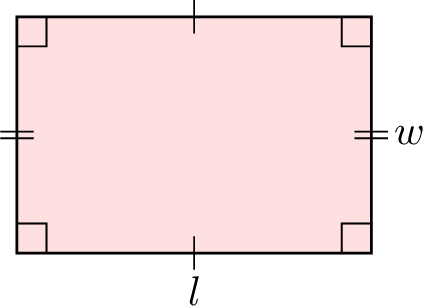 | \(A = l \times w\) |
| Square | 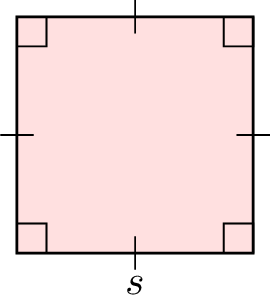 | \(\begin{aligned}A &= s \times s \\&= s^2\end{aligned}\) |
| Parallelogram | 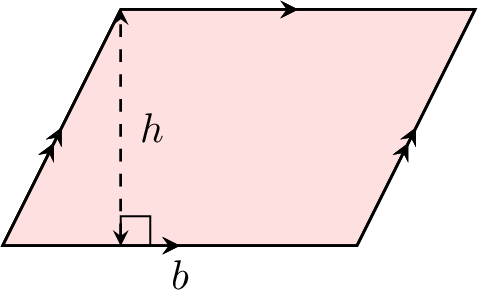 | \(A = b \times h\) |
| Triangle | 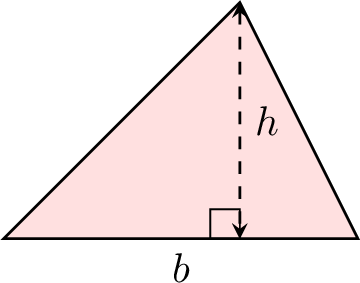 | \(A = \dfrac{b \times h}{2}\) |
| Circle | | \(\begin{aligned}A &= \pi \times r \times r \\&= \pi r^2\end{aligned}\) |
Area of Composite Figures
Definition Composite Figure
A composite figure is made up of two or more simple geometric shapes, like rectangles, triangles, or circles, combined together.
Method Finding the Area of a Composite Figure
To find the area of a composite figure, follow these steps:
- Divide the figure into simple, non-overlapping shapes, such as rectangles, triangles, or circles.
- Find the area of each simpler shape using the appropriate formula.
- Add the areas together to find the total area of the composite figure.
Example
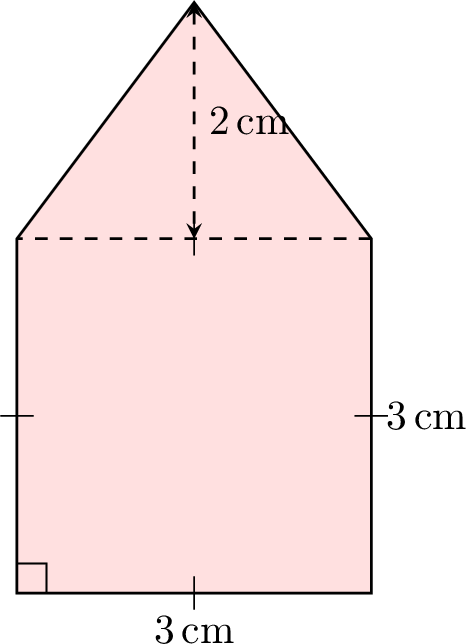
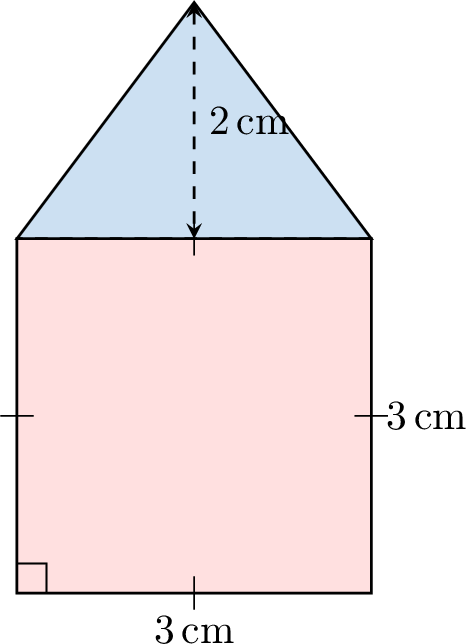
Find the area of the composite figure below, which is made up of a square and a triangle: