Limits of Sequences
Infinite Limits
Definition Limit equal to \(+\infty\)
We say that a sequence \((u_n)\) has a limit of \(+\infty\) if every interval \((A, +\infty)\) (where \(A\) is a real number) contains all terms of the sequence from a certain index onwards. We write:$$\lim_{n \to +\infty} u_n = +\infty$$
Graphical Illustration
No matter how large the real number \(A\) is, we can find a natural number \(n_0\) such that for all \(n \ge n_0\), \(u_n > A\).
In intuitive terms: "no matter how high the horizontal barrier \(A\) is placed, the terms \(u_n\) eventually manage to stay above it permanently."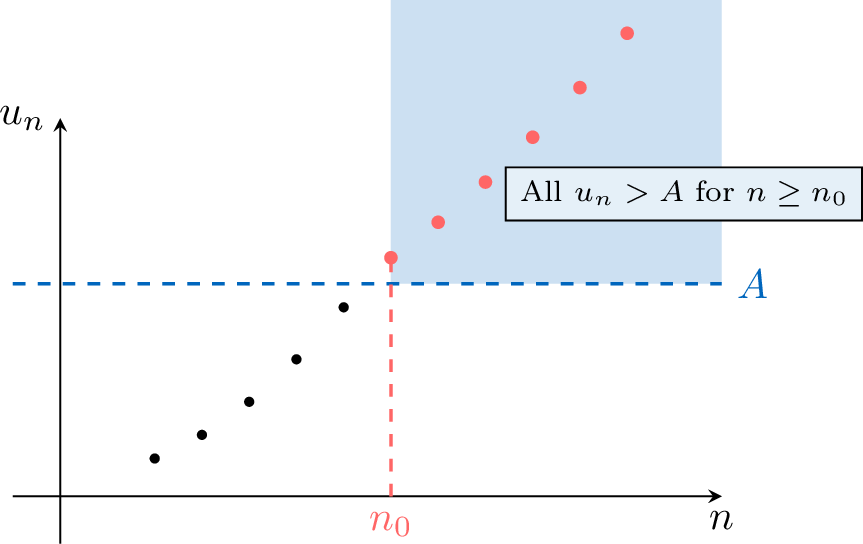
In intuitive terms: "no matter how high the horizontal barrier \(A\) is placed, the terms \(u_n\) eventually manage to stay above it permanently."
Example
The sequences \((n)\), \((n^2)\), \((\sqrt{n})\), and \((e^n)\) all have limit \(+\infty\).
Definition Limit equal to \(-\infty\)
We say that a sequence \((u_n)\) has a limit of \(-\infty\) if every interval \((-\infty, A)\) (where \(A\) is a real number) contains all terms of the sequence from a certain index onwards. We write:$$\lim_{n \to +\infty} u_n = -\infty$$
Graphical Illustration
No matter how small (negative) the real number \(A\) is, we can find a natural number \(n_0\) such that for all \(n \ge n_0\), \(u_n < A\).In intuitive terms: "no matter how low the horizontal barrier \(A\) is placed, the terms \(u_n\) eventually manage to stay below it permanently."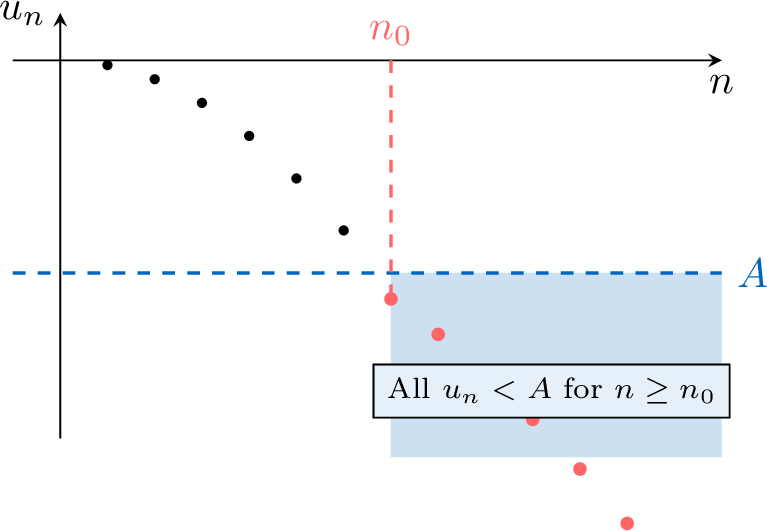
Example
The sequences \((-2n)\), \((-n^2)\) and \((-5\sqrt{n})\) all have limit \(-\infty\).
Finite Limits and Convergence
Definition Limit equal to a Real Number \(\ell\)
We say that a sequence \((u_n)\) converges to a real number \(\ell\) if every open interval containing \(\ell\) contains all the terms from some index onwards. We write:$$\lim_{n \to +\infty} u_n = \ell$$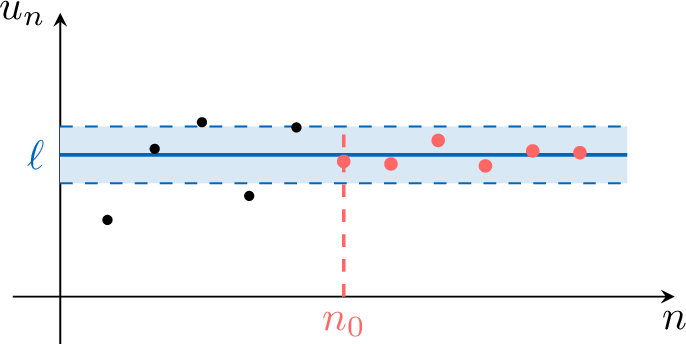
Definition Divergent Sequence
A sequence that does not have a finite limit is called a divergent sequence. This includes sequences that tend to \(\pm\infty\) and sequences that have no limit at all.
Example
The sequence defined by \(u_n = (-1)^n\) has no limit. It alternates between \(-1\) and \(1\) and never settles toward a specific value. It is therefore a divergent sequence.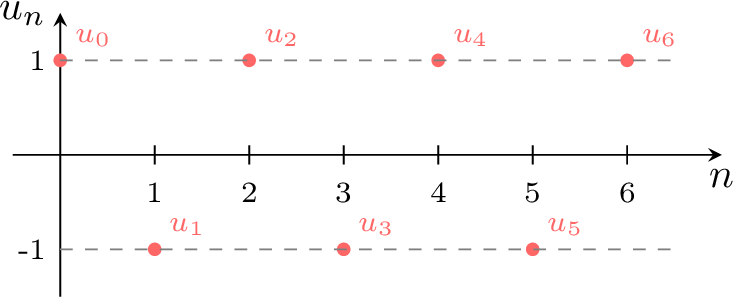
Operations on Limits
Proposition Sum and Product Rules
Let \(\ell\) and \(\ell'\) be real numbers.
- Sum:
\(\displaystyle \lim_{n \to +\infty} u_n\) \(\ell\) \(\ell\) \(+\infty\) \(-\infty\) \(+\infty\) \(-\infty\) \(\displaystyle \lim_{n \to +\infty} v_n\) \(\ell'\) \(+\infty\) \(+\infty\) \(-\infty\) \(-\infty\) \(+\infty\) \(\displaystyle \lim_{n \to +\infty} (u_n+v_n)\) \(\ell+\ell'\) \(+\infty\) \(+\infty\) \(-\infty\) IF IF - Product:
\(\displaystyle \lim_{n \to +\infty} u_n\) \(\ell\) \(\ell \neq 0\) \(\pm\infty\) \(0\) \(\displaystyle \lim_{n \to +\infty} v_n\) \(\ell'\) \(\pm\infty\) \(\pm\infty\) \(\pm\infty\) \(\displaystyle \lim_{n \to +\infty} (u_n \times v_n)\) \(\ell\ell'\) \(\pm\infty\) (sign rule) \(\pm\infty\) (sign rule) IF
Proposition Quotient Rule
Let \((u_n)\) and \((v_n)\) be two sequences such that for all \(n\), \(v_n \neq 0\).
- Case where \(\lim v_n = \ell' \neq 0\) or \(\pm\infty\)
\(\displaystyle \lim_{n \to +\infty} u_n\) \(\ell\) \(\ell\) \(+\infty\) \(+\infty\) \(-\infty\) \(-\infty\) \(\pm\infty\) \(\displaystyle \lim_{n \to +\infty} v_n\) \(\ell' \neq 0\) \(\pm\infty\) \(\ell'>0\) \(\ell'<0\) \(\ell'>0\) \(\ell'<0\) \(\pm\infty\) \(\displaystyle \lim_{n \to +\infty} \left(\frac{u_n}{v_n}\right)\) \(\frac{\ell}{\ell'}\) \(0\) \(+\infty\) \(-\infty\) \(-\infty\) \(+\infty\) IF - Case where \(\lim v_n = 0\)
\(\displaystyle \lim_{n \to +\infty} u_n\) \(\ell>0\) or \(+\infty\) \(\ell<0\) or \(-\infty\) \(\ell>0\) or \(+\infty\) \(\ell<0\) or \(-\infty\) \(0\) \(\displaystyle \lim_{n \to +\infty} v_n\) \(0\) (pos.) \(0\) (pos.) \(0\) (neg.) \(0\) (neg.) \(0\) \(\displaystyle \lim_{n \to +\infty} \left(\frac{u_n}{v_n}\right)\) \(+\infty\) \(-\infty\) \(-\infty\) \(+\infty\) IF
Proposition Limits of Arithmetic Sequences
Let \((u_n)\) be an arithmetic sequence with common difference \(d\).
- If \(\boldsymbol{d > 0}\), then \(\displaystyle \lim_{n \to +\infty} u_n = +\infty\).
- If \(\boldsymbol{d < 0}\), then \(\displaystyle \lim_{n \to +\infty} u_n = -\infty\).
Example
- Let \(u_n = 5 + 3n\). Since \(d=3 > 0\), \(\displaystyle\lim_{n \to +\infty} u_n = +\infty\).
- Let \(v_n = 10 - 2n\). Since \(d=-2 < 0\), \(\displaystyle\lim_{n \to +\infty} v_n = -\infty\).
Comparison and Squeeze Theorems
Theorem Comparison for Infinite Limits
Let \((u_n)\) and \((v_n)\) be two sequences.
If (1) from a certain index \(n_0\) onwards, \(u_n \ge v_n\), and if (2) \(\displaystyle \lim_{n \to +\infty} v_n = +\infty\),
then:$$\lim_{n \to +\infty} u_n = +\infty$$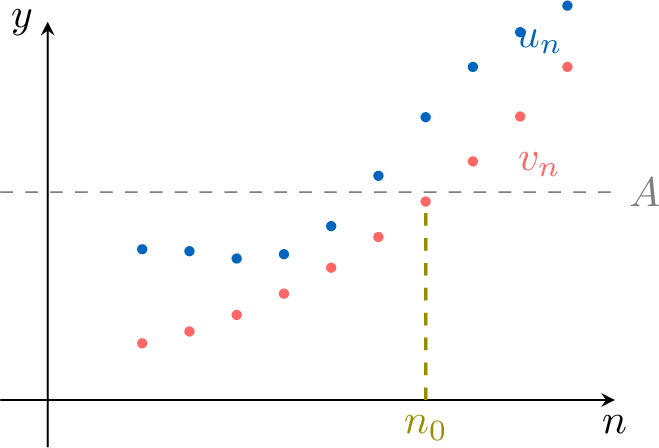
If (1) from a certain index \(n_0\) onwards, \(u_n \ge v_n\), and if (2) \(\displaystyle \lim_{n \to +\infty} v_n = +\infty\),
then:$$\lim_{n \to +\infty} u_n = +\infty$$
Theorem Squeeze Theorem / Sandwich Theorem
Let \((u_n)\), \((v_n)\), and \((w_n)\) be three sequences.
If (1) from a certain index onwards, \(\textcolor{colordef}{v_n} \leqslant \textcolor{olive}{u_n} \leqslant \textcolor{colorprop}{w_n}\), and (2) \(\displaystyle \lim_{n \to +\infty} v_n = \lim_{n \to +\infty} w_n = \ell\),
then the sequence \((u_n)\) converges and \(\displaystyle\lim_{n \to +\infty} u_n = \ell\).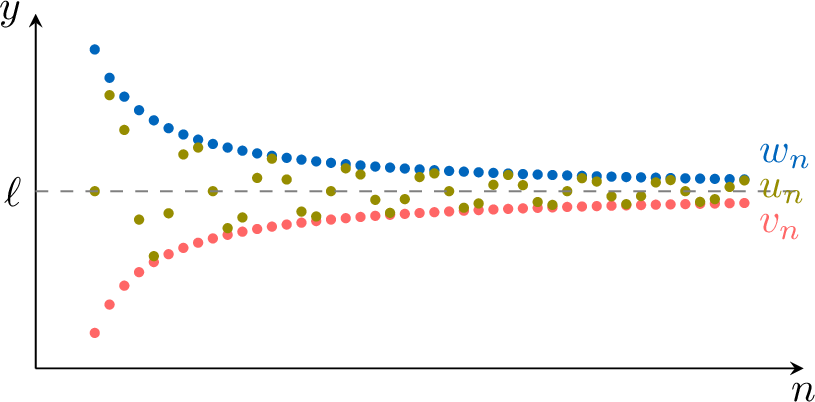
If (1) from a certain index onwards, \(\textcolor{colordef}{v_n} \leqslant \textcolor{olive}{u_n} \leqslant \textcolor{colorprop}{w_n}\), and (2) \(\displaystyle \lim_{n \to +\infty} v_n = \lim_{n \to +\infty} w_n = \ell\),
then the sequence \((u_n)\) converges and \(\displaystyle\lim_{n \to +\infty} u_n = \ell\).
Example
Calculate the limit of the sequence \((u_n)\) defined for \(n \ge 1\) by \(u_n = \dfrac{(-1)^n}{n}\).
For all \(n \ge 1\), we know that \(-1 \le (-1)^n \le 1\).
Since \(n > 0\), we can divide all parts of the inequality by \(n\) without changing the signs:$$-\frac{1}{n} \le \frac{(-1)^n}{n} \le \frac{1}{n}$$We know that: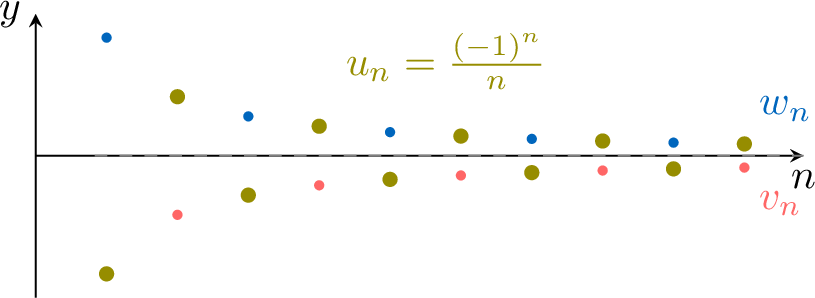
Since \(n > 0\), we can divide all parts of the inequality by \(n\) without changing the signs:$$-\frac{1}{n} \le \frac{(-1)^n}{n} \le \frac{1}{n}$$We know that:
- \(\displaystyle \lim_{n \to +\infty} -\frac{1}{n} = 0\)
- \(\displaystyle \lim_{n \to +\infty} \frac{1}{n} = 0\)
Limits of Geometric Sequences
Proposition Limits of Geometric Sequences
Let \(q\) be a real number. The limit of the sequence \((q^n)\) depends on the value of \(q\):
- If \(\boldsymbol{q > 1}\), then \(\displaystyle \lim_{n \to +\infty} q^n = +\infty\).
- If \(\boldsymbol{-1 < q < 1}\), then \(\displaystyle \lim_{n \to +\infty} q^n = 0\).
- If \(\boldsymbol{q = 1}\), then the sequence is constant and \(\displaystyle \lim_{n \to +\infty} q^n = 1\).
- If \(\boldsymbol{q \le -1}\), then the sequence has no limit (it diverges).
Example
- \(\displaystyle \lim_{n \to +\infty} 1.05^n = +\infty\) because \(1.05 > 1\).
- \(\displaystyle \lim_{n \to +\infty} \left(\frac{1}{2}\right)^n = 0\) because \(-1 < 0.5 < 1\).
- The sequence \(((-2)^n)\) has no limit because \(-2 \le -1\).
Graphical Analysis of Recurrence Sequences
When a sequence is defined by \(u_{n+1} = f(u_n)\), we can visualize its terms without calculating them by using the graph of the function \(f\) and the line with equation \(y = x\) (the first angular bisector). This allows us to conjecture the behavior of the sequence (monotonicity and limit).
Method The "Staircase" or "Cobweb" Plot
To represent the first terms of the sequence \((u_n)\) on the \(x\)-axis:
- Plot the curve \(C_f\) of the function \(f\) and the line \(\Delta: y = x\).
- Place \(u_0\) on the \(x\)-axis.
- Move vertically from the \(x\)-axis to the curve \(C_f\). The \(y\)-coordinate of this point is \(f(u_0) = u_1\).
- Move horizontally to the line \(\Delta\). This "transfers" the value \(u_1\) from the \(y\)-axis back to the \(x\)-axis.
- Repeat the process from this new position to find \(u_2, u_3, \dots\)
Example
Let \(u_{n+1} = \sqrt{u_n + 2}\) with \(u_0 = 0.5\).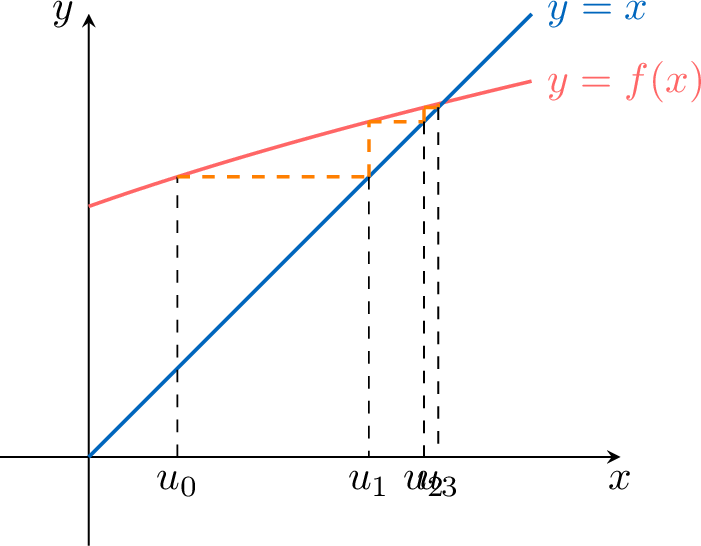
Proposition Making Conjectures
By observing the construction, we can conjecture:
- Global behavior: If the points move consistently in one direction, the sequence is likely monotone (increasing or decreasing).
- Asymptotic behavior: If the "stairs" or "spirals" tighten around an intersection point between \(C_f\) and \(\Delta\), the sequence likely converges to the \(x\)-coordinate of that point (the fixed point \(\ell = f(\ell)\)).
Arithmetic-Geometric Sequences
Definition Arithmetic-Geometric Sequence
A sequence \((u_n)\) is said to be arithmetic-geometric if there exist two real numbers \(a\) and \(b\) such that for all \(n \in \mathbb{N}\):$$ u_{n+1} = a u_n + b $$
Notes
- If \(a = 1\), the sequence is arithmetic (\(u_{n+1} = u_n + b\)).
- If \(b = 0\), the sequence is geometric (\(u_{n+1} = a u_n\)).
- If \(a = 0\), the sequence is constant from the second term onwards (\(u_{n+1} = b\)).
Method Finding the General Term
To express an arithmetic-geometric sequence \(u_n\) in terms of \(n\):
- Solve the equation \(\ell = a\ell + b\) to find the fixed point \(\ell\).
- Define the auxiliary sequence \(v_n = u_n - \ell\).
- Write the general term of the geometric sequence: \(v_n = v_0 \times a^n\).
- Deduce the expression for \(u_n\): \(u_n = v_n + \ell = (u_0 - \ell) a^n + \ell\).
Example
Let \((u_n)\) be defined by \(u_0 = 3\) and \(u_{n+1} = 3u_n - 4\). Find the expression for \(u_n\) in terms of \(n\).
- Find the fixed point \(\ell\):
We solve the equation \(x = 3x - 4\): $$ \ell - 3\ell = -4 \implies -2\ell = -4 \implies \ell = 2 $$ So, the fixed point is \(\ell = 2\). - Define the auxiliary sequence \(v_n\): Let \(v_n = u_n - 2\). Then: $$ \begin{aligned} v_{n+1} &= u_{n+1} - 2 \\ &= (3u_n - 4) - 2 \\ &= 3u_n - 6 \\ &= 3(u_n - 2)\\ &= \mathbf{3v_n} \end{aligned} $$ Thus, \((v_n)\) is a geometric sequence with common ratio \(q = 3\).
- Express \(v_n\) and \(u_n\) in terms of \(n\):
The first term is \(v_0 = u_0 - 2 = 3 - 2 = 1\).
Therefore, \(v_n = v_0 \times q^n = 1 \times 3^n = 3^n\).
Since \(v_n = u_n - 2\), we conclude: $$ \mathbf{u_n = 3^n + 2} $$
Modeling Real-World Situations
Many practical problems involve a starting value (a fixed cost or initial population) and a regular change (a constant addition or a percentage increase). Choosing the right sequence to represent these facts is called modeling.
Method Translating Context into Sequences
To build a mathematical model from a text, follow these steps:
- Identify the variable: Define what \(n\) represents (time, number of items) and what \(u_n\) represents (cost, total quantity).
- Identify the initial state: Determine the value of \(u_0\) (the value at "zero" steps or before any items are added).
- Identify the type of growth:
- If a constant amount is added at each step: use an arithmetic model (\(u_{n+1} = u_n + d\)).
- If the value is multiplied by a constant ratio (percentage): use a geometric model (\(u_{n+1} = u_n \times q\)).
- If both occur: use an arithmetic-geometric model (\(u_{n+1} = au_n + b\)).
To take the train, Sofia buys a monthly pass that costs \(400\) dollars. With this pass, each train ticket she buys costs \(2\) dollars.
- How much will Sofia pay in total if she buys 10 train tickets?
- Let \(u_n\) be the price Sofia pays per month for the pass and \(n\) train tickets.
- Express \(u_n\) in terms of \(n\).
- Sofia paid \(434\) dollars. How many train tickets did she buy?
- Calculation for 10 tickets:
Sofia pays the fixed cost plus the cost of 10 tickets: \(400 + 10 \times 2 = 400 + 20 = \mathbf{420}\) dollars. - General model:
- For \(n\) tickets, the total price is the pass price plus \(2\) dollars per ticket: $$ \mathbf{u_n = 400 + 2n} $$
- We solve the equation \(u_n = 434\): $$ \begin{aligned} 400 + 2n &= 434 \\ 2n &= 434 - 400 \\ 2n &= 34 \\ n &= \frac{34}{2}\\ n&= \mathbf{17}\\ \end{aligned} $$ Sofia bought 17 tickets.