Ratios
What is a Ratio?
Definition Ratio
A ratio is a comparison of two quantities. The ratio of \(\textcolor{colordef}{2}\) to \(\textcolor{colorprop}{3}\) can be expressed as the fraction \(\dfrac{\textcolor{colordef}{2}}{\textcolor{colorprop}{3}}\).
Part-to-Part Ratios
Definition Part-Part Ratio
A part-part ratio compares two distinct parts of a whole.$$\textcolor{colordef}{\text{Part 1}}:\textcolor{colorprop}{\text{Part 2}}$$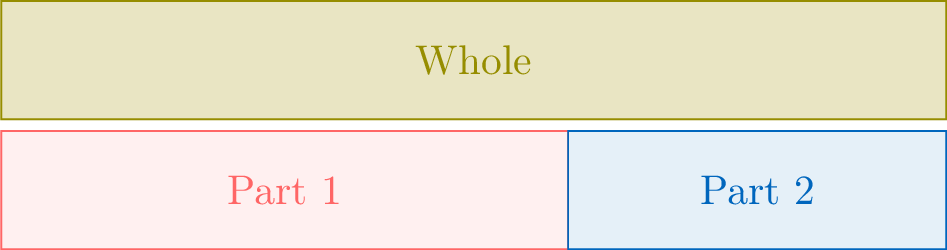
Example
A fruit bowl contains 3 cherries and 2 apples. What is the ratio of cherries to apples?
The ratio of cherries to apples is \(\textcolor{colordef}{3}:\textcolor{olive}{2}\). This compares the two parts of the fruit collection to each other.
Part-Whole Ratios
Definition Part-Whole Ratio
A part-whole ratio compares one part of a whole to the whole.$$\textcolor{colordef}{\text{Part 1}}:\textcolor{olive}{\text{Whole}}\text{ or }\textcolor{colorprop}{\text{Part 2}}:\textcolor{olive}{\text{Whole}}$$
Example
A juice is made with 1 lemon and 2 oranges. What is the ratio of oranges to the total number of fruits?
- First, determine the total number of fruits. The total is \(1 + 2 = 3\) fruits.
- The ratio of oranges (the part) to the total number of fruits (the whole) is \(\textcolor{orange}{2}:3\).
- This part-to-whole ratio can also be expressed as the fraction \(\dfrac{\textcolor{orange}{2}}{3}\).
Equivalent Ratios
Method Simplifying Ratios
The ratio of red apples to all apples is \(\textcolor{colordef}{2}:\textcolor{olive}{4}\), which simplifies to \(\textcolor{colordef}{1}:\textcolor{olive}{2}\) (half are red). 
Part in Whole-Part Relationships
Method Finding a Part in Whole-Part Relationships
To find the number of apples corresponding to \(\dfrac{1}{2}\) of 4 apples, we start with the whole: 
- Divide the whole into 2 equal parts (the denominator) and select 1 part (the numerator):

- Count the apples in the selected part: there are 2 apples.