Discrete Random Variables
Random Variables
Definitions
Definition Random Variable
A random variable, denoted \(X\), is a function that assigns a numerical value to each outcome \(\omega\) in a random experiment. We write this value as \(X(\omega)\).
Example
Let \(X\) be the number of heads when tossing 2 fair coins:  (red coin) and
  (blue coin). Find \(X(\textcolor{colordef}{H},\textcolor{colorprop}{T})\).
(red coin) and (blue coin). Find \(X(\textcolor{colordef}{H},\textcolor{colorprop}{T})\).
The outcome \((\textcolor{colordef}{H},\textcolor{colorprop}{T})\) means the red coin shows heads (H) and the blue coin shows tails (T). Since \(X\) counts heads, there’s 1 head. Thus, \(X(\textcolor{colordef}{H},\textcolor{colorprop}{T}) = 1\).
Definition Discrete Random Variable
A random variable is discrete if its set of possible values is finite or countably infinite. This means we can list all possible values.
Definition Events Involving a Random Variable
For a random variable \(X\):
- \((X = x)\): The set of outcomes where \(X\) takes the value \(x\).
- \((X \leq x)\): The set of outcomes where \(X\) is less than or equal to \(x\).
- \((X \geq x)\): The set of outcomes where \(X\) is greater than or equal to \(x\).
Example
Let \(X\) be the number of heads when tossing 2 coins: and . List the outcomes for \((X = 0)\), \((X = 1)\), \((X = 2)\), \((X \leq 1)\), and \((X \geq 1)\).
and . List the outcomes for \((X = 0)\), \((X = 1)\), \((X = 2)\), \((X \leq 1)\), and \((X \geq 1)\).
- \((X = 0) = \{(\textcolor{colordef}{T},\textcolor{colorprop}{T})\}\) (no heads).
- \((X = 1) = \{(\textcolor{colordef}{T},\textcolor{colorprop}{H}), (\textcolor{colordef}{H},\textcolor{colorprop}{T})\}\) (one head).
- \((X = 2) = \{(\textcolor{colordef}{H},\textcolor{colorprop}{H})\}\) (two heads).
- \((X \leq 1) = (X = 0) \cup (X = 1) = \{(\textcolor{colordef}{T},\textcolor{colorprop}{T}), (\textcolor{colordef}{T},\textcolor{colorprop}{H}), (\textcolor{colordef}{H},\textcolor{colorprop}{T})\}\) (at most one head).
- \((X \geq 1) = (X = 1) \cup (X = 2) = \{(\textcolor{colordef}{T},\textcolor{colorprop}{H}), (\textcolor{colordef}{H},\textcolor{colorprop}{T}), (\textcolor{colordef}{H},\textcolor{colorprop}{H})\}\) (at least one head).
Probability Distribution
Definition Probability Distribution
The probability distribution of a random variable \(X\) lists the probability \(P(X = x_i)\) for each possible value \(x_1,x_2,\dots,x_n\). It can be shown as a table or formula.
Proposition Characteristic of a Probability Distribution
For a random variable \(X\) with possible values \(x_1,x_2,\dots,x_n\), we have
- \(0 \leq P(X=x_i) \leq 1\) for all \(i=1,\dots,n\),
- \(\displaystyle\sum_{i=1}^n P(X=x_i) =P(X=x_1)+P(X=x_2)+\dots+P(X=x_n)= 1 \).
Example
Let \(X\) be the number of heads when tossing 2 fair coins: and .
and .- List the possible values of \(X\).
- Find the probability distribution.
- Create the probability table.
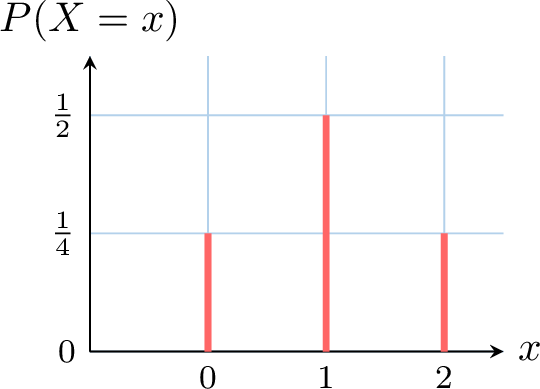
- Draw the probability distribution graph.
- Possible values: \(0\) (no heads), \(1\) (one head), \(2\) (two heads).
- Probability distribution:
- \(P(X = 0) = P(\{(\textcolor{colordef}{T},\textcolor{colorprop}{T})\}) = \frac{1}{4}\),
- \(P(X = 1) = P(\{(\textcolor{colordef}{T},\textcolor{colorprop}{H}), (\textcolor{colordef}{H},\textcolor{colorprop}{T})\}) = \frac{2}{4} = \frac{1}{2}\),
- \(P(X = 2) = P(\{(\textcolor{colordef}{H},\textcolor{colorprop}{H})\}) = \frac{1}{4}\).
- Probability table:
\(x\) 0 1 2 \(P(X = x)\) \(\frac{1}{4}\) \(\frac{1}{2}\) \(\frac{1}{4}\) - Graph:
Existence of a Random variable with a given Probability Distribution
Usually, defining a random variable begins by establishing:
- a sample space, that is, the set of all possible outcomes,
- a probability associated with this sample space,
- a function \(X\) that assigns a number to each outcome in the sample space.
| \(x\) | 0 | 1 | 2 | 3 |
| \(P(X = x)\) | \(\frac{10}{30}\) | \(\frac{12}{30}\) | \(\frac{5}{30}\) | \(\frac{3}{30}\) |
Theorem Existence of a Random Variable with a Given Probability Distribution
Suppose you have possible values \(x_1, x_2, \ldots, x_n\) and probabilities \(p_1, p_2, \ldots, p_n\).
If:
If:
- \(0 \leq p_i \leq 1\) for each \(i = 1, 2, \ldots, n\),
- \(\displaystyle\sum_{i=1}^n p_i = p_1 + p_2 + \cdots + p_n = 1\),
Method Defining a Random Variable \(X\) with a Valid Probability Distribution
In practice, we often define a random variable \(X\) directly by specifying its probability distribution. The key is to ensure that this distribution is valid, meaning it satisfies the conditions for a probability distribution: all probabilities must be non-negative and sum to 1.
Example
We survey a class of 30 students about their siblings and obtain these results: 10 students have 0 siblings, 12 have 1 sibling, 5 have 2 siblings, and 3 have 3 siblings. We define a random variable \(X\) as the number of siblings of a randomly chosen student, with this probability distribution:
| \(x\) | 0 | 1 | 2 | 3 |
| \(P(X = x)\) | \(\frac{10}{30}\) | \(\frac{12}{30}\) | \(\frac{5}{30}\) | \(\frac{3}{30}\) |
- \(P(X = x) \geq 0\) for all \(x = 0, 1, 2, 3\) (true: \(\frac{10}{30}\), \(\frac{12}{30}\), \(\frac{5}{30}\), and \(\frac{3}{30}\) are all non-negative),
- \(P(X = 0) + P(X = 1) + P(X = 2) + P(X = 3) = \frac{10}{30} + \frac{12}{30} + \frac{5}{30} + \frac{3}{30} = \frac{30}{30} = 1\) (true: the sum equals 1).
Measures of Center and Spread
Expectation
The expected value of a random variable \(X\) is the "average you’d expect if you repeated the experiment many times". It’s found by taking all possible values, multiplying each by its probability, and adding them up — essentially a weighted average where the probabilities act as the weights.
Definition Expected Value
For a random variable \(X\) with possible values \(x_1, x_2, \ldots, x_n\), the expected value, \(E(X)\), also called the mean, is:$$\begin{aligned}E(X) &= \sum_{i=1}^{n} x_i P(X = x_i)\\
&= x_1 P(X = x_1) + x_2 P(X = x_2) + \cdots + x_n P(X = x_n)\\
\end{aligned}$$
Example
You toss 2 fair coins, and \(X\) is the number of heads. The probability distribution is:
| \(x\) | 0 | 1 | 2 |
| \(P(X = x)\) | \(\frac{1}{4}\) | \(\frac{1}{2}\) | \(\frac{1}{4}\) |
Calculate \(E(X)\) using the formula:$$\begin{aligned}E(X) &= 0 \times \frac{1}{4} + 1 \times \frac{1}{2} + 2 \times \frac{1}{4} \\
&= \frac{1}{2} + \frac{2}{4} \\
&= 1\end{aligned}$$So, on average, you expect 1 head when tossing 2 coins.
Proposition Linearity of Expectation
For any random variable \(X\) and constants \(a\) and \(b\), the expected value of a linear transformation of \(X\) is:$$ E(aX + b) = aE(X) + b $$This property is derived from two simpler rules:
- \(E(aX) = aE(X)\) (The expectation of a scaled variable is the scaled expectation).
- \(E(X+b) = E(X) + b\) (The expectation of a shifted variable is the shifted expectation).
The following derivation relies on the formula for the expectation of a function of a discrete random variable, \(g(X)\), which is given by \(E(g(X)) = \sum g(x_i)P(X=x_i)\).
Let the function be \(g(X) = aX + b\).$$\begin{aligned}E(aX+b) &= \sum_{i} (ax_i + b) P(X=x_i) && \text{(by the formula for } E(g(X))\text{)} \\ &= \sum_{i} (ax_i P(X=x_i) + b P(X=x_i)) && \text{(distribute the probability)} \\ &= \sum_{i} ax_i P(X=x_i) + \sum_{i} b P(X=x_i) && \text{(split the summation)} \\ &= a \sum_{i} x_i P(X=x_i) + b \sum_{i} P(X=x_i) && \text{(factor out constants } a \text{ and } b\text{)} \\ &= a E(X) + b(1) && \text{(using } E(X) \text{ definition and } \sum P(X=x_i)=1\text{)} \\ &= aE(X) + b\end{aligned}$$
Let the function be \(g(X) = aX + b\).$$\begin{aligned}E(aX+b) &= \sum_{i} (ax_i + b) P(X=x_i) && \text{(by the formula for } E(g(X))\text{)} \\ &= \sum_{i} (ax_i P(X=x_i) + b P(X=x_i)) && \text{(distribute the probability)} \\ &= \sum_{i} ax_i P(X=x_i) + \sum_{i} b P(X=x_i) && \text{(split the summation)} \\ &= a \sum_{i} x_i P(X=x_i) + b \sum_{i} P(X=x_i) && \text{(factor out constants } a \text{ and } b\text{)} \\ &= a E(X) + b(1) && \text{(using } E(X) \text{ definition and } \sum P(X=x_i)=1\text{)} \\ &= aE(X) + b\end{aligned}$$
Variance and Standard Deviation
The variance measures how spread out the values of a random variable are from its expected value. The standard deviation is the square root of the variance, giving a sense of typical deviation in the same units as \(X\).
Definition Variance and Standard Deviation
The variance, denoted \(V(X)\), is:$$\begin{aligned}V(X) &= \sum_{i=1}^{n} (x_i - E(X))^2 P(X = x_i)\\
&= \left(x_1-E(X)\right)^2 P(X = x_1) + \left(x_2-E(X)\right)^2 P(X = x_2) + \cdots + \left(x_n-E(X)\right)^2 P(X = x_n)\\
\end{aligned}$$The standard deviation, denoted \(\sigma(X)\), is \(\sigma(X) = \sqrt{V(X)}\).
Example
You toss 2 fair coins, and \(X\) is the number of heads. The probability table is:
| \(x\) | 0 | 1 | 2 |
| \(P(X = x)\) | \(\frac{1}{4}\) | \(\frac{1}{2}\) | \(\frac{1}{4}\) |
Calculate \(V(X)\):$$\begin{aligned}V(X) &= (0 - 1)^2 \times \frac{1}{4} + (1 - 1)^2 \times \frac{1}{2} + (2 - 1)^2 \times \frac{1}{4} \\
&= 1 \times \frac{1}{4} + 0 \times \frac{1}{2} + 1 \times \frac{1}{4} \\
&= \frac{1}{4} + 0 + \frac{1}{4} \\
&= \frac{1}{2} \\
\end{aligned}$$The variance is \(\frac{1}{2}\).
Proposition Computational Formula for Variance
A more convenient formula for computation is:$$V(X) = E(X^2) - [E(X)]^2$$
Let \(\mu = E(X)\).$$\begin{aligned}V(X) &= E[(X - \mu)^2] \\
&= E[X^2 - 2\mu X + \mu^2] \\
&= E(X^2) - E(2\mu X) + E(\mu^2) && \text{(by linearity of expectation)} \\
&= E(X^2) - 2\mu E(X) + \mu^2 && \text{(since } \mu \text{ and } \mu^2 \text{ are constants)} \\
&= E(X^2) - 2\mu(\mu) + \mu^2 \\
&= E(X^2) - 2\mu^2 + \mu^2 \\
&= E(X^2) - \mu^2 \\
&= E(X^2) - [E(X)]^2\end{aligned}$$