Fractions
Definitions
Consider the model below, which illustrates one whole unit and one half: . To express this quantity as a single fraction, we follow two steps:
. To express this quantity as a single fraction, we follow two steps:- Identify the denominator: The units are divided into halves, so the denominator is 2.
- Count the parts: In total, there are three shaded parts of this size. This count becomes the numerator.
Definition Fraction
A fraction has two numbers separated by a fraction bar: the numerator (on top) and the denominator (on the bottom). 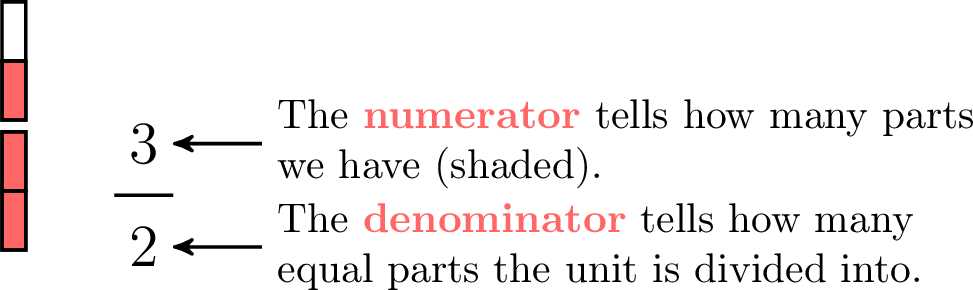
On the Number Line
Fractions do not only represent parts of a shape; they can also represent points on a number line. The space between 0 and 1 is a unit.
If we divide the unit into 2 equal parts, the point in the middle represents the fraction \(\dfrac{1}{2}\).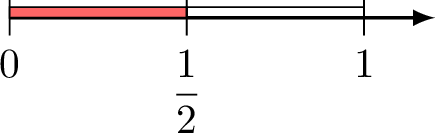
If we divide the unit into 2 equal parts, the point in the middle represents the fraction \(\dfrac{1}{2}\).
Method Representing a Fraction on the Number Line
To represent the fraction \(\dfrac{\textcolor{colordef}{2}}{\textcolor{colorprop}{3}}\) on a number line:
- Draw a straight line and mark the points \(0\) and \(1\).

- Divide the segment from \(0\) to \(1\) into \(\textcolor{colorprop}{3}\) equal parts (the denominator).

- Count \(\textcolor{colordef}{2}\) parts from \(0\) (the numerator) and mark the point at \(\dfrac{\textcolor{colordef}{2}}{\textcolor{colorprop}{3}}\).

Equivalent Fractions
A cake is cut into 3 equal parts. One part, representing \(\dfrac{1}{3}\) of the cake, is set aside.

No—the amount of cake did not change. The models show that the shaded portion is the same in both cases.\(\quad=\quad\) Therefore, the fractions \(\dfrac{1}{3}\) and \(\dfrac{2}{6}\) represent the same value.
\(\quad=\quad\)
Definition Equivalent Fractions
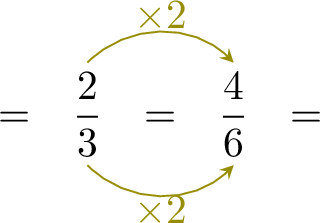
Two fractions are equivalent if they represent the same amount. You can make an equivalent fraction by multiplying or dividing the numerator and the denominator by the same nonzero number.

Simplification
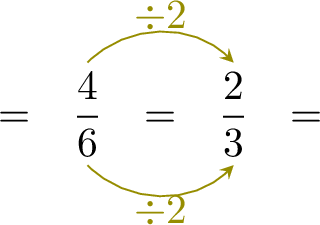
Consider the fraction \(\dfrac{4}{6}\):  . While this is a valid representation of a quantity, it is not the most efficient. Among all possible equivalent fractions, there is one that uses the smallest possible integers for the numerator and denominator.
The process of finding this simplest form is known as simplifying or reducing a fraction.
. While this is a valid representation of a quantity, it is not the most efficient. Among all possible equivalent fractions, there is one that uses the smallest possible integers for the numerator and denominator.The process of finding this simplest form is known as simplifying or reducing a fraction.
Method Simplifying a fraction
To simplify a fraction is to find an equivalent fraction that uses the smallest possible whole numbers for its numerator and denominator.
The procedure is to divide both the numerator and the denominator by the same number (a common factor). This process may need to be repeated until there are no more common factors (other than 1) that can divide both the numerator and the denominator.
The procedure is to divide both the numerator and the denominator by the same number (a common factor). This process may need to be repeated until there are no more common factors (other than 1) that can divide both the numerator and the denominator.
Example
Simplify \(\dfrac{4}{6}\).

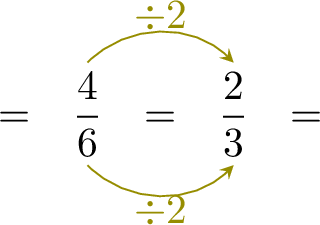

Ordering Fractions
To determine which of two fractions is greater, the fractions must represent parts of the same size. Consider two fractions, \(\dfrac{3}{4}\) and \(\dfrac{5}{8}\). \(\;\)
\(\;\)
Definition Ordering Fractions with the Same Denominator
For two fractions with the same denominator, the fraction with the larger numerator is larger.
Example
Compare \(\dfrac{6}{8}\) and \(\dfrac{5}{8}\).
 \(= \dfrac{6}{8} > \dfrac{5}{8} = \)
Method Comparing Fractions with Different Denominators
The standard procedure for comparing two fractions with different denominators is as follows:
- Find a common denominator: Identify a common multiple of both denominators. A simple method is to multiply the denominators together.
- Create equivalent fractions: Convert each fraction into an equivalent fraction with the chosen common denominator.
- Compare the numerators: Once the denominators are the same, the fraction with the larger numerator is the greater fraction.
Example
Compare \(\dfrac{3}{4}\) and \(\dfrac{5}{8}\).
We will apply the three-step procedure.
- 1. Find a common denominator: The denominators are 4 and 8. A common multiple is 8.
- 2. Create equivalent fractions:
- The fraction \(\dfrac{5}{8}\) already has the common denominator.
- Convert \(\dfrac{3}{4}\) to an equivalent fraction with a denominator of 8. To change the denominator from 4 to 8, we multiply by 2. Therefore, we must also multiply the numerator by 2.
 \quad
\quad 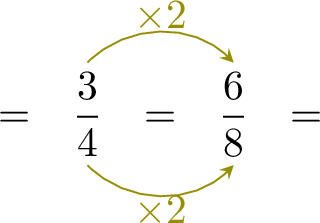 \quad
\quad
- 3. Compare the numerators: We now compare the equivalent fractions. \(= \dfrac{6}{8} > \dfrac{5}{8} = \)
- Conclusion: Therefore, it is concluded that \(\dfrac{3}{4} > \dfrac{5}{8}\).
Addition and Subtraction with Common Denominators
Consider a unit divided into four equal parts (fourths). One portion is \(\dfrac{2}{4}=\)  , and a second portion is \(\dfrac{1}{4}=\)
  .
.
What fraction of the unit is represented when these two portions are combined?
, and a second portion is \(\dfrac{1}{4}=\) .What fraction of the unit is represented when these two portions are combined?
To find the total, combine the shaded parts. Since all parts are the same size (fourths), just add the counts: \(2+1=3\) shaded parts.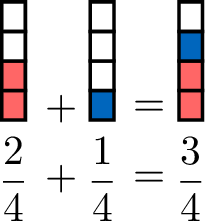
Definition Addition of Fractions with Common Denominators
To add fractions with the same denominator, add the numerators and keep the denominator the same:
Definition Subtraction of Fractions with Common Denominators
To subtract fractions with the same denominator, subtract the numerators and keep the denominator the same: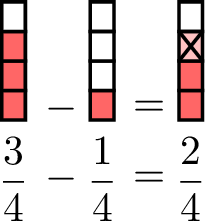
Addition and Subtraction with Unlike Denominators
The operations of addition and subtraction can only be performed on fractions that represent parts of the same size, i.e., fractions with a common denominator.
Consider the problem of adding \(\dfrac{1}{2}\) and \(\dfrac{1}{4}\).  \(+\)
\(+\) 
Because the fractions have unlike denominators (2 and 4), the parts are of different sizes. A direct addition of the numerators is not possible. To solve this, we must first express the fractions with a common denominator.
Consider the problem of adding \(\dfrac{1}{2}\) and \(\dfrac{1}{4}\).
\(+\)
Method Procedure for Adding or Subtracting Fractions
To add or subtract fractions with unlike denominators, follow this three-step procedure:
- Find a Common Denominator: Identify a common multiple of the denominators.
- Create Equivalent Fractions: Convert each fraction to an equivalent fraction with the common denominator.
- Add or Subtract the Numerators: With the denominators now the same, perform the operation on the numerators and keep the common denominator.
Example
We will apply the procedure to calculate \(\dfrac{1}{2} + \dfrac{1}{4}\).
The total fraction is \(\dfrac{3}{4}\).
- Step 1: Find a common denominator. The denominators are 2 and 4. A common multiple is 4.
- Step 2: Create equivalent fractions.
- The fraction \(\dfrac{1}{4}\) already has the common denominator.
- Convert \(\dfrac{1}{2}\) into an equivalent fraction with a denominator of 4:

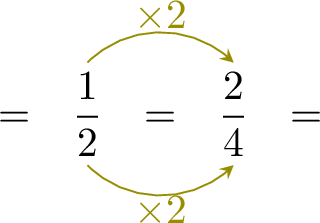

- Step 3: Add the numerators. Now that both fractions have the same denominator, we can add them: $$ \frac{2}{4} + \frac{1}{4} = \frac{2+1}{4} = \frac{3}{4} $$
| \(+\) | \(=\) |  \(+\) \(+\) |
| \(=\) |  | |
| \(\dfrac{1}{2}+\dfrac{1}{4}\) | \(=\) | \(\dfrac{2}{4}+\dfrac{1}{4}\) |
| \(=\) | \(\dfrac{3}{4}\) |