Subtraction
What is Subtraction?
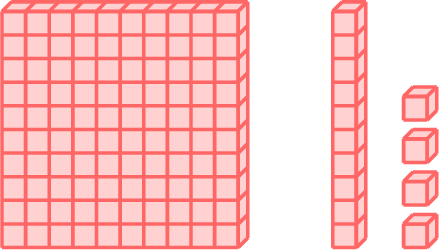
Imagine you have a big collection of 237 cubes. If you give 114 of them to a friend, how can you find out how many cubes you have left?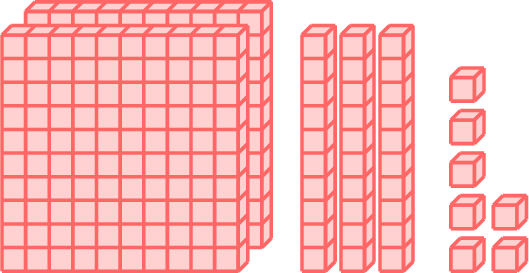 \(-\)
\(-\)  \(=\)
\(=\)
\(-\) \(=\)
To find what is left, we subtract:$$237-114$$Visually, we can see that when we take 114 blocks away from 237, we are left with 123. \(-\) \(=\)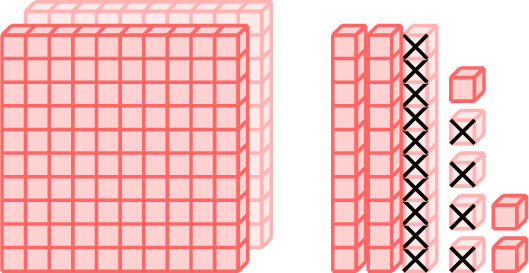
So, you have 123 cubes left. For big numbers like this, counting blocks is slow. A much faster strategy is to use column subtraction.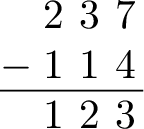
\(-\) \(=\)
Definition Subtraction
Subtraction means taking an amount away from a group to find out what is left. This result is called the difference. The minus sign (\(-\)) tells us to subtract.
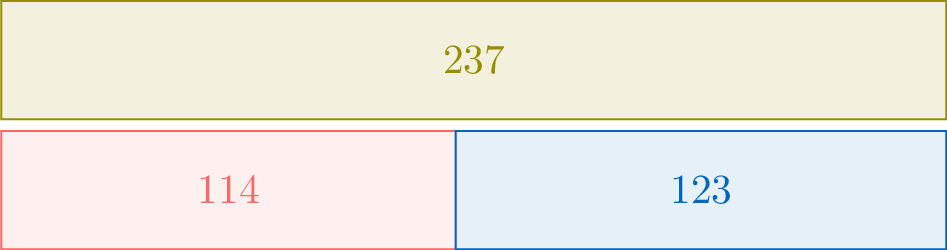
We can show "two hundred thirty-seven minus one hundred fourteen equals one hundred twenty-three" in different ways:
We can show "two hundred thirty-seven minus one hundred fourteen equals one hundred twenty-three" in different ways:
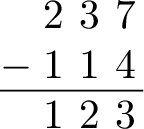
- With Numbers: $$237 - 114 = 123$$
- With Cubes: \(-\) \(=\)
- With Column Subtraction:
- With a Part-Whole Model:
Subtraction In Columns
You have learned how to subtract using the regrouping ("borrowing") method. Today, we will explore another clever strategy: the compensation method.
The big idea is that the difference between two numbers stays the same if you add the same amount to both numbers. This allows us to change a tricky problem into an easier one.
The big idea is that the difference between two numbers stays the same if you add the same amount to both numbers. This allows us to change a tricky problem into an easier one.
Method Subtraction by Compensation
Let's calculate:\(32 - 14\) 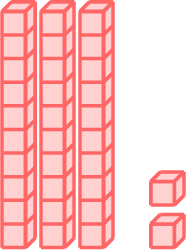 \(-\)
\(-\)  \(=\)
\(=\) 
- Step 1: Set up the subtraction.
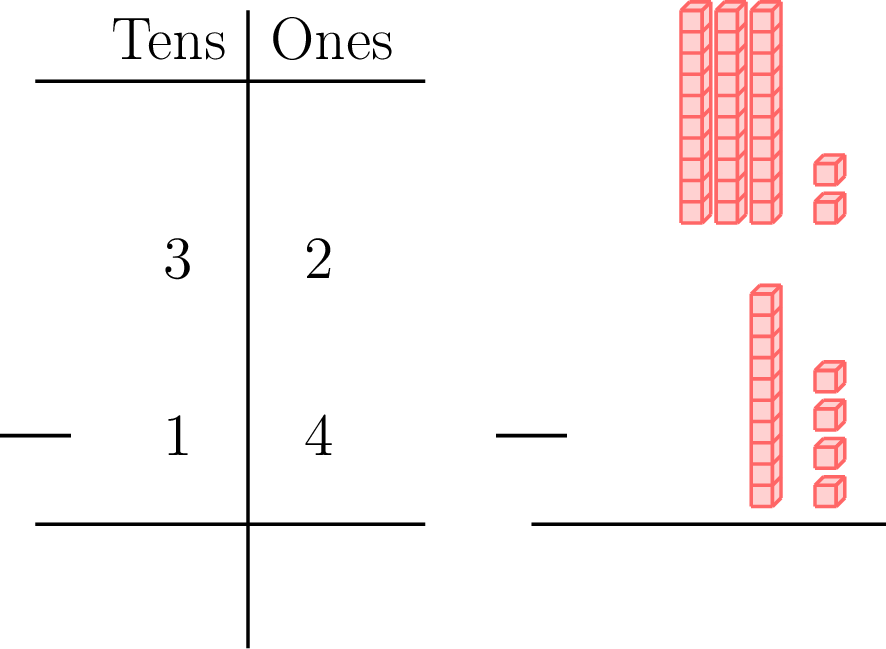
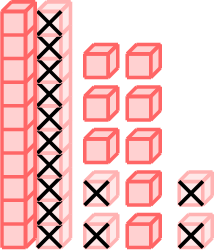
- Step 2: Check the ones place. We need to do \(2 - 4\), but we don't have enough ones.
- Step 3: Compensate. Add 10 to both numbers (10 ones to the top; 1 ten to the bottom)
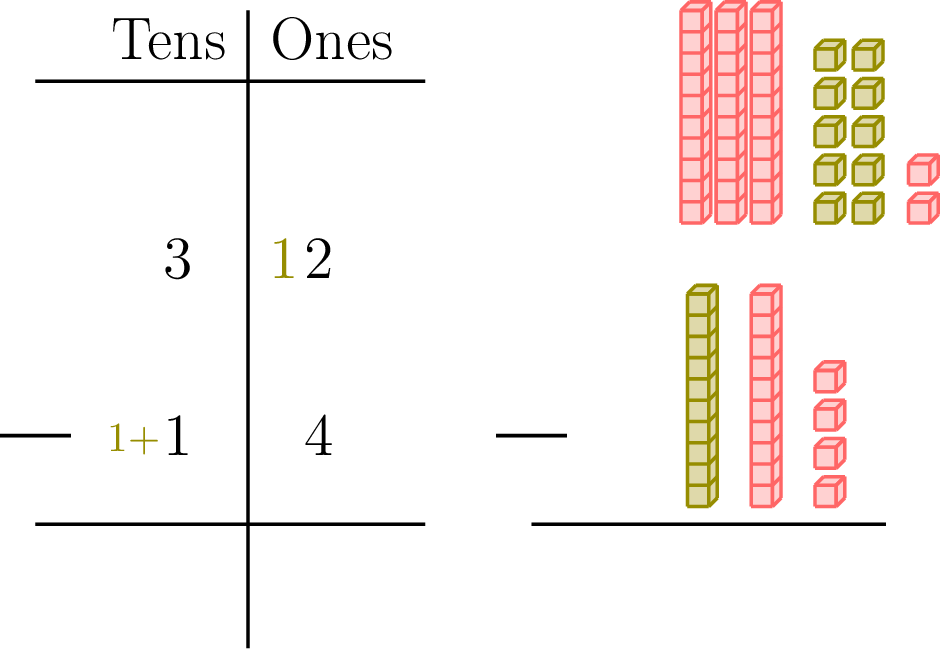
- Step 4: Subtract the ones. Now it's easy: $$12 \text{ ones} - 4 \text{ ones} = 8 \text{ ones}$$
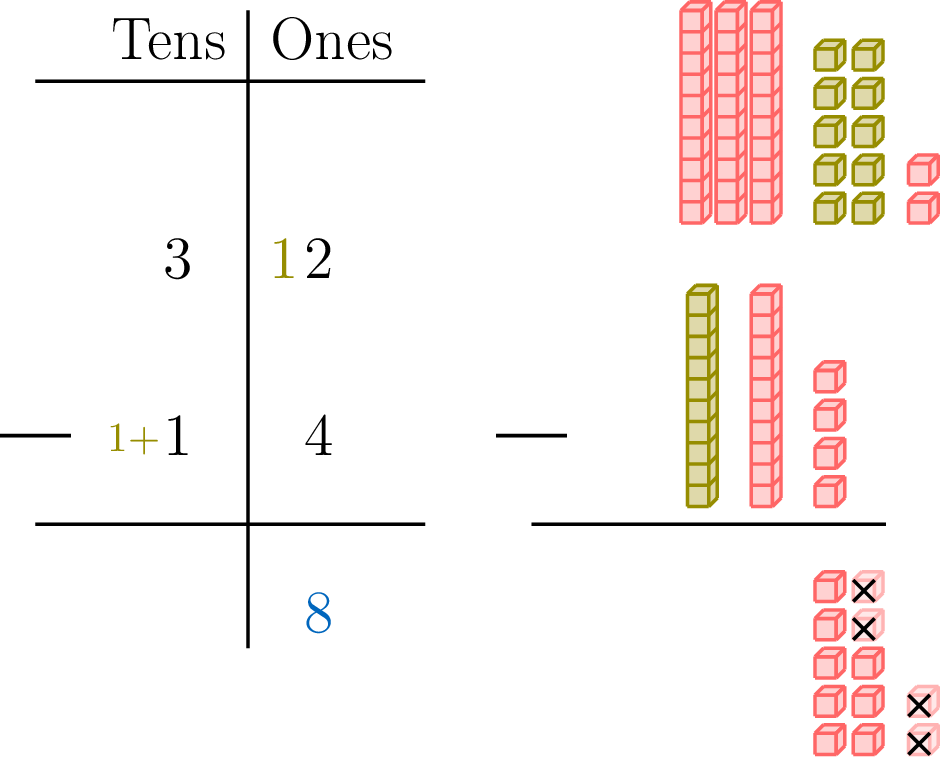
- Step 5: Subtract the tens.$$3 \text{ tens (from 32)} - 1 \text{ ten (from 14)} - 1 \text{ ten (compensated)} = 1 \text{ ten}$$
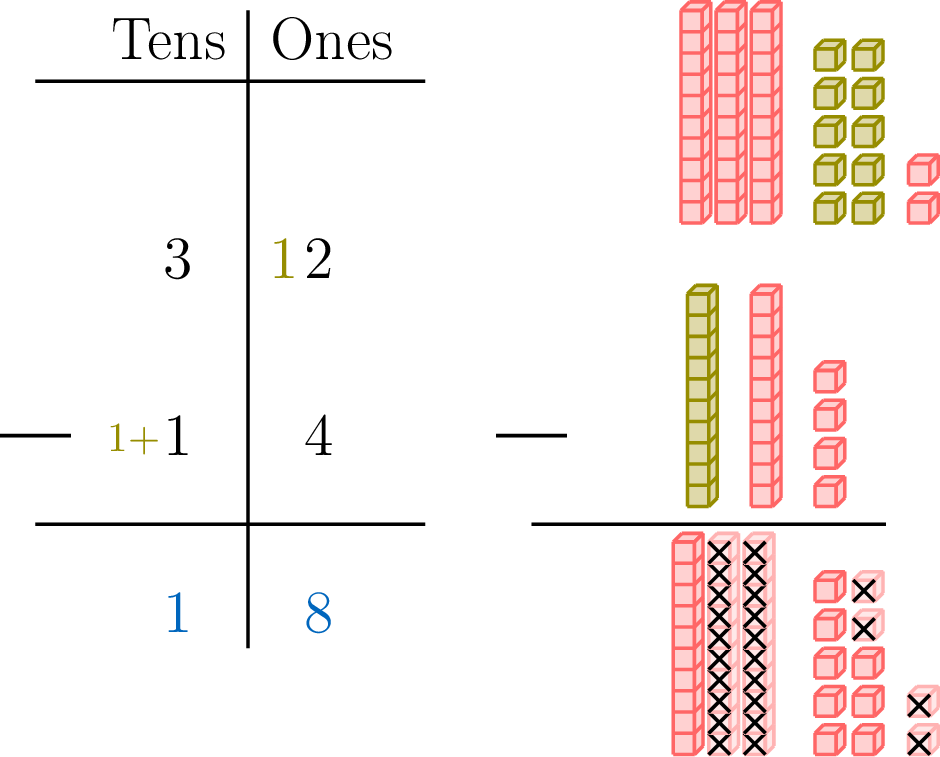
- Result: The difference is 1 ten and 8 ones. So, $$32 - 14 = 18$$
\(-\) \(=\)