Divisibility and Modular Arithmetic
Divisibility
Definition Divisibility Relationships
We say that an integer \(b\) divides an integer \(a\) if there exists an integer \(k\) such that:$$a = kb.$$We write \(b\mid a\).
We can also use the following formulations:
We can also use the following formulations:
- \(b\) is a divisor of \(a\),
- \(b\) is a factor of \(a\),
- \(a\) is a multiple of \(b\).
Example
Consider the numbers \(10\) and \(5\).
Since we can write \(\textcolor{olive}{10} = \textcolor{colorprop}{2}\times \textcolor{colordef}{5}\), we can say that:
Since we can write \(\textcolor{olive}{10} = \textcolor{colorprop}{2}\times \textcolor{colordef}{5}\), we can say that:
- \(\textcolor{colordef}{5}\) divides \(\textcolor{olive}{10}\),
- \(\textcolor{colordef}{5}\) is a divisor (or factor) of \(\textcolor{olive}{10}\),
- \(\textcolor{olive}{10}\) is divisible by \(\textcolor{colordef}{5}\),
- \(\textcolor{olive}{10}\) is a multiple of \(\textcolor{colordef}{5}\).
Notes
Let \(a\) and \(b\) be two integers.
- \(1\) divides every integer \(a\) because \(a=1\times a\) (hence \(1\mid a\)).
- If \(a\) is a multiple of \(b\) and \(a\neq 0\), then \(|a|\ge |b|\).
- If \(a\) divides \(b\) and \(b\) divides \(a\), with \(a\neq 0\) and \(b\neq 0\), then \(a=b\) or \(a=-b\).
Proposition Linear combinations
Let \(a,b,c\) be integers.
If \(a\mid b\) and \(a\mid c\), then for all integers \(m\) and \(n\),$$a \mid (mb+nc).$$
If \(a\mid b\) and \(a\mid c\), then for all integers \(m\) and \(n\),$$a \mid (mb+nc).$$
Suppose \(a \mid b\) and \(a \mid c\).
By definition, there exist integers \(k\) and \(\ell\) such that$$b = ka \quad \text{and} \quad c = \ell a.$$Now let \(m\) and \(n\) be any integers. We consider the linear combination \(mb + nc\):$$\begin{aligned}mb + nc &= m(ka) + n(\ell a) \\ &= (mk + n\ell)a.\end{aligned}$$Since \(m,k,n,\ell\) are integers, the term \((mk+n\ell)\) is an integer.
Therefore, by definition, \(a\) divides \(mb+nc\).
By definition, there exist integers \(k\) and \(\ell\) such that$$b = ka \quad \text{and} \quad c = \ell a.$$Now let \(m\) and \(n\) be any integers. We consider the linear combination \(mb + nc\):$$\begin{aligned}mb + nc &= m(ka) + n(\ell a) \\ &= (mk + n\ell)a.\end{aligned}$$Since \(m,k,n,\ell\) are integers, the term \((mk+n\ell)\) is an integer.
Therefore, by definition, \(a\) divides \(mb+nc\).
Euclidean Division (Division with Remainder)
Theorem Euclidean Division
Given any two integers \(\textcolor{olive}{a}\) and \(\textcolor{colordef}{b}\) with \(\textcolor{colordef}{b}>0\), there exist unique integers \(\textcolor{colorprop}{q}\) and \(\textcolor{orange}{r}\) such that$$\textcolor{olive}{a}=\textcolor{colordef}{b}\,\textcolor{colorprop}{q}+\textcolor{orange}{r}\quad\text{and}\quad0\le \textcolor{orange}{r}<\textcolor{colordef}{b}.$$
- \(\textcolor{olive}{a}\) is the \(\textcolor{olive}{\text{dividend}}\),
- \(\textcolor{colordef}{b}\) is the \(\textcolor{colordef}{\text{divisor}}\),
- \(\textcolor{colorprop}{q}\) is the \(\textcolor{colorprop}{\text{quotient}}\),
- \(\textcolor{orange}{r}\) is the \(\textcolor{orange}{\text{remainder}}\).
This proof models sharing through repeated subtraction.
Consider the following algorithm for \(\textcolor{olive}{a}\in\mathbb{N}\) and \(\textcolor{colordef}{b}\in\mathbb{N}^*\):
Invariant: The relation \(\textcolor{olive}{a}=\textcolor{colordef}{b}\textcolor{colorprop}{q}+\textcolor{orange}{r}\) is preserved at each iteration. Upon termination, we have \(0\le \textcolor{orange}{r}<\textcolor{colordef}{b}\).
Uniqueness: If \(\textcolor{olive}{a}=\textcolor{colordef}{b}q+r=\textcolor{colordef}{b}q'+r'\) with \(0\le r,r'<\textcolor{colordef}{b}\), then \(\textcolor{colordef}{b}(q-q')=r'-r\). The right-hand side satisfies \(-(\textcolor{colordef}{b}-1)\le r'-r\le \textcolor{colordef}{b}-1\), so the only multiple of \(\textcolor{colordef}{b}\) in this range is \(0\). Hence \(r=r'\) and \(q=q'\).
Consider the following algorithm for \(\textcolor{olive}{a}\in\mathbb{N}\) and \(\textcolor{colordef}{b}\in\mathbb{N}^*\):
- Initialization: Set \(\textcolor{orange}{r}=\textcolor{olive}{a}\) and \(\textcolor{colorprop}{q}=0\).
- Loop: While \(\textcolor{orange}{r}\ge \textcolor{colordef}{b}\) do: $$ \textcolor{orange}{r}\leftarrow \textcolor{orange}{r}-\textcolor{colordef}{b} \quad\text{and}\quad \textcolor{colorprop}{q}\leftarrow \textcolor{colorprop}{q}+1. $$
Invariant: The relation \(\textcolor{olive}{a}=\textcolor{colordef}{b}\textcolor{colorprop}{q}+\textcolor{orange}{r}\) is preserved at each iteration. Upon termination, we have \(0\le \textcolor{orange}{r}<\textcolor{colordef}{b}\).
Uniqueness: If \(\textcolor{olive}{a}=\textcolor{colordef}{b}q+r=\textcolor{colordef}{b}q'+r'\) with \(0\le r,r'<\textcolor{colordef}{b}\), then \(\textcolor{colordef}{b}(q-q')=r'-r\). The right-hand side satisfies \(-(\textcolor{colordef}{b}-1)\le r'-r\le \textcolor{colordef}{b}-1\), so the only multiple of \(\textcolor{colordef}{b}\) in this range is \(0\). Hence \(r=r'\) and \(q=q'\).
Example
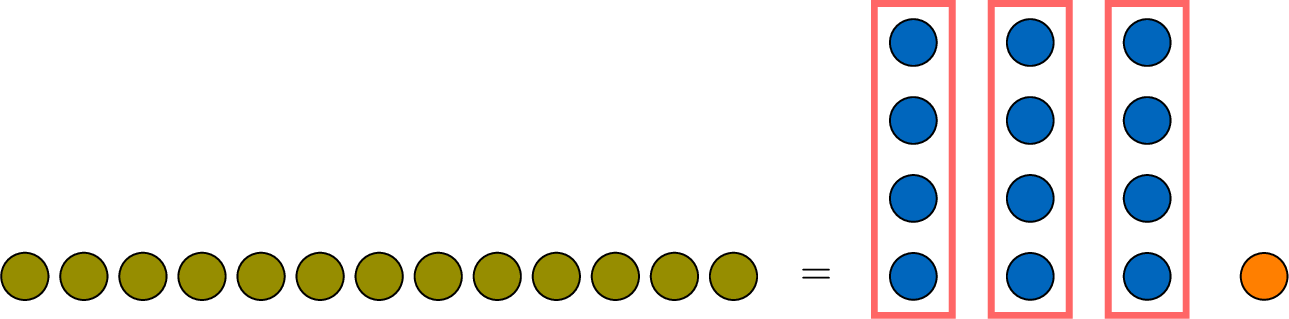
$$\begin{array}{ccccccccl} \textcolor{olive}{13} &=& \textcolor{colordef}{3} & \times & \textcolor{colorprop}{4} & + & \textcolor{orange}{1} & \text{with} & 0 \leq \textcolor{orange}{1} < \textcolor{colordef}{3} \\
\textcolor{olive}{\text{Dividend}} &=& \textcolor{colordef}{\text{Divisor}} & \times & \textcolor{colorprop}{\text{Quotient}} & + & \textcolor{orange}{\text{Remainder}} & \text{with} & 0 \leq\textcolor{orange}{\text{Remainder}} < \textcolor{colordef}{\text{Divisor}}\end{array}$$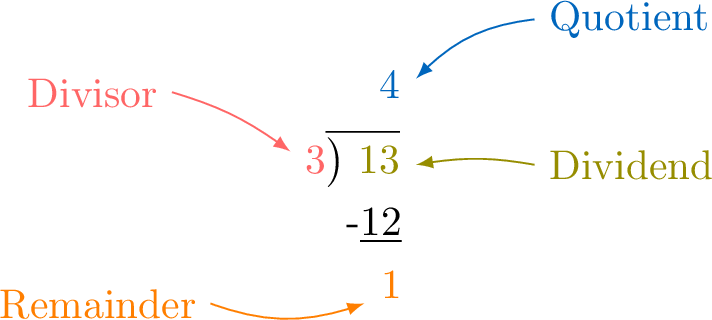
Method Check divisibility
To check whether an integer \(a\) is divisible by a positive integer \(b\), perform the Euclidean division of \(a\) by \(b\).
- If the remainder is zero, then \(a\) is divisible by \(b\).
- If the remainder is not zero, then \(a\) is not divisible by \(b\).
Example
Is \(13\) divisible by \(5\)?
We perform the Euclidean division of \(13\) by \(5\):$$\textcolor{olive}{13}=\textcolor{colordef}{5}\times \textcolor{colorprop}{2}+\textcolor{orange}{3}.$$The remainder is \(\textcolor{orange}{3}\) (which is not zero). Therefore, \(\textcolor{olive}{13}\) is not divisible by \(\textcolor{colordef}{5}\).
Congruences
Definition Congruent Integers
Let \(n\) be an integer (\(n \ge 2\)).
Two integers \(a\) and \(b\) are said to be congruent modulo \(n\) if their difference \(a-b\) is divisible by \(n\).
We write: \(a \equiv b \pmod{n}\), or sometimes \(a \equiv b \ (n)\), or \(a \equiv b \ [n]\).
Two integers \(a\) and \(b\) are said to be congruent modulo \(n\) if their difference \(a-b\) is divisible by \(n\).
We write: \(a \equiv b \pmod{n}\), or sometimes \(a \equiv b \ (n)\), or \(a \equiv b \ [n]\).
Proposition Same Remainder Property
Two integers \(a\) and \(b\) are congruent modulo \(n\) if and only if \(a\) and \(b\) have the same remainder in the Euclidean division by \(n\).
Let$$a = nq_1 + r_1\quad \text{and}\quad b = nq_2 + r_2$$be the Euclidean divisions of \(a\) and \(b\) by \(n\), with \(0 \le r_1, r_2 < n\).
- If \(r_1 = r_2\), then $$ a-b = (nq_1 + r_1) - (nq_2 + r_2) = n(q_1-q_2), $$ so \(n\mid (a-b)\) and thus \(a \equiv b \pmod{n}\).
- Conversely, if \(a \equiv b \pmod{n}\), then \(n\mid (a-b)\). But $$ a-b = n(q_1-q_2) + (r_1-r_2), $$ hence \(n\mid (r_1-r_2)\). Since \(-n < r_1-r_2 < n\), the only multiple of \(n\) in this range is \(0\). Therefore \(r_1-r_2=0\), so \(r_1=r_2\).
Example
Prove that \(57 \equiv 15 \pmod{7}\).
- Method 1 (Remainders): \(57 = 7\times 8 + 1\) (remainder \(1\)) and \(15 = 7\times 2 + 1\) (remainder \(1\)). Since they have the same remainder, \(57 \equiv 15 \pmod{7}\).
- Method 2 (Difference): \(57-15 = 42 = 7\times 6\). Since the difference is a multiple of \(7\), \(57 \equiv 15 \pmod{7}\).
Proposition Congruence to the Remainder
An integer is congruent to its remainder in the Euclidean division by \(n\).
Let \(a = nq + r\) be the Euclidean division of \(a\) by \(n\).
Then \(a-r = nq\). Since \(nq\) is a multiple of \(n\), we have \(n\mid (a-r)\), hence \(a \equiv r \pmod{n}\).
Then \(a-r = nq\). Since \(nq\) is a multiple of \(n\), we have \(n\mid (a-r)\), hence \(a \equiv r \pmod{n}\).
Example
As \(2019 = 201\times 10 + 9\), we have \(2019 \equiv 9 \pmod{10}\).
Proposition Equivalence Relation
Congruence modulo \(n\) is an equivalence relation, which means that for any integers \(a, b,\) and \(c\):
- \(a \equiv a \pmod{n}\) (reflexivity),
- \(a \equiv b \pmod{n} \Rightarrow b \equiv a \pmod{n}\) (symmetry),
- \(a \equiv b \pmod{n}\) and \(b \equiv c \pmod{n} \Rightarrow a \equiv c \pmod{n}\) (transitivity).
- \(a-a=0\), and \(0\) is divisible by any \(n\ge 2\). So \(a \equiv a \pmod{n}\).
- If \(a \equiv b \pmod{n}\), then \(a-b=kn\) for some integer \(k\). Hence \(b-a=(-k)n\), so \(b \equiv a \pmod{n}\).
- If \(a \equiv b \pmod{n}\) and \(b \equiv c \pmod{n}\), then \(a-b=kn\) and \(b-c=mn\) for some integers \(k,m\). Summing gives $$ (a-b)+(b-c)=kn+mn \implies a-c=(k+m)n, $$ so \(a \equiv c \pmod{n}\).
Example
If \(x \equiv y \pmod{5}\) and \(y \equiv 12 \pmod{5}\), then \(x \equiv 12 \pmod{5}\). Since \(12 = 5\times 2 + 2\), we can further say \(x \equiv 2 \pmod{5}\).