Sequences
A sequence is a list of numbers in a special order that follows a rule. By finding the rule or pattern, we can figure out what number comes next.
We will work with sequences where we always add or subtract the same number (these are called arithmetic sequences). We will also work with sequences where we always multiply or divide by the same number (these are called geometric sequences).
We will work with sequences where we always add or subtract the same number (these are called arithmetic sequences). We will also work with sequences where we always multiply or divide by the same number (these are called geometric sequences).
Numerical Sequence
Definition Numerical Sequence
A numerical sequence is a list of numbers in a special order. Each number in the sequence is called a term, and the terms follow a rule that tells us how to find the next number.
Example
What is the next number in the sequence?$$0, 1, 2, 3, 4, ?$$
The next number in the sequence is \(5\). In this sequence, we start at \(0\) and each time we add \(1\) to get the next number.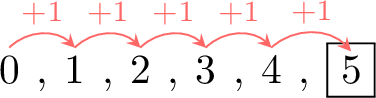
Definition Arithmetic Sequence
An arithmetic sequence is a list of numbers where the same number is added or subtracted each time to get the next number.
The difference between two consecutive terms (two numbers that are next to each other in the sequence) is called the common difference.
The difference between two consecutive terms (two numbers that are next to each other in the sequence) is called the common difference.
Example
What is the next number in the sequence?$$3, 6, 9, 12, ?$$
The next number is \(15\), because each number increases by \(3\).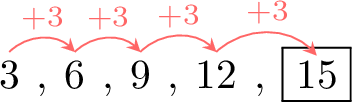
Definition Geometric Sequence
A geometric sequence is a list of numbers where the same number is multiplied or divided each time to get the next number.
The ratio of two consecutive terms is called the common ratio.
The ratio of two consecutive terms is called the common ratio.
Example
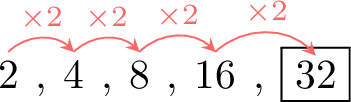
What is the next number in the sequence?$$2, 4, 8, 16, ?$$
The next number is \(32\), because each number is multiplied by \(2\).