Division
Have you ever shared something fairly with friends? Or have you ever put your toys away into equal groups? When you do this, you are using division! Division is a powerful tool for sharing and grouping equally.
What is Division?
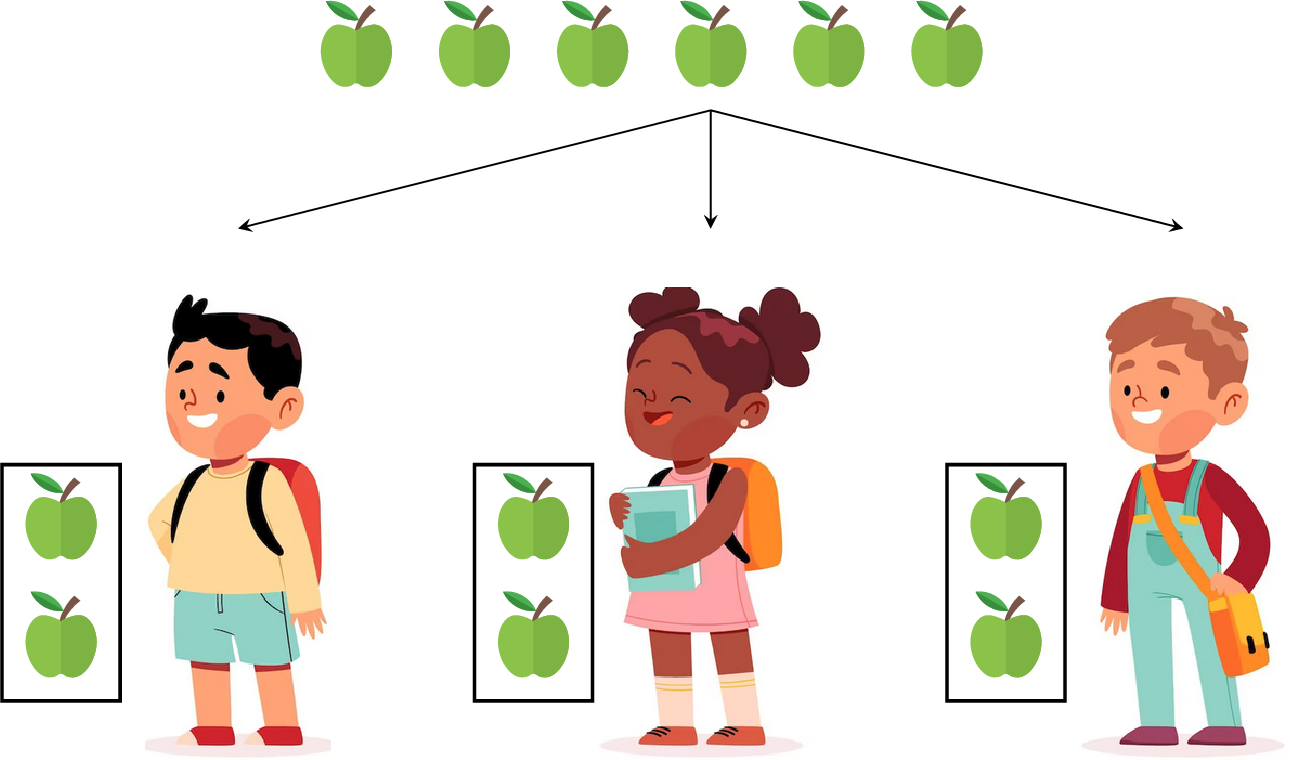
Hugo, Aisha, and Louis have 6 apples. They want to share them equally. How can they do it so that it's fair?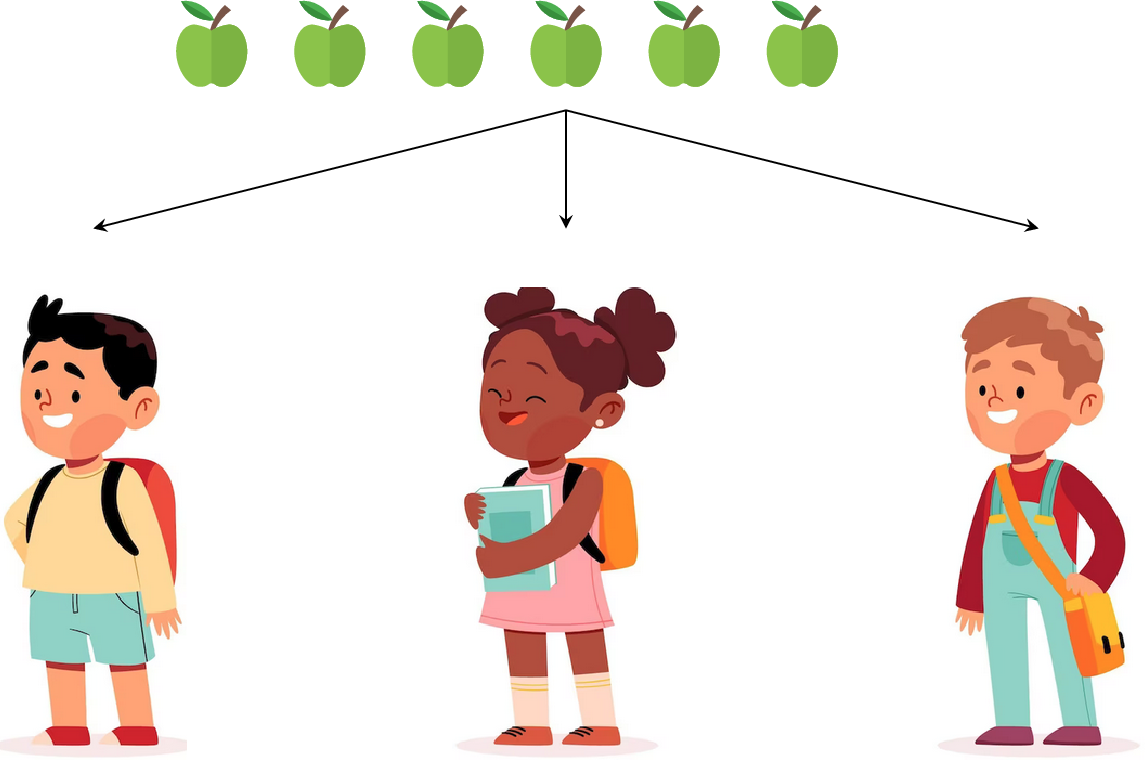
Definition Division
Division is the process of splitting a total amount into equal groups. We use the division sign (\(\div\)) to write a division sentence.
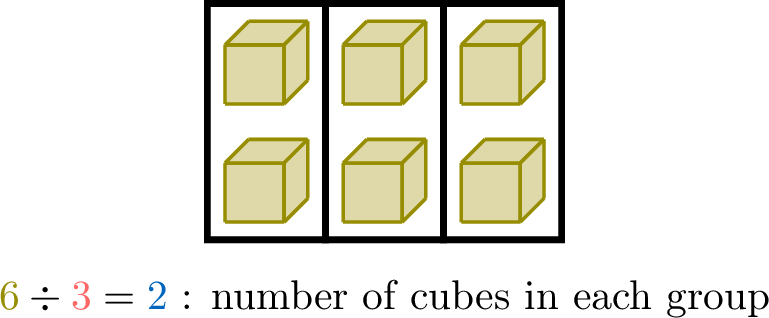
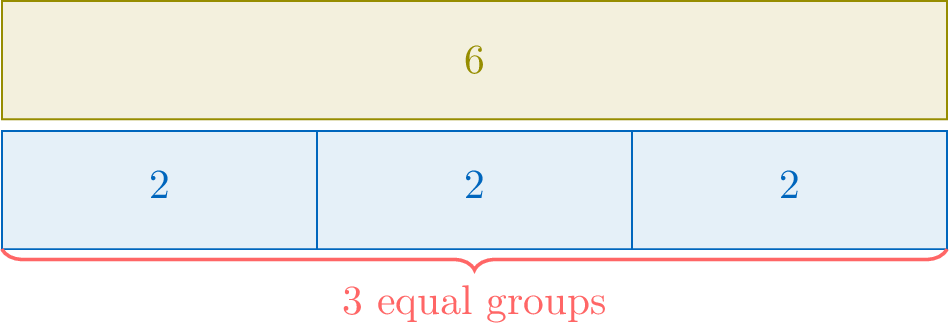
We can show "six divided by three equals two" in many ways:
We can show "six divided by three equals two" in many ways:
- With Numbers: $$\textcolor{olive}{6}\div \textcolor{colordef}{3}=\textcolor{colorprop}{2}$$
- In Groups
\(\textcolor{olive}{6}\) shared into \(\textcolor{colordef}{3}\) equal groups is \(\textcolor{colorprop}{2}\) in each group - With Cubes:
- With a Part-Whole Model:
Two Kinds of Division Questions
Method Question 1: How many in each group?
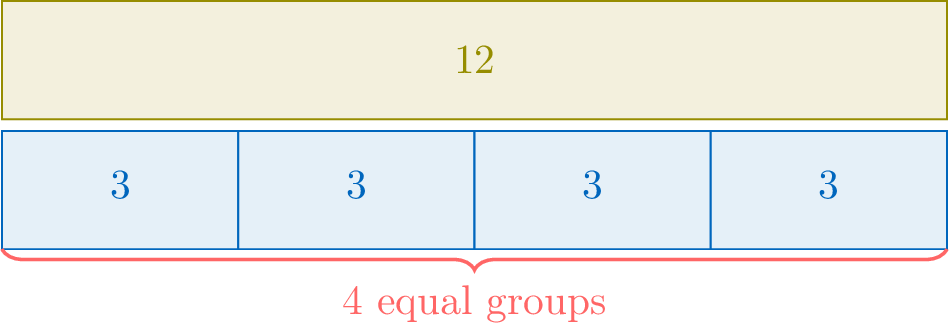
Sometimes you know the \(\textcolor{olive}{\text{total}}\) and the \(\textcolor{colordef}{\text{number of groups}}\). Division helps you find the \(\textcolor{colorprop}{\text{number of items in each group}}\).$$\begin{aligned}[t]\textcolor{olive}{\text{Total}} \div \textcolor{colordef}{\text{Number of groups}} &= \textcolor{colorprop}{\text{Number in each group}}\end{aligned}$$For example, we have \(\textcolor{olive}{12}\) apples to share equally among \(\textcolor{colordef}{4}\) friends.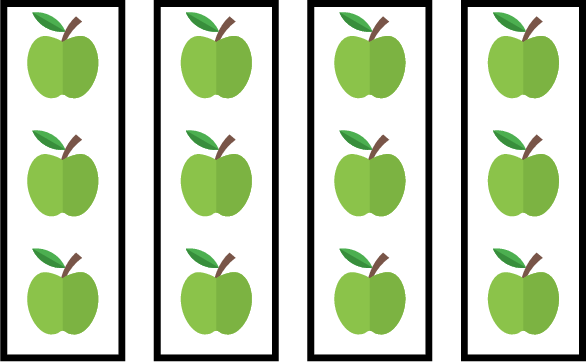
Method Question 2: How many groups can be made?
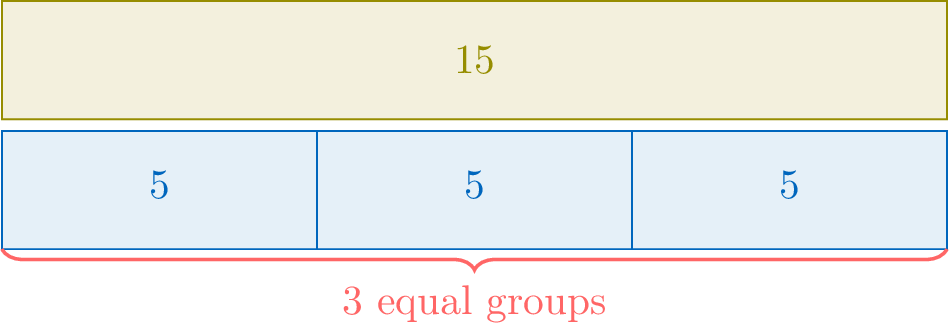
Other times, you know the \(\textcolor{olive}{\text{total}}\) and the \(\textcolor{colorprop}{\text{number of items for each group}}\). Division helps you find the \(\textcolor{colordef}{\text{number of groups}}\) you can make.$$\begin{aligned}[t]\textcolor{olive}{\text{Total}} \div \textcolor{colorprop}{\text{Number in each group}} &= \textcolor{colordef}{\text{Number of groups}}\end{aligned}$$For example, we have \(\textcolor{olive}{15}\) apples and we put them into boxes of \(\textcolor{colorprop}{5}\).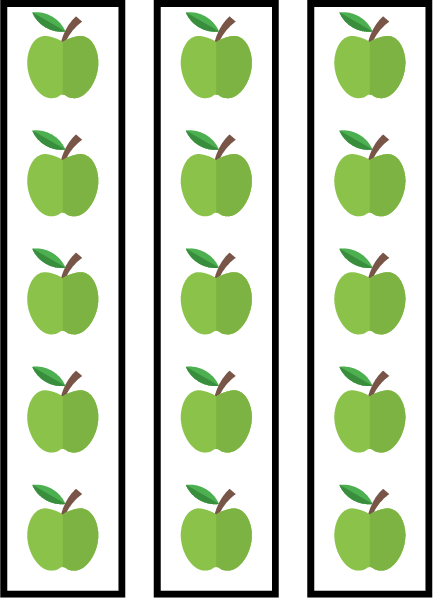
The Multiplication and Division Connection
This array of cubes shows how multiplication and division are connected.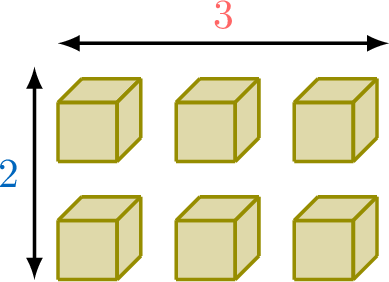
- Multiplication builds the total:
3 columns of 2 cubes each make 6 cubes in total. $$\textcolor{colordef}{3} \times \textcolor{colorprop}{2} = \textcolor{olive}{6}$$ - Division finds the group size:
6 cubes shared among 3 columns give 2 cubes per column. $$\textcolor{olive}{6} \div \textcolor{colordef}{3} = \textcolor{colorprop}{2}$$
Proposition The Multiplication and Division Connection
Multiplication and division are inverse operations. This means they are partners that "undo" each other.