Fractions
What is a Fraction?
Consider the model below, which illustrates one whole unit and one half: . To express this quantity as a single fraction, we follow two steps:
. To express this quantity as a single fraction, we follow two steps:- Identify the denominator: The units are divided into halves, so the denominator is 2.
- Count the parts: In total, there are three shaded parts of this size. This count becomes the numerator.
Definition Fraction
A fraction has two numbers separated by a fraction bar: the numerator (on top) and the denominator (on the bottom). 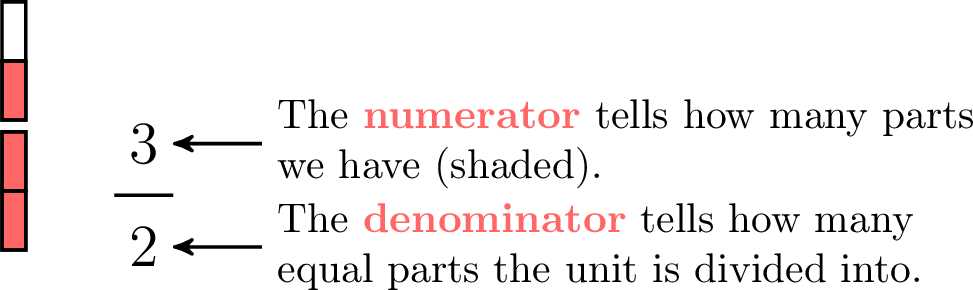
On the Number Line
Fractions do not only represent parts of a shape; they can also represent points on a number line. The space between 0 and 1 is a unit.
If we divide the unit into 2 equal parts, the point in the middle represents the fraction \(\dfrac{1}{2}\).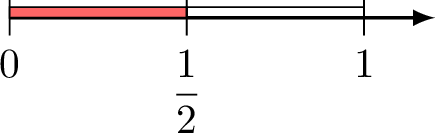
If we divide the unit into 2 equal parts, the point in the middle represents the fraction \(\dfrac{1}{2}\).
Method Representing a Fraction on the Number Line
To represent the fraction \(\dfrac{\textcolor{colordef}{2}}{\textcolor{colorprop}{3}}\) on a number line:
- Draw a straight line and mark the points \(0\) and \(1\).

- Divide the segment from \(0\) to \(1\) into \(\textcolor{colorprop}{3}\) equal parts (the denominator).

- Count \(\textcolor{colordef}{2}\) parts from \(0\) (the numerator) and mark the point at \(\dfrac{\textcolor{colordef}{2}}{\textcolor{colorprop}{3}}\).

Equivalent Fractions
A cake is cut into 3 equal parts. One part, representing \(\dfrac{1}{3}\) of the cake, is set aside.

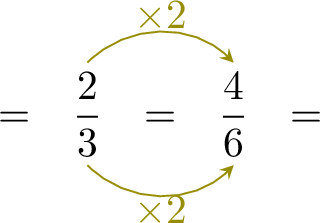
No—the amount of cake did not change. The models show that the shaded portion is the same in both cases.\(\quad=\quad\) Therefore, the fractions \(\dfrac{1}{3}\) and \(\dfrac{2}{6}\) represent the same value.
\(\quad=\quad\)
Definition Equivalent Fractions
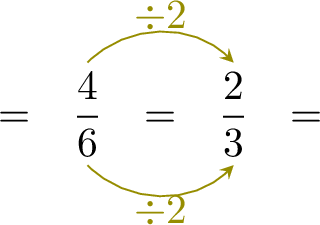
Two fractions are equivalent if they represent the same amount. You can make an equivalent fraction by multiplying or dividing the numerator and the denominator by the same nonzero number.

Addition and Subtraction of Fractions with Common Denominators
Consider a unit divided into four equal parts (fourths). One portion is \(\dfrac{2}{4}=\)  , and a second portion is \(\dfrac{1}{4}=\)
  .
.
What fraction of the unit is represented when these two portions are combined?
, and a second portion is \(\dfrac{1}{4}=\) .What fraction of the unit is represented when these two portions are combined?
To find the total, combine the shaded parts. Since all parts are the same size (fourths), just add the counts: \(2+1=3\) shaded parts.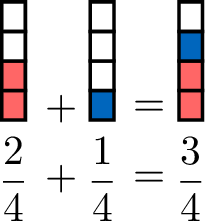
Definition Addition of Fractions with Common Denominators
To add fractions with the same denominator, add the numerators and keep the denominator the same:
Definition Subtraction of Fractions with Common Denominators
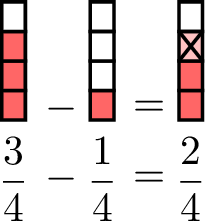
To subtract fractions with the same denominator, subtract the numerators and keep the denominator the same: