Division with Remainders
In mathematics, division is used for equal sharing or grouping. Sometimes, a number cannot be shared perfectly into equal groups. The amount that is left over after sharing is called the remainder.
Division without Remainders
Definition Division
Division is the inverse operation of multiplication. It is the process of determining how many times one number is contained within another.
The components of a division expression are formally named:
The components of a division expression are formally named:
- The dividend: the number that is being divided.
- The divisor: the number by which the dividend is divided.
- The quotient: the result of the division.
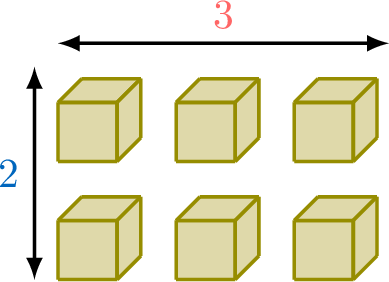
- Numerical Form: $$\textcolor{olive}{6}\div \textcolor{colordef}{3}=\textcolor{colorprop}{2}$$
- Word Form:
Six divided by three equals two. - Grid Model:
Division with Remainders
Definition Euclidean Division
Euclidean Division is the process of dividing one integer (the dividend) by another (the divisor) when the division is not exact. This process yields an integer quotient and a remainder.
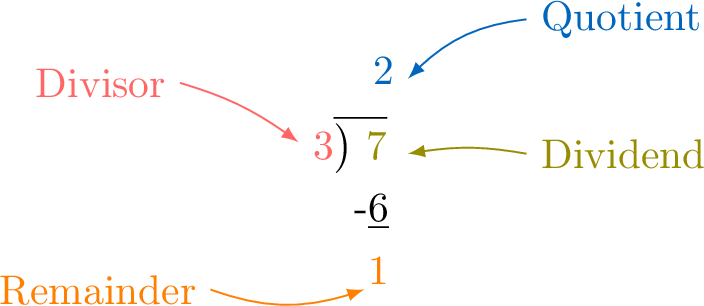
The components of a Euclidean division expression are formally named:
The components of a Euclidean division expression are formally named:
- The dividend: the number that is being divided.
- The divisor: the number by which the dividend is divided.
- The quotient: the whole number of times the divisor fits into the dividend.
- The remainder: the amount left over after the division.
- The remainder is always smaller than the divisor. (If it isn’t, you can still make another group!)
- If the remainder is \(0\), the division is exact (no remainder).
- Word Form:
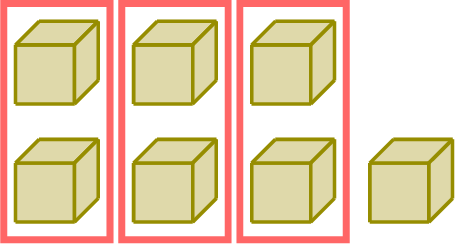
Seven divided by three equals two, with a remainder of \(\textcolor{orange}{\text{one}}\) - Division Sentence:$$\underbrace{\textcolor{olive}{7}}_{\textcolor{olive}{\text{Dividend}}} \div \underbrace{\textcolor{colordef}{3}}_{\textcolor{colordef}{\text{Divisor}}} = \divionRemainder{\underbrace{\textcolor{colorprop}{2}}_{\textcolor{colorprop}{\text{Quotient}}}}{\underbrace{\textcolor{orange}{1}}_{\textcolor{orange}{\text{Remainder}}}}$$
- Euclidean Identity:$$\underbrace{\textcolor{olive}{7}}_{\textcolor{olive}{\text{Dividend}}}= (\underbrace{\textcolor{colordef}{3}}_{\textcolor{colordef}{\text{Divisor}}} \times \underbrace{\textcolor{colorprop}{2}}_{\textcolor{colorprop}{\text{Quotient}}}) +\underbrace{\textcolor{orange}{1}}_{\textcolor{orange}{\text{Remainder}}}$$
- Group Model:
- Long Division Algorithm:
Long Division
Long division is an organized method for solving division problems. The main idea is to find how many times one number fits into another.
- Case 1: An Exact Fit
To solve \(\textcolor{olive}{12} \div \textcolor{colordef}{4}\), we ask: "How many times does \(\textcolor{colordef}{4}\) fit into \(\textcolor{olive}{12}\)?"
By knowing our multiplication facts, we know that \(\textcolor{colordef}{4} \times \textcolor{colorprop}{3} = \textcolor{olive}{12}\). It fits exactly \(\textcolor{colorprop}{3}\) times.
The answer is \(\textcolor{colorprop}{3}\). - Case 2: A Fit with a Remainder
To solve \(\textcolor{olive}{13} \div \textcolor{colordef}{4}\), we ask: "How many times does \(\textcolor{colordef}{4}\) fit into 13 without going over?"- \(\textcolor{colordef}{4} \times \textcolor{colorprop}{3} = 12\) (This fits)
- \(\textcolor{colordef}{4} \times \textcolor{colorprop}{3} = 16\) (This is too large)
The answer is \(\textcolor{colorprop}{3}\) with a remainder of \(\textcolor{orange}{1}\).
Method The Long Division Algorithm: Single-Step
To divide with a remainder, like \(\textcolor{olive}{13} \div \textcolor{colordef}{4}\), follow these steps:
- Set up: Write the dividend (\(\textcolor{olive}{13}\)) inside the division bracket and the divisor (\(\textcolor{colordef}{4}\)) on the outside.

- Divide: Ask "How many times does 4 go into 13?"\(\begin{aligned}\textcolor{colordef}{4}\times \textcolor{colorprop}{3}&=\boxed{12}\ \ (\leqslant\,\textcolor{olive}{13}),\\\textcolor{colordef}{4}\times \textcolor{colorprop}{4}&=\cancel{16}\ \ (> \textcolor{olive}{13}).\end{aligned}\).
The answer is \(\textcolor{colorprop}{3}\). Write \(\textcolor{colorprop}{3}\) above the line and \(12\) under \(\textcolor{olive}{13}\).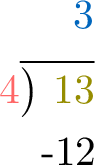
- Subtract: Subtract 12 from 13 to find the remainder. \(\textcolor{olive}{13} - 12 = \textcolor{orange}{1}\).
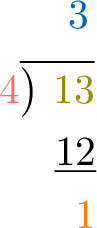
- Final answer: \(\textcolor{olive}{13} \div \textcolor{colordef}{4} = \divionRemainder{\textcolor{colorprop}{3}}{\textcolor{orange}{1}}\), and \(\textcolor{olive}{13} = \textcolor{colordef}{4}\times \textcolor{colorprop}{3}+\textcolor{orange}{1}\).
Method The Long Division Algorithm: Multi-Steps
To divide with a remainder, like \(\textcolor{olive}{130} \div \textcolor{colordef}{4}\), follow these steps:
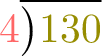
- Set up: Write the dividend (\(\textcolor{olive}{130}\)) inside the bracket and the divisor (\(\textcolor{colordef}{4}\)) outside.
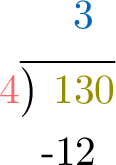
- Divide the first part (13): “How many times does \(4\) go into \(13\)?”$$\textcolor{colordef}{4}\times \textcolor{colorprop}{3}=\boxed{12}\ (\le \textcolor{olive}{13}),\qquad\textcolor{colordef}{4}\times \textcolor{colorprop}{4}=\cancel{16}\ (> \textcolor{olive}{13}).$$Write \(\textcolor{colorprop}{3}\) above and \(12\) under \(13\); then subtract.
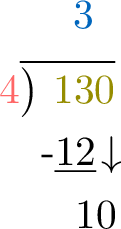
- Subtract and Bring down the next digit: \(\textcolor{olive}{13}-12=\textcolor{orange}{1}\); bring down \(0\) to make \(\textcolor{olive}{10}\).
- Divide the new number (10): “How many times does \(4\) go into \(10\)?”$$\textcolor{colordef}{4}\times \textcolor{colorprop}{2}=\boxed{8}\ (\le \textcolor{olive}{10}),\qquad\textcolor{colordef}{4}\times \textcolor{colorprop}{3}=\cancel{12}\ (> \textcolor{olive}{10}).$$Write \(\textcolor{colorprop}{2}\) above, put \(8\) under \(10\), and subtract to get the remainder.
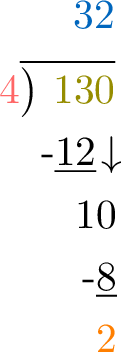
- Final answer: \(\textcolor{olive}{130} \div \textcolor{colordef}{4}= \divionRemainder{\textcolor{colorprop}{32}}{\textcolor{orange}{2}}\), and\(\textcolor{olive}{130}=\textcolor{colordef}{4}\times\textcolor{colorprop}{32}+\textcolor{orange}{2}\).
Two Ways to Think About Division
Method The Two Models of Division
Division answers two kinds of questions. When the total does not split evenly, we record a remainder.
- Sharing. The number of groups is known; find the size of each group (and any leftover).$$\textcolor{olive}{\text{total}} \div \textcolor{colordef}{\text{number of groups}}= \textcolor{colorprop}{\text{size of each group}} \text{ with } \textcolor{orange}{\text{a remainder}}.$$Example: 13 cookies are shared among 3 friends.$$\textcolor{olive}{\text{13 cookies}} \div \textcolor{colordef}{\text{3 friends}}= \textcolor{colorprop}{\text{4 cookies per friend}} \text{ with remainder } \textcolor{orange}{\text{1 cookie}}.$$
- Grouping. The size of each group is known; find how many full groups can be made (and what remains).$$\textcolor{olive}{\text{total}} \div \textcolor{colorprop}{\text{size of each group}}= \textcolor{colordef}{\text{number of groups}} \text{ with } \textcolor{orange}{\text{a remainder}}.$$Example: 13 cookies are packed in bags of 4 cookies each.$$\textcolor{olive}{\text{13 cookies}} \div \textcolor{colorprop}{\text{4 cookies per bag}}= \textcolor{colordef}{\text{3 bags}} \text{ with remainder } \textcolor{orange}{\text{1 cookie}}.$$