Time
A Full Day is 24 Hours
Definition One Day\(\virgule\) 24 Hours
It takes the Earth 24 hours to complete one full spin on its axis. We call this spinning motion a rotation. This 24-hour period of rotation is one full day.
As the Earth rotates, different parts of it face the Sun.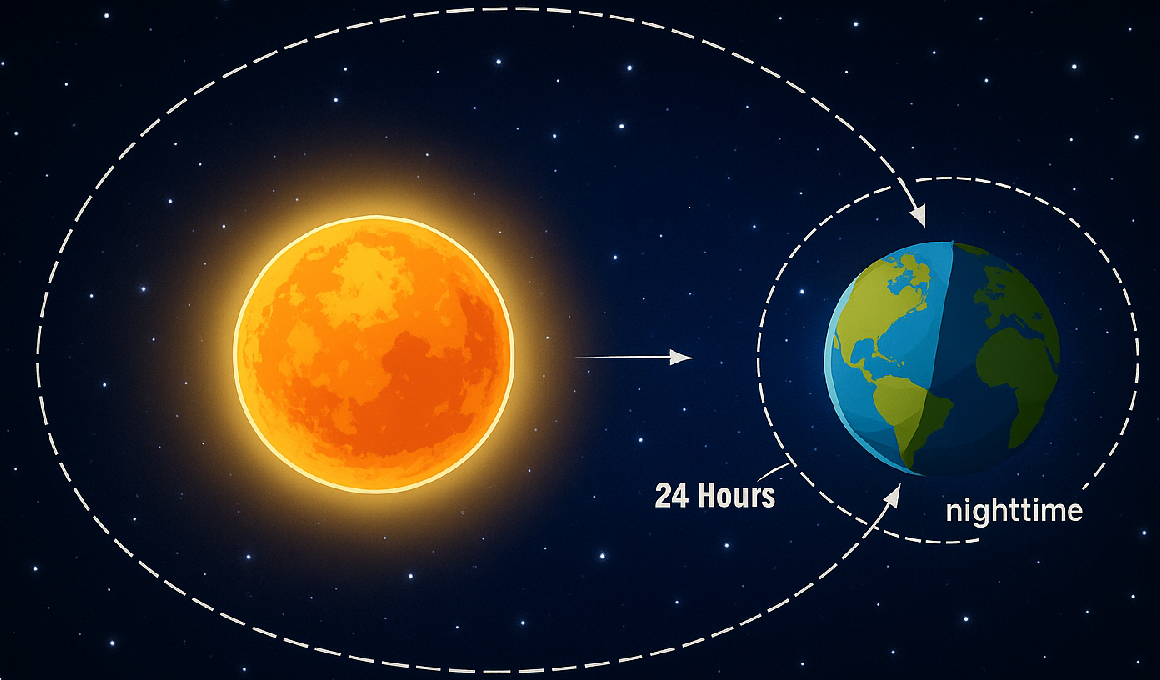
As the Earth rotates, different parts of it face the Sun.
- The part of the Earth facing the Sun is lit up. We call this period daytime.
- The part of the Earth facing away from the Sun is in darkness. We call this period nighttime.
Order of the Day
Definition Parts of the Day
We organize our day into different parts: morning, noon, afternoon, and evening. Each part of the day has its own activities.
Days of the Week
Definition Days of the Week
A week is made up of 7 days. Each day has a special name, and the days always come in the same order.Monday, Tuesday, Wednesday, Thursday, Friday, Saturday, Sunday The first five days are often called ``school days'' or ``weekdays''. Saturday and Sunday are called the ``weekend''. After Sunday, a new week begins again with Monday.
Months of the Year
Definition The 12 Months of the Year
A year is the time it takes for the Earth to make one complete journey, or orbit, around the Sun. This long journey is divided into 12 smaller parts called months.
The 12 months always follow the same order. After December, a new year begins with January.January, February, March, April, May, June, July, August, September, October, November, December We use the months to talk about special times of the year, such as holidays, seasons, and birthdays.
The 12 months always follow the same order. After December, a new year begins with January.
Days in a Month
Definition Days in Each Month
Not all months have the same number of days. Some are longer than others.
- 31 days: January, March, May, July, August, October, December.
- 30 days: April, June, September, November.
- 28 or 29 days: February is a special case. It is the shortest month with 28 days. However, every four years, we have a leap year, and February gets an extra day, giving it 29 days!
A Fun Trick to Remember!
You can use your knuckles to remember which months have 31 days.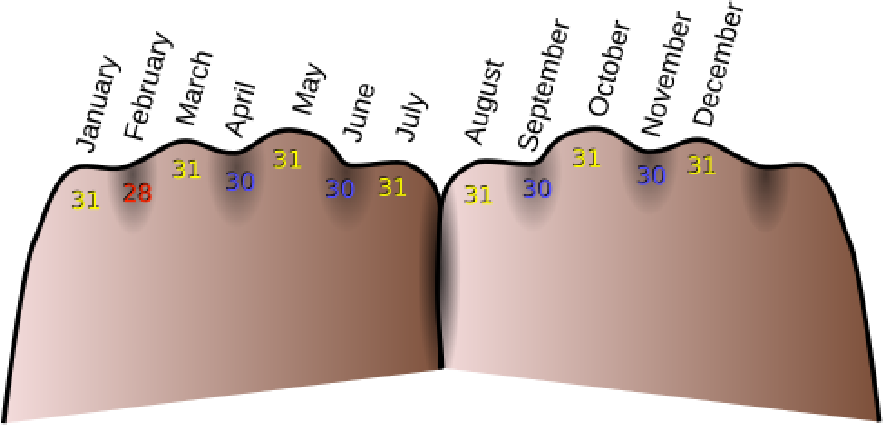
You can use your knuckles to remember which months have 31 days.
- Make a fist with both hands and place them together.
- Each knuckle (the bumpy part) is a month with 31 days.
- Each valley (the space between knuckles) is a month with 30 days (or February).
Definition A Calendar
A calendar is a tool that shows all the days, weeks, and months of a year. It helps us organize our time and remember important dates.
Here is an example of a calendar page for March 2025: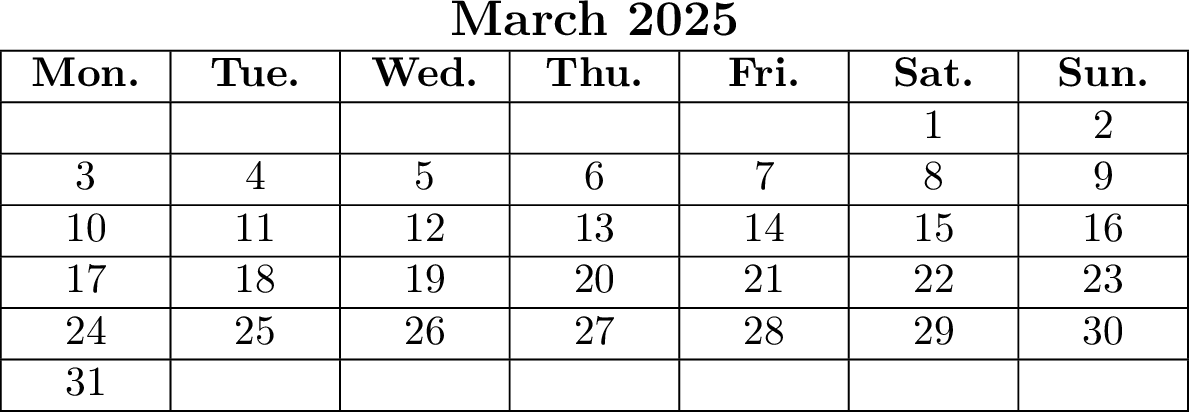
Here is an example of a calendar page for March 2025:
Telling Time to the Half Hour
Method How to Read Half-Hour Times
When we tell time to the half hour, we use the phrase ``half past''. This means 30 minutes have passed since the o'clock hour.
- Look at the long minute hand. When it points straight down to the 6, it has moved halfway around the clock. This means it is 30 minutes past the hour.
- Look at the short hour hand. Because 30 minutes have passed, the hour hand is no longer pointing directly at an hour. It has moved halfway past the last hour and is on its way to the next one. To know the hour, we look at the number the hand has just passed.
Example
What time does this clock show? It is morning.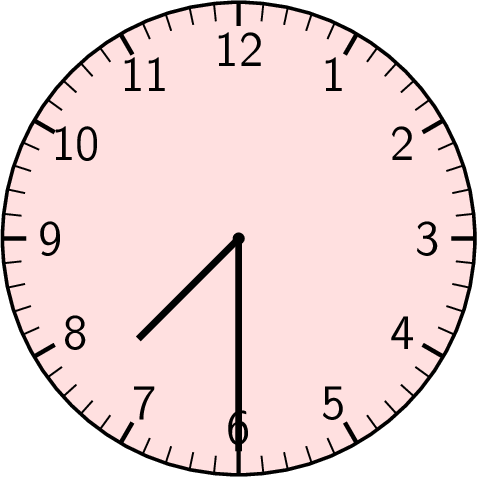
- The long minute hand is pointing to the 6, so it is 30 minutes past the hour.
- The short hour hand is between the 7 and the 8. It has passed the 7.
- The time is 7:30. We can also say half past 7.