Even and Odd Numbers
Partners for Everyone?
Let's investigate a property of numbers! Imagine you have some marbles to share equally between yourself and a friend, so you can both have the same amount.
- First, imagine you have 8 marbles. Can you share them equally with no marbles left over?

- Now, what if you have 9 marbles? Can you still share them equally?

- With 8 marbles, you can make two equal groups of 4. There are no marbles left over!

- With 9 marbles, you can each get 4, but there is always 1 marble left over.
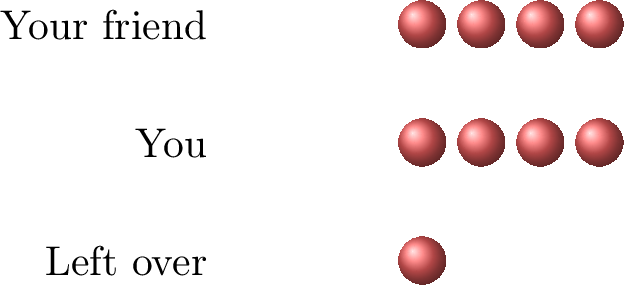
Definition Even and Odd Numbers
- An even number is a number that can be split into two equal groups or where every item has a partner. Nothing is left out.
Examples: \(0, 2, 4, 6, 8, 10, 12, \dots\) - An odd number is a number that cannot be split into two equal groups or one item will always be left without a partner.
Examples: \(1, 3, 5, 7, 9, 11, 13, \dots\)
Handy Tip: Look at the last digit!
- Numbers ending in 0, 2, 4, 6, or 8 are always even.
- Numbers ending in 1, 3, 5, 7, or 9 are always odd.
Example
Is 6 even or odd?
The number 6 is even. We can see this in two ways:
- We can make 2 equal groups of 3 with no apples left over.

- We can make 3 pairs with no apples left over.