Multiplication
In math, we are always looking for faster ways to solve problems. Think about when you add the same number over and over again. This is called repeated addition. Multiplication is a powerful shortcut for repeated addition!
What is Multiplication?
Louis loves apples and eats 2 apples every day:  .
.
How could we figure out how many apples he eats in one week (7 days)?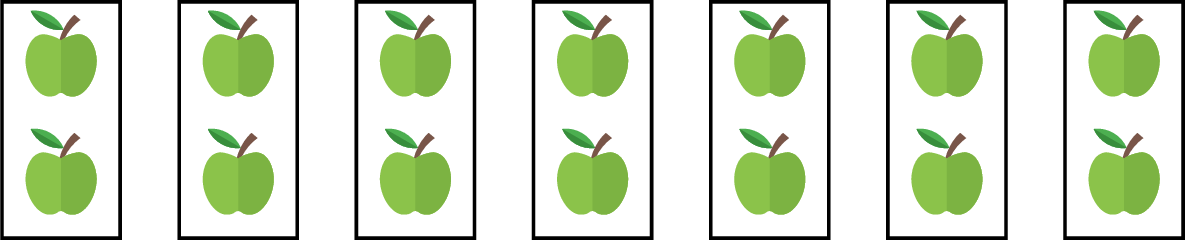
.How could we figure out how many apples he eats in one week (7 days)?
One way is to use repeated addition. We can add 2 apples for each of the 7 days:$$\textcolor{colorprop}{2}+\textcolor{colorprop}{2}+\textcolor{colorprop}{2}+\textcolor{colorprop}{2}+\textcolor{colorprop}{2}+\textcolor{colorprop}{2}+\textcolor{colorprop}{2} = 14$$This works, but it takes a long time to write. A much faster way is to use multiplication.
When we have \(\textcolor{colordef}{7}\) groups of \(\textcolor{colorprop}{2}\), we can write it as \(\textcolor{colordef}{7}\times \textcolor{colorprop}{2}\). The symbol \(\times\) means "times" or "groups of."$$\textcolor{colordef}{7}\times \textcolor{colorprop}{2} \quad \text{is the same as} \quad \textcolor{colorprop}{2}+\textcolor{colorprop}{2}+\textcolor{colorprop}{2}+\textcolor{colorprop}{2}+\textcolor{colorprop}{2}+\textcolor{colorprop}{2}+\textcolor{colorprop}{2}$$
When we have \(\textcolor{colordef}{7}\) groups of \(\textcolor{colorprop}{2}\), we can write it as \(\textcolor{colordef}{7}\times \textcolor{colorprop}{2}\). The symbol \(\times\) means "times" or "groups of."$$\textcolor{colordef}{7}\times \textcolor{colorprop}{2} \quad \text{is the same as} \quad \textcolor{colorprop}{2}+\textcolor{colorprop}{2}+\textcolor{colorprop}{2}+\textcolor{colorprop}{2}+\textcolor{colorprop}{2}+\textcolor{colorprop}{2}+\textcolor{colorprop}{2}$$
Definition Multiplication
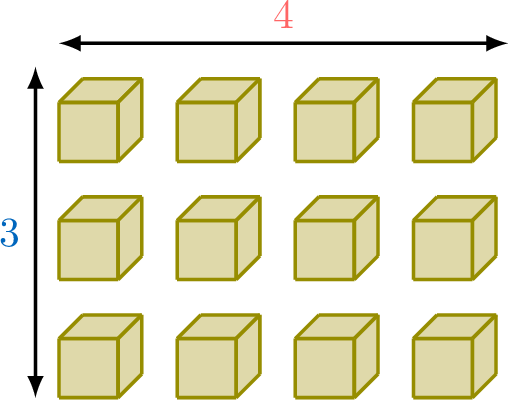
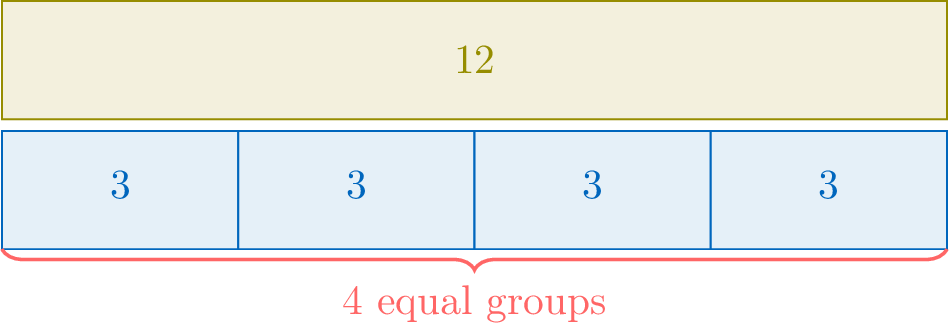
Multiplication is a fast way to show repeated addition. We can show the idea of "four times three equals twelve" in many different ways:
- With Numbers: $$\textcolor{colordef}{4}\times \textcolor{colorprop}{3}=\textcolor{olive}{12}$$
- In Groups: $$\textcolor{colordef}{4}\text{ groups of }\textcolor{colorprop}{3}=\textcolor{olive}{12}$$
- As Repeated Addition: $$\textcolor{colorprop}{3}+\textcolor{colorprop}{3}+\textcolor{colorprop}{3}+\textcolor{colorprop}{3}=\textcolor{olive}{12}$$
- With Cubes:
- With a Part-Whole Model:
Example
Write the repeated addition \(\textcolor{colorprop}{5}+\textcolor{colorprop}{5}+\textcolor{colorprop}{5}\) as a multiplication.
We are adding the number 5, and we are adding it 3 times. So, the multiplication is:$$ \textcolor{colordef}{3}\times \textcolor{colorprop}{5}$$
On the Number Line
Let's consider the multiplication: \(\textcolor{colordef}{4} \times \textcolor{colorprop}{3}\) that is:$$\textcolor{colorprop}{3}+\textcolor{colorprop}{3}+\textcolor{colorprop}{3}+\textcolor{colorprop}{3}$$We can visualize this on a number line:
Method Multiplication on the Number Line
We can show multiplication as "jumps" on a number line. To show \(\textcolor{colordef}{4} \times \textcolor{colorprop}{3}\), we can start at 0 and make \(\textcolor{colordef}{4}\) jumps of size \(\textcolor{colorprop}{3}\).
Multiplication in Word Problems
Method Finding the Total with Groups
In word problems, we can find the total by multiplying the number of groups by the number of items in each group.$$\textcolor{colordef}{\text{Number of groups}} \times \textcolor{colorprop}{\text{Number in each group}} =\textcolor{olive}{\text{Total}}$$For example, if there are \(\textcolor{colordef}{3}\) bags and each bag has \(\textcolor{colorprop}{2}\) apples, the total number of apples is:$$\textcolor{colordef}{3} \times \textcolor{colorprop}{2} = \textcolor{olive}{6}$$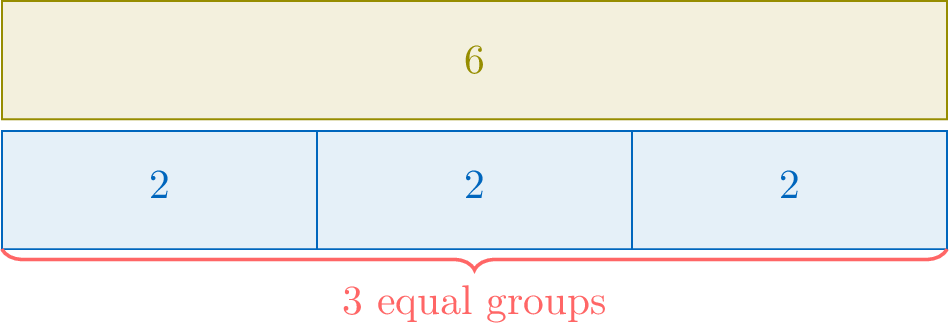
Does the Order Matter?
Proposition Commutative Property
In multiplication, changing the order of the numbers does not change the result.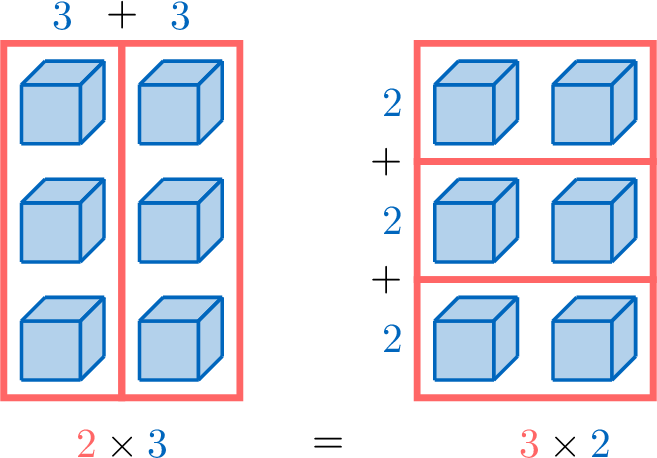
Decompose with Addition
Let's solve a tricky multiplication problem. We need to find the total for 7 groups of 6 cubes, which is \(7 \times 6\).
Multiplying by 7 can be tricky. But multiplying by 5 is easy! We know that: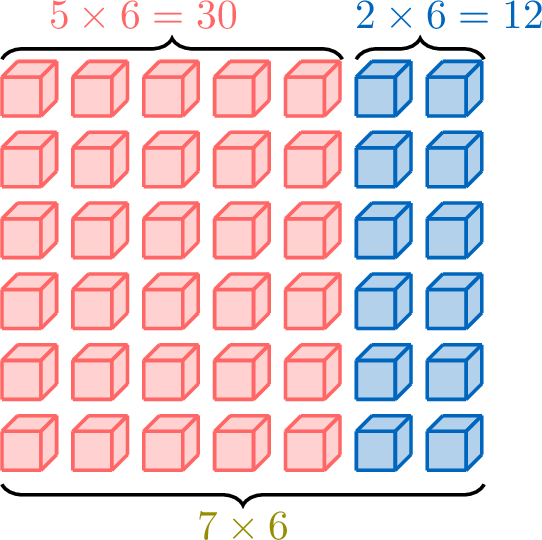
Multiplying by 7 can be tricky. But multiplying by 5 is easy! We know that:
- 5 groups of 6 cubes have 30 cubes (\(5 \times 6 = 30\)).
- 2 groups of 6 cubes have 12 cubes (\(2 \times 6 = 12\)).
Since 7 groups is just 5 groups plus 2 more groups, we can simply add their totals together!$$\begin{aligned}[t]\text{Total for 7 groups} &= (\text{Total for 5 groups}) + (\text{Total for 2 groups})\\
7 \times 6&= (5 \times 6) + (2 \times 6)\\
&=30+12\\
&=42\end{aligned}$$So, there are 42 cubes in total.
Method The "Break Apart" Strategy
This powerful strategy is called the distributive property. It means you can "break apart" a difficult multiplication into two easier ones, and then add the results.
For example, to solve \(7 \times 6\), we can break the 7 into a 5 and a 2:$$\begin{aligned}[t]\text{Total for 7 groups} &= (\text{Total for 5 groups}) + (\text{Total for 2 groups})\\ 7 \times 6&= (5 \times 6) + (2 \times 6)\\ &=30+12\\ &=42\end{aligned}$$
For example, to solve \(7 \times 6\), we can break the 7 into a 5 and a 2:$$\begin{aligned}[t]\text{Total for 7 groups} &= (\text{Total for 5 groups}) + (\text{Total for 2 groups})\\ 7 \times 6&= (5 \times 6) + (2 \times 6)\\ &=30+12\\ &=42\end{aligned}$$
Decompose with Subtraction
Let's try another problem: \(9 \times 8\).Multiplying by 9 can be tricky. But multiplying by 10 is easy! We know that: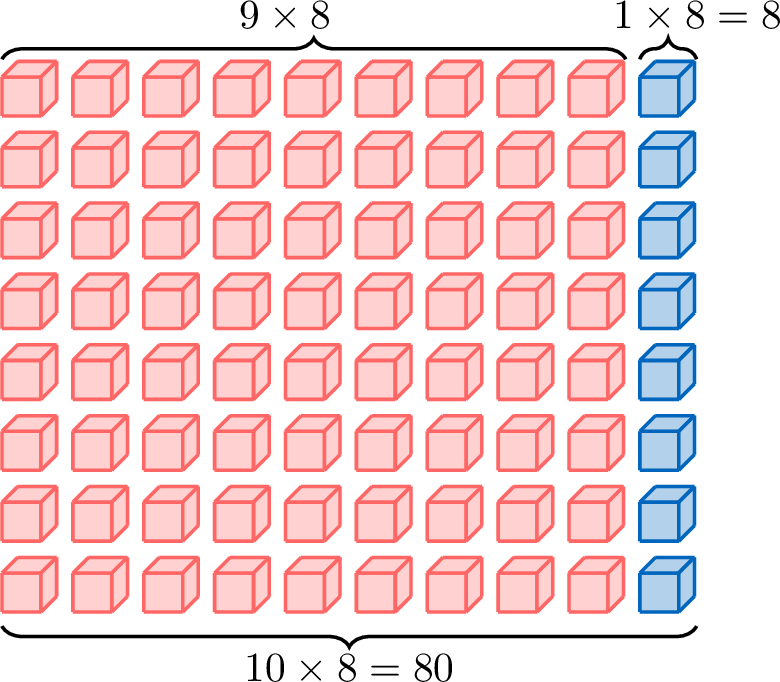
- 10 groups of 8 cubes have 80 cubes (\(10 \times 8 = 80\)).
- 1 groups of 8 cubes have a 8 cubes (\(1 \times 8 = 8\)).
Since 9 groups is just 1 group less than 10 groups, we can start with the total for 10 groups and simply subtract the one extra group.$$\begin{aligned}[t]\text{Total for 9 groups} &= (\text{Total for 10 groups}) - (\text{Total for 1 group})\\
9 \times 8 &= (10 \times 8) - (1 \times 8) \\
&= 80 - 8 \\
&= 72\end{aligned}$$So, there are 72 cubes in total.
Method Using Subtraction to Break Apart
This is another way to use the distributive property. It's very useful when multiplying by numbers that are close to a multiple of ten (like 8, 9, 18, or 19).To solve \(9 \times 8\), you can think of 9 as \((10 - 1)\):$$\begin{aligned}[t]\text{Total for 9 groups} &= (\text{Total for 10 groups}) - (\text{Total for 1 group})\\
9 \times 8 &= (10 \times 8) - (1 \times 8) \\
&= 80 - 8 \\
&= 72\end{aligned}$$