Subtraction Within 20
What is Subtraction?
Imagine you have some toys, but then you give some away. The number of toys you have has become less. This process of "taking away" is called subtraction!
Let's try it. If you have 13 blocks and you give 5 away, how many blocks do you have left? 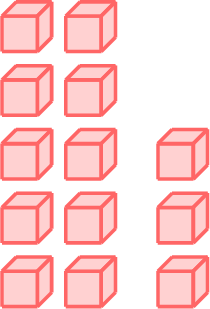 \(-\)
\(-\)  \(=\)
\(=\) 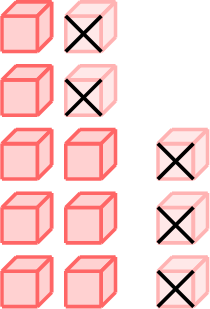
Let's count what is left. You have 8 blocks left!
Let's try it. If you have 13 blocks and you give 5 away, how many blocks do you have left?
\(-\) \(=\)
Definition Subtraction
Subtraction means taking an amount away from a group to find out what is left. This result is called the difference.
- The minus sign (\(-\)) tells us to subtract.
- The equals sign (\(=\)) shows that both sides have the same value.
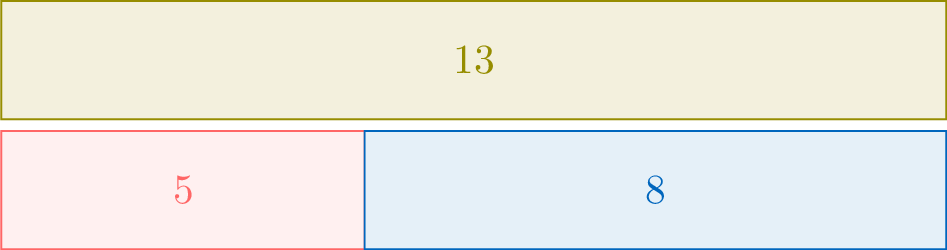
- With number: $$13 - 5 = 8$$
- With cubes: \(-\) \(=\)
- With part-whole model:
Method Subtracting by Counting Back
A great way to subtract is by "Counting Back." You start with the first number and then count backward.
Let's solve: \(13 - 5 = ?\) \(13 - 5 = 8\)
Let's solve: \(13 - 5 = ?\)
- Step 1: Start with the first number. Keep the number 13 in your head and say it out loud: "Thirteen."
- Step 2: Get your fingers ready. The second number, 5, tells you how many steps to count back. Hold up 5 fingers to keep track of your steps.

- Step 3: Count back from 13. Now, put down one finger for each number you say as you count backward: "Twelve, eleven, ten, nine, eight!"
- Say "Twelve" \(\rightarrow\) Put down 1st finger.
- Say "Eleven" \(\rightarrow\) Put down 2nd finger.
- Say "Ten" \(\rightarrow\) Put down 3rd finger.
- Say "Nine" \(\rightarrow\) Put down 4th finger.
- Say "Eight!" \(\rightarrow\) Put down 5th finger.
Subtracting on the Number Line
Method Using a Number Line to Subtract
We can also use a number line to subtract. Subtraction is like taking steps backward on a path.
Let's solve: \(7 - 3\)
Let's solve: \(7 - 3\)
- Start at the first number. Find the number 7 on the number line. This is your starting point.
- Jump backward. The second number, 3, tells you how many jumps to make. Since we are subtracting, we move to the left, where the numbers get smaller. Make 3 jumps backward.
- Find your landing spot. The number you land on is the answer.
The "Subtract to Make 10" Strategy
Method Subtracting by Making a Ten
The "Make a Ten" strategy is a powerful way to subtract. We break the subtraction into two smaller, easier steps: first, we jump back to 10, and then we subtract the rest.
Let's solve: \(13 - 5\) \(-\)  \(=\) \(-\)
  \(-\)
\(-\) 
\(\quad\)
 \(\textcolor{white}{-}\)
  \(=\)
\(=\) 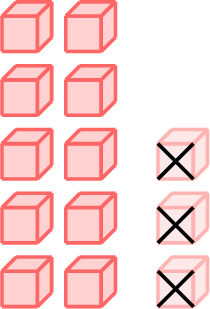 \(-\)
\(-\)
\(\quad\)
\(\textcolor{white}{-}\) \(=\)
By breaking 5 into 3 and 2, we can solve the problem easily:$$\begin{aligned}13 - 5 &= 13 - 3 - 2\\ &= 10 - 2\\ &= 8\end{aligned}$$So, \(13 - 5 = 8\).
Let's solve: \(13 - 5\)
- Start at the first number, which is 13.
- Jump back to 10. How many steps do we take to get from 13 to 10? We take 3 steps back.
- Figure out the rest. We needed to subtract a total of 5. We already subtracted 3. How many more do we need to subtract? We can break 5 into 3 and 2 (\(5 = 3 + 2\)). So, we still need to subtract 2 more.
- Take the final jump. From 10, jump back 2 more steps. You land on 8!
\(-\) \(=\) \(-\) \(-\) \(\quad\)
\(\textcolor{white}{-}\) \(=\) \(-\) \(\quad\)
\(\textcolor{white}{-}\) \(=\) By breaking 5 into 3 and 2, we can solve the problem easily:$$\begin{aligned}13 - 5 &= 13 - 3 - 2\\ &= 10 - 2\\ &= 8\end{aligned}$$So, \(13 - 5 = 8\).