Addition Within 20
What is Addition?
Imagine you have a collection of toys, and then you get even more. The total number of toys you have increases. This process of joining groups together is called addition!
Let's try it with a bigger number. If you have 8 red blocks and your friend gives you 6 blue blocks, how many blocks do you have now? 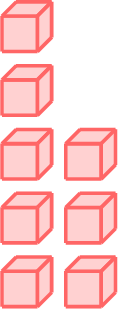 \(+\)
\(+\)  \(=\)
\(=\) 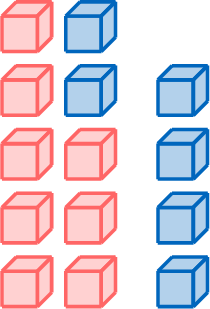
Let's count them all together... one, two, three... all the way to fourteen. You have 14 blocks in total!
Let's try it with a bigger number. If you have 8 red blocks and your friend gives you 6 blue blocks, how many blocks do you have now?
\(+\) \(=\)
Definition Addition
Addition is joining groups together to find the total, called sum.
In mathematics, we use symbols to write this down:
In mathematics, we use symbols to write this down:
- The plus sign (\(+\)) means to add.
- The equals sign (\(=\)) shows that what is on one side is the same amount as what is on the other side.
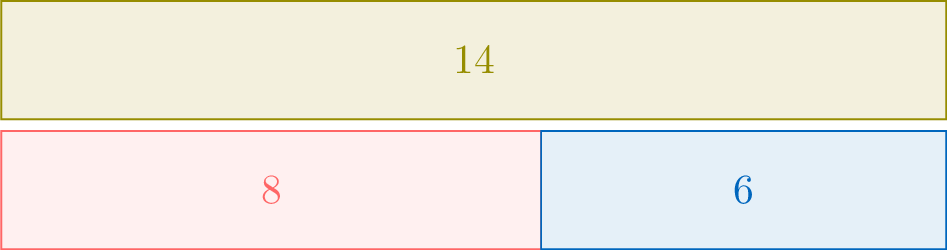
- With numbers: $$\textcolor{colordef}{8} + \textcolor{colorprop}{6} = \textcolor{olive}{14}$$
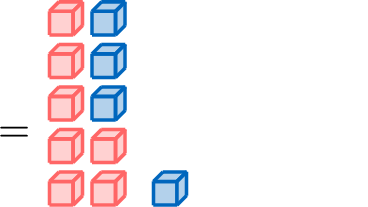
- With Cubes: \(+\) \(=\)
- With a part-whole model:
Method Counting On
Let's solve: \(8 + 6 = ?\) \(8 + 6 = 14\)
- Step 1: Start with the bigger number. The bigger number is 8. Keep this number in your head and say it out loud: "Eight..."
- Step 2: Get your fingers ready. The second number is 6. This is the number of steps we will count on. Hold up 6 fingers to keep track.

- Step 3: Count on from 8. Now, touch each of your 6 fingers one by one as you continue counting up from 8: "Nine, ten, eleven, twelve, thirteen, fourteen!"
Adding on the Number Line
Method Using a Number Line to Add
A number line is a great tool for visualizing addition. It's like taking steps on a path.
Let's solve: \(3 + 5\)
Let's solve: \(3 + 5\)
- Start at the first number. Find the number 3 on the number line. This is your starting point.
- Jump forward. The second number, 5, tells you how many jumps to make. Since we are adding, we move to the right, where the numbers get bigger. Make 5 jumps.
- Find your landing spot. The number you land on is the answer.
The "Make a Ten" Strategy
Method Adding by Making a Ten
The "Make a Ten" strategy is a smart way to add numbers. We build a group of 10 first, which makes adding the rest much easier.
Let's solve: \(\textcolor{colordef}{7}+\textcolor{colorprop}{4}\)
\(\quad\)
Let's solve: \(\textcolor{colordef}{7}+\textcolor{colorprop}{4}\)
- Start with the first number. We have 7 cubes.
- Find the complement to 10. How many more cubes do we need to make a full ten? We need 3 more.
- Break apart the second number. We can break the \textcolor{colorprop}{4} cubes into a group of \textcolor{colorprop}{3} (to complete our ten) and a group of \textcolor{colorprop}{1} (which is left over).
- Make a ten and add the rest. We join the 7 and 3 to make 10, and then add the leftover 1.
\(\quad\)