Vector Product
While the scalar product of two vectors results in a scalar, there is a second form of product, defined only in three dimensions, called the vector product or cross product. Given two vectors in three-dimensional space, this operation produces a third vector that is perpendicular to both of the original vectors. The cross product is a fundamental tool in physics (for example, in torque and angular momentum) and in mathematics (for calculating areas, volumes, and describing geometric orientations).
Definition
The vector product arises from the problem of finding a vector that is simultaneously perpendicular to two other given vectors. Unlike the scalar product, the vector product is defined exclusively for vectors in three-dimensional space.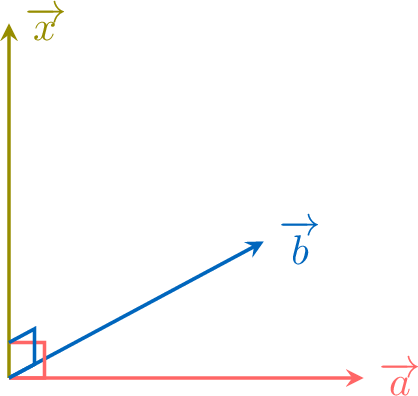
Definition Vector (Cross) Product
The vector product of two vectors in space \(\Vect{a} = \begin{pmatrix} a_1 \\ a_2 \\ a_3 \end{pmatrix}\) and \(\Vect{b} = \begin{pmatrix} b_1 \\ b_2 \\ b_3 \end{pmatrix}\) is defined as:$$\Vect{a} \times \Vect{b} =\begin{pmatrix} a_2b_3 - a_3b_2 \\
a_3b_1 - a_1b_3 \\
a_1b_2 - a_2b_1\end{pmatrix}$$The result \(\Vect{a} \times \Vect{b}\) is a vector in three-dimensional space that is perpendicular to both \(\Vect{a}\) and \(\Vect{b}\).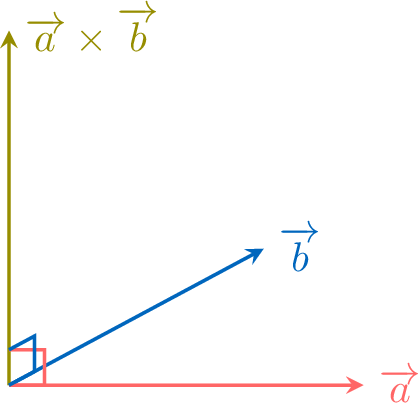
Geometric Interpretation
Proposition Right-Hand Rule
The direction of the vector product \(\textcolor{colordef}{\Vect{a}} \times \textcolor{colorprop}{\Vect{b}}\) is determined by the right-hand rule. If you curl the fingers of your right hand in the direction from vector \(\textcolor{colordef}{\Vect{a}}\) to vector \(\textcolor{colorprop}{\Vect{b}}\), your thumb will point in the direction of \(\textcolor{colordef}{\Vect{a}} \times \textcolor{colorprop}{\Vect{b}}\).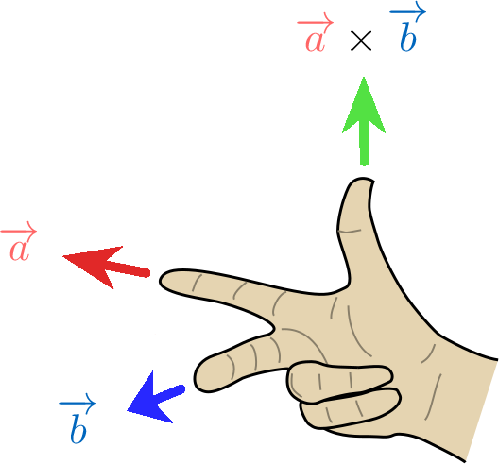
Proposition Magnitude Formulas
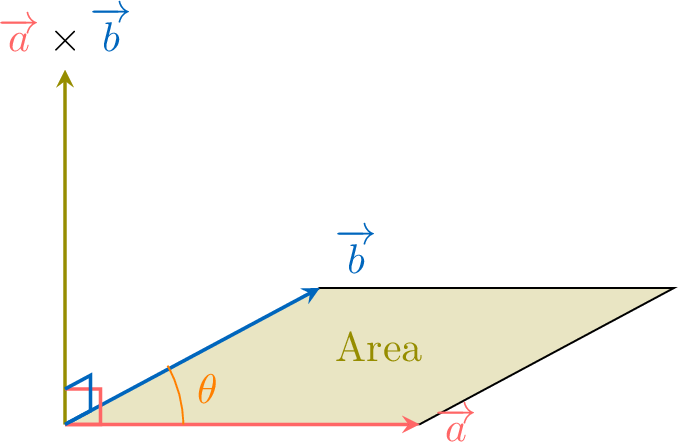
- The magnitude (or length) of the vector product is given by:$$|\textcolor{colordef}{\Vect{a}} \times \textcolor{colorprop}{\Vect{b}}|= |\textcolor{colordef}{\Vect{a}}|\,|\textcolor{colorprop}{\Vect{b}}| \sin\textcolor{orange}{\theta}$$where \(\textcolor{orange}{\theta}\) is the angle between vectors \(\textcolor{colordef}{\Vect{a}}\) and \(\textcolor{colorprop}{\Vect{b}}\), with \(0 \le \theta \le \pi\).
- Geometrically, the magnitude of the cross product equals the area of the parallelogram with sides represented by \(\textcolor{colordef}{\Vect{a}}\) and \(\textcolor{colorprop}{\Vect{b}}\):$$|\textcolor{colordef}{\Vect{a}} \times \textcolor{colorprop}{\Vect{b}}|= \textcolor{olive}{\text{Area}}.$$Consequently, the area of the triangle formed by \(\textcolor{colordef}{\Vect{a}}\) and \(\textcolor{colorprop}{\Vect{b}}\) is\(\dfrac12 |\textcolor{colordef}{\Vect{a}} \times \textcolor{colorprop}{\Vect{b}}|\).