Sine and Cosine Functions
Trigonometric functions are real-valued functions that relate the measure of an angle in a right triangle to the ratios of two of its sides. They play a fundamental role in geometry and are widely used in many scientific fields, such as navigation, mechanics, astronomy, geodesy, and more. Trigonometric functions are also among the simplest examples of periodic functions, making them essential for modeling periodic phenomena (such as waves) and for applications like Fourier analysis.
Sine and Cosine Functions
Definition Periodic Function
A function \(f\) is periodic if there exists a constant \(P>0\) such that$$f(x+P) = f(x), \forall x$$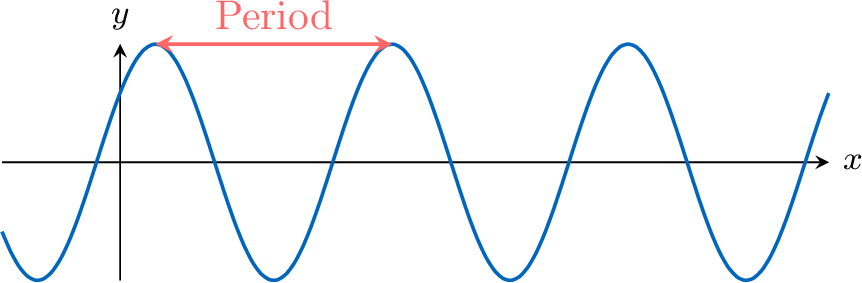
Let \(M(\cos x, \sin x)\) be the point on the unit circle corresponding to an angle \(x\) (in radians).
See for example: \href{https://www.geogebra.org/m/j7w29vj4}{GeoGebra demo}.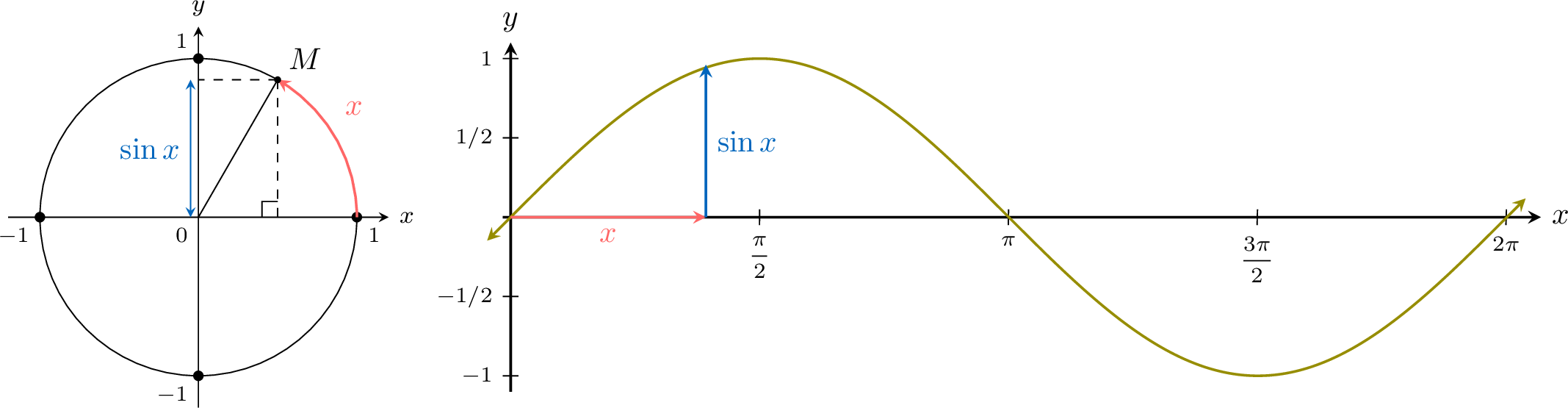
- The angle \(x\) on the unit circle corresponds to the input for the sine function.
- The \(y\)-coordinate of point \(M\) on the unit circle, \(\sin x\), gives the output of the sine function.
See for example: \href{https://www.geogebra.org/m/j7w29vj4}{GeoGebra demo}.
Definition Sine Function
The sine function, denoted \(\sin\), is defined by \(x\mapsto \sin(x)\), where \(x\) is interpreted as an angle in radians.
Example
Complete the following table with the values of the sine function at key angles:
| \(x\) | 0 | \(\dfrac{\pi}{6}\) | \(\dfrac{\pi}{4}\) | \(\dfrac{\pi}{3}\) | \(\dfrac{\pi}{2}\) | \(\dfrac{2 \pi}{3}\) | \(\dfrac{3 \pi}{4}\) | \(\dfrac{5 \pi}{6}\) | \(\pi\) |
| \(\sin (x)\) |
| \(x\) | 0 | \(\dfrac{\pi}{6}\) | \(\dfrac{\pi}{4}\) | \(\dfrac{\pi}{3}\) | \(\dfrac{\pi}{2}\) | \(\dfrac{2 \pi}{3}\) | \(\dfrac{3 \pi}{4}\) | \(\dfrac{5 \pi}{6}\) | \(\pi\) |
| \(\sin (x)\) | 0 | \(\dfrac{1}{2}\) | \(\dfrac{\sqrt{2}}{2}\) | \(\dfrac{\sqrt{3}}{2}\) | 1 | \(\dfrac{\sqrt{3}}{2}\) | \(\dfrac{\sqrt{2}}{2}\) | \(\dfrac{1}{2}\) | \(0\) |
If we instead project the values of \(\cos x\) from the unit circle onto a graph, we obtain the graph of the cosine function \(x \mapsto \cos x\).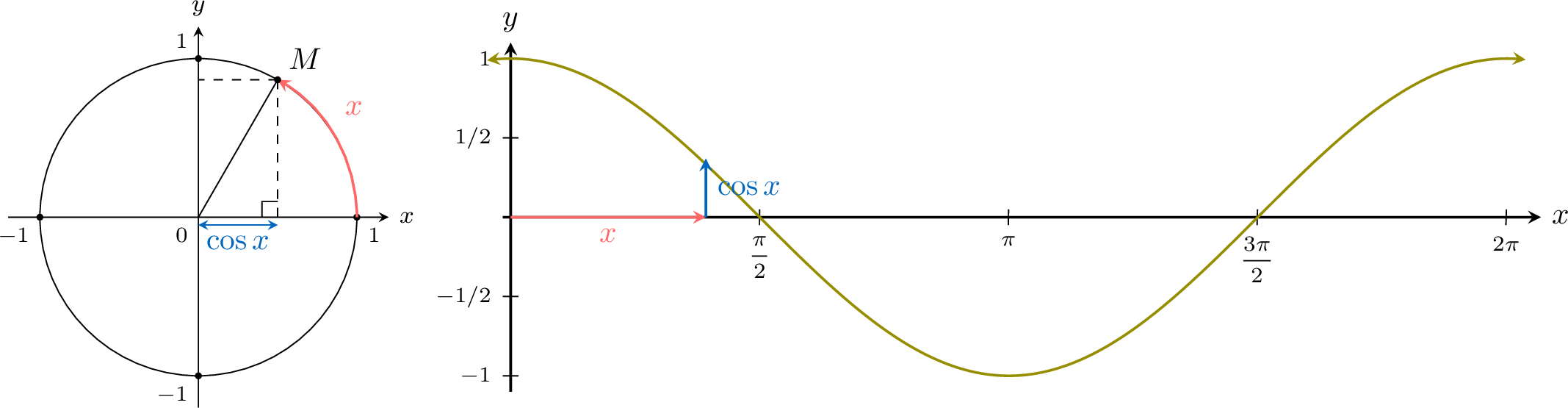
Definition Cosine Function
The cosine function, denoted \(\cos\), is defined by \(x\mapsto\cos(x)\), where \(x\) is interpreted as an angle in radians.
Example
Complete the following table with the values of the cosine function at key angles:
| \(x\) | 0 | \(\dfrac{\pi}{6}\) | \(\dfrac{\pi}{4}\) | \(\dfrac{\pi}{3}\) | \(\dfrac{\pi}{2}\) | \(\dfrac{2 \pi}{3}\) | \(\dfrac{3 \pi}{4}\) | \(\dfrac{5 \pi}{6}\) | \(\pi\) |
| \(\cos (x)\) |
| \(x\) | \(0\) | \(\dfrac{\pi}{6}\) | \(\dfrac{\pi}{4}\) | \(\dfrac{\pi}{3}\) | \(\dfrac{\pi}{2}\) | \(\dfrac{2 \pi}{3}\) | \(\dfrac{3 \pi}{4}\) | \(\dfrac{5 \pi}{6}\) | \(\pi\) |
| \(\cos (x)\) | \(1\) | \(\dfrac{\sqrt{3}}{2}\) | \(\dfrac{\sqrt{2}}{2}\) | \(\dfrac{1}{2}\) | \(0\) | \(-\dfrac{1}{2}\) | \(-\dfrac{\sqrt{2}}{2} \) | \(-\dfrac{\sqrt{3}}{2}\) | \(-1\) |
Proposition Properties of Sine and Cosine
- Periodicity: Both functions are periodic with a period of \(2\pi\). \(\sin(x+2\pi) = \sin(x)\) and \(\cos(x+2\pi) = \cos(x)\).
- Domain and Range: The domain is \(\mathbb{R}\). The range is \([-1, 1]\).
- Symmetry: Cosine is an even function (\(\cos(-x)=\cos(x)\)). Sine is an odd function (\(\sin(-x)=-\sin(x)\)).
- Amplitude: The amplitude of the base functions is 1.
Solving Trigonometric Equations
Method Solving a Trigonometric Equation
- Use identities to simplify the equation into a form involving a single trigonometric function, e.g., \(\sin(X)=k\).
- Find the principal value (the first solution) using an inverse function, \(X = \arcsin(k)\).
- Use the symmetry and periodicity of the function to find all solutions within one period.
- Add multiples of the period (\(2k\pi\) or \(k\pi\)) to find the general solution or all solutions in a specified domain.
Example
Find the general solution to the equation \(2\sin(3x) = \sqrt{3}\), and hence find all solutions in the interval \(0 \le x \le \pi\).
- Simplify the equation: We first isolate the trigonometric function. $$ \sin(3x) = \frac{\sqrt{3}}{2} $$ Let \(u = 3x\). We are now solving \(\sin(u) = \frac{\sqrt{3}}{2}\).
- Find the principal value: The first solution for \(u\) is the principal value: $$ u = \arcsin\left(\frac{\sqrt{3}}{2}\right) = \frac{\pi}{3} $$
- Find all solutions for \(u\) in one period: For the sine function, a second solution exists at \(\pi - u\). $$ \text{Second solution: } u = \pi - \frac{\pi}{3} = \frac{2\pi}{3} $$
- Find the general solution for \(u\): Since the period of sine is \(2\pi\), we add multiples of \(2\pi\) to our initial solutions. Let \(k\) be any integer (\(k \in \mathbb{Z}\)). $$ u = \frac{\pi}{3} + 2k\pi \quad \text{or} \quad u = \frac{2\pi}{3} + 2k\pi $$
- Solve for \(x\): Now we substitute back \(u=3x\) to find the general solution for \(x\). $$ 3x = \frac{\pi}{3} + 2k\pi \implies \boldsymbol{x = \frac{\pi}{9} + \frac{2k\pi}{3}} $$ $$ 3x = \frac{2\pi}{3} + 2k\pi \implies \boldsymbol{x = \frac{2\pi}{9} + \frac{2k\pi}{3}} $$
- Find solutions in the specified domain \(0 \le x \le \pi\): We test integer values for \(k\).
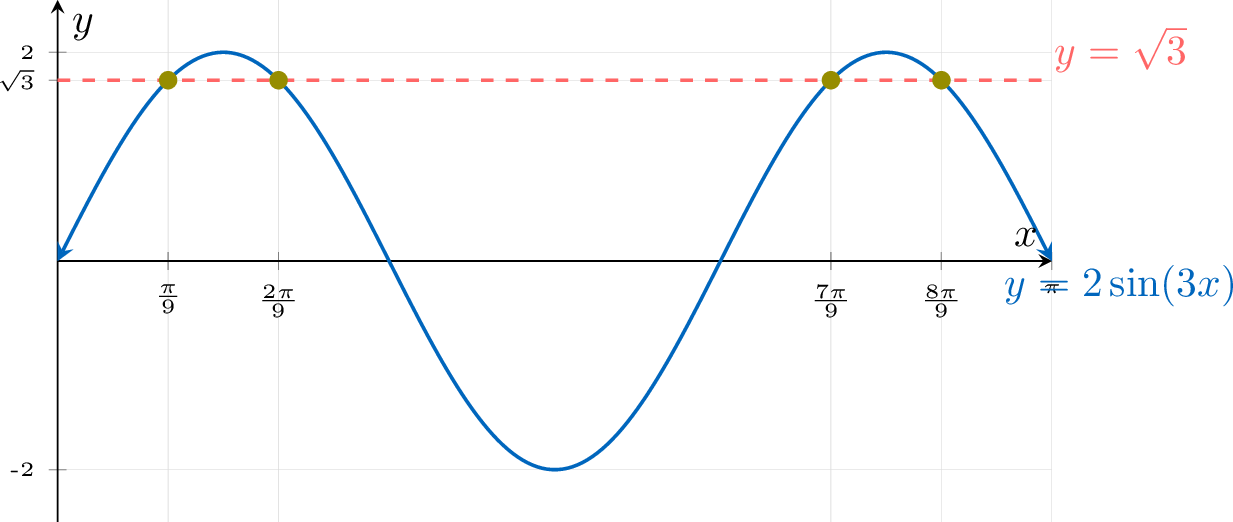
- For \(k=0\): \(x = \frac{\pi}{9}\) and \(x = \frac{2\pi}{9}\). (Both are in the domain)
- For \(k=1\): \(x = \frac{\pi}{9} + \frac{2\pi}{3} = \frac{7\pi}{9}\) and \(x = \frac{2\pi}{9} + \frac{2\pi}{3} = \frac{8\pi}{9}\). (Both are in the domain)
- For \(k=2\): \(x = \frac{\pi}{9} + \frac{4\pi}{3} = \frac{13\pi}{9}\). (This is outside the domain \(x \le \pi\))
- We can verify our solutions by plotting the graphs of \(y=2\sin(3x)\) and \(y=\sqrt{3}\) on the same set of axes for the domain \(0 \le x \le \pi\). The x-coordinates of the intersection points correspond to the solutions of the equation.
Differentiation
Proposition Fundamental Trigonometric Limits
For all \(x \in \mathbb{R}\):$$ \lim_{x \to 0} \dfrac{\sin(x)}{x} = 1 \quad \text{and} \quad \lim_{x \to 0} \dfrac{\cos(x)-1}{x} = 0 $$
Proposition Derivatives of Sine and Cosine
The functions sine and cosine are differentiable on \(\mathbb{R}\). For all \(x \in \mathbb{R}\):$$ \sin'(x) = \cos(x) \quad \text{and} \quad \cos'(x) = -\sin(x) $$
We evaluate the derivative of \(f(x) = \sin(x)\) using the limit definition and the sum-to-product identity \(\sin(A)-\sin(B) = 2\cos(\frac{A+B}{2})\sin(\frac{A-B}{2})\):$$ \begin{aligned}\dfrac{\sin(x+h)-\sin(x)}{h} &= \dfrac{2\cos\left(\frac{x+h+x}{2}\right)\sin\left(\frac{x+h-x}{2}\right)}{h} \\
&= \dfrac{2\cos\left(x+\frac{h}{2}\right)\sin\left(\frac{h}{2}\right)}{h} \\
&= \cos\left(x+\frac{h}{2}\right) \cdot \dfrac{\sin\left(\frac{h}{2}\right)}{\frac{h}{2}}\end{aligned} $$As \(h \to 0\), we know that \(x + \frac{h}{2} \to x\) and \(\displaystyle\lim_{h \to 0} \dfrac{\sin(h/2)}{h/2} = 1\). Therefore:$$ \lim_{h \to 0} \dfrac{\sin(x+h)-\sin(x)}{h} = \cos(x) \cdot 1 = \cos(x) $$The proof for \(\cos(x)\) is similar.
Proposition Variations of Sine and Cosine
Since the sine and cosine functions are \(2\pi\)-periodic, their study can be restricted to an interval of length \(2\pi\), such as \([-\pi, \pi]\). Their variations on this interval are given by the following tables: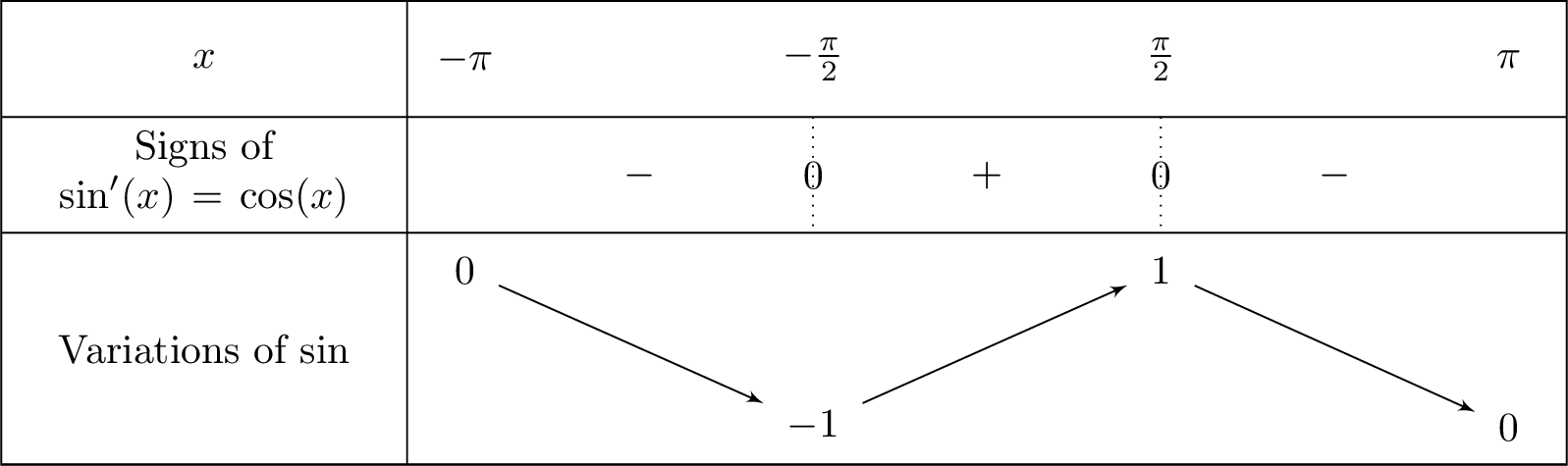
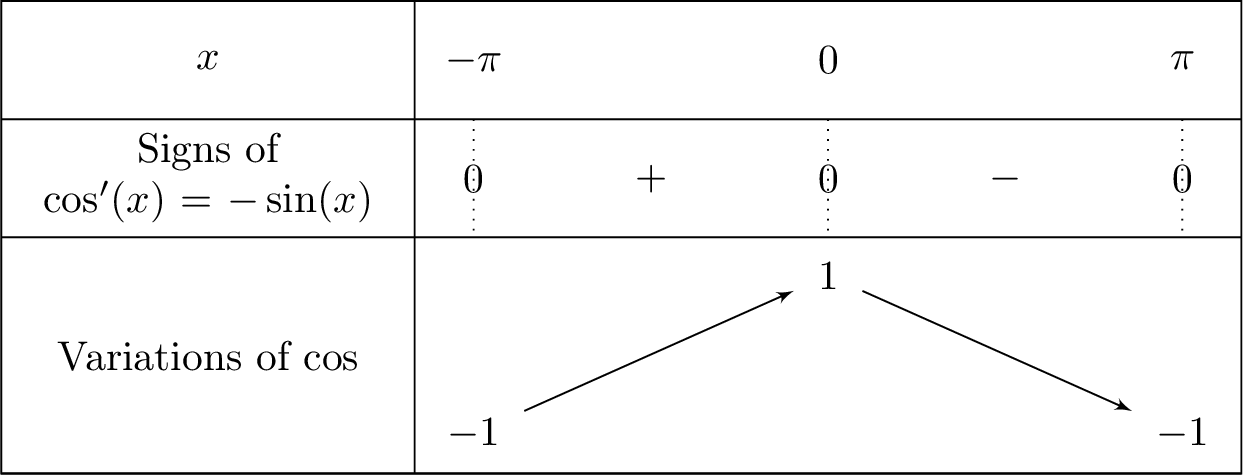
The variations are determined by the sign of the derivative functions:
- For sine: The derivative is \(\sin'(x) = \cos(x)\). On the interval \([-\pi, \pi]\), \(\cos(x)\) is positive on \([-\frac{\pi}{2}, \frac{\pi}{2}]\) and negative on \([-\pi, -\frac{\pi}{2}] \cup [\frac{\pi}{2}, \pi]\). Thus, \(\sin\) increases on \([-\frac{\pi}{2}, \frac{\pi}{2}]\) and decreases elsewhere.
- For cosine: The derivative is \(\cos'(x) = -\sin(x)\). On the interval \([-\pi, \pi]\), \(\sin(x)\) is negative on \([-\pi, 0]\) (so \(-\sin(x) > 0\)) and positive on \([0, \pi]\) (so \(-\sin(x) < 0\)). Thus, \(\cos\) increases on \([-\pi, 0]\) and decreases on \([0, \pi]\).
Proposition Chain Rule for Trigonometric Functions
Let \(u\) be a differentiable function on an interval \(I\).
- \((\sin(u(x)))' = u'(x)\cos(u(x))\)
- \((\cos(u(x)))' = -u'(x)\sin(u(x))\)
These formulas are a direct application of the general chain rule for composite functions:
- For sine: Let \(f(x) = \sin(x)\). Since \(f'(x) = \cos(x)\), then: $$ (\sin(u(x)))' = f'(u(x)) \times u'(x) = \cos(u(x)) \times u'(x) $$
- For cosine: Let \(g(x) = \cos(x)\). Since \(g'(x) = -\sin(x)\), then: $$ (\cos(u(x)))' = g'(u(x)) \times u'(x) = -\sin(u(x)) \times u'(x) $$
Example
Find the derivative of \(f(x) = \sin(3x)\).
Let the inner function be \(u(x)=3x\). The derivative is \(u'(x)=3\).$$\begin{aligned}f'(x) &= u'(x)\cos(u(x)) \\
&= 3\cos(3x)\end{aligned}$$