Curves
Equation of the Tangent
The most direct geometric interpretation of the derivative is that it gives the slope of the tangent line. Finding the equation of this line is a fundamental application of differentiation.
Proposition Equation of the Tangent
Assume \(f\) is differentiable at \(x=a\) and that the tangent is not vertical. Then the equation of the tangent to the curve \(y=f(x)\) at the point \((a, f(a))\) is:$$\textcolor{colorprop}{y = f^{\prime}(a)(x-a) +f(a)}$$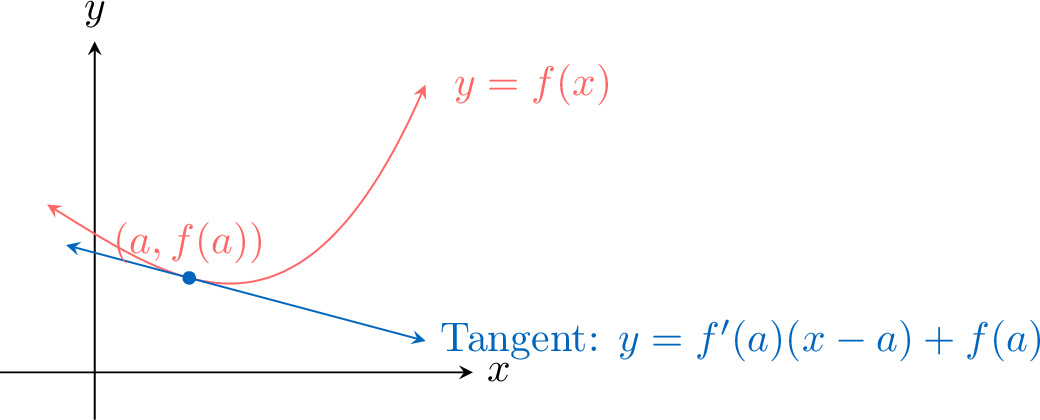
Let \(B(x,y)\) be any point on the tangent line. The point of tangency is \(A(a,f(a))\), which also belongs to the tangent line.
The slope of a line is given by the formula \(m = \dfrac{\Delta y}{\Delta x}\). Using points \(A\) and \(B\), the slope of the tangent line is:$$ m = \dfrac{y-f(a)}{x-a}\quad \text{for }x\neq a. $$By definition, the slope of the tangent to the curve \(y=f(x)\) at the point \(x=a\) is the value of the derivative at that point, so:$$ m = f'(a). $$Equating the two expressions for the slope, we get:$$ f'(a) = \dfrac{y-f(a)}{x-a}. $$Multiplying both sides by \((x-a)\) gives the point-slope form of the equation:$$ y - f(a) = f'(a)(x-a). $$This can be rearranged to the slope-intercept form:$$ y = f'(a)(x-a) + f(a). $$
The slope of a line is given by the formula \(m = \dfrac{\Delta y}{\Delta x}\). Using points \(A\) and \(B\), the slope of the tangent line is:$$ m = \dfrac{y-f(a)}{x-a}\quad \text{for }x\neq a. $$By definition, the slope of the tangent to the curve \(y=f(x)\) at the point \(x=a\) is the value of the derivative at that point, so:$$ m = f'(a). $$Equating the two expressions for the slope, we get:$$ f'(a) = \dfrac{y-f(a)}{x-a}. $$Multiplying both sides by \((x-a)\) gives the point-slope form of the equation:$$ y - f(a) = f'(a)(x-a). $$This can be rearranged to the slope-intercept form:$$ y = f'(a)(x-a) + f(a). $$
Example
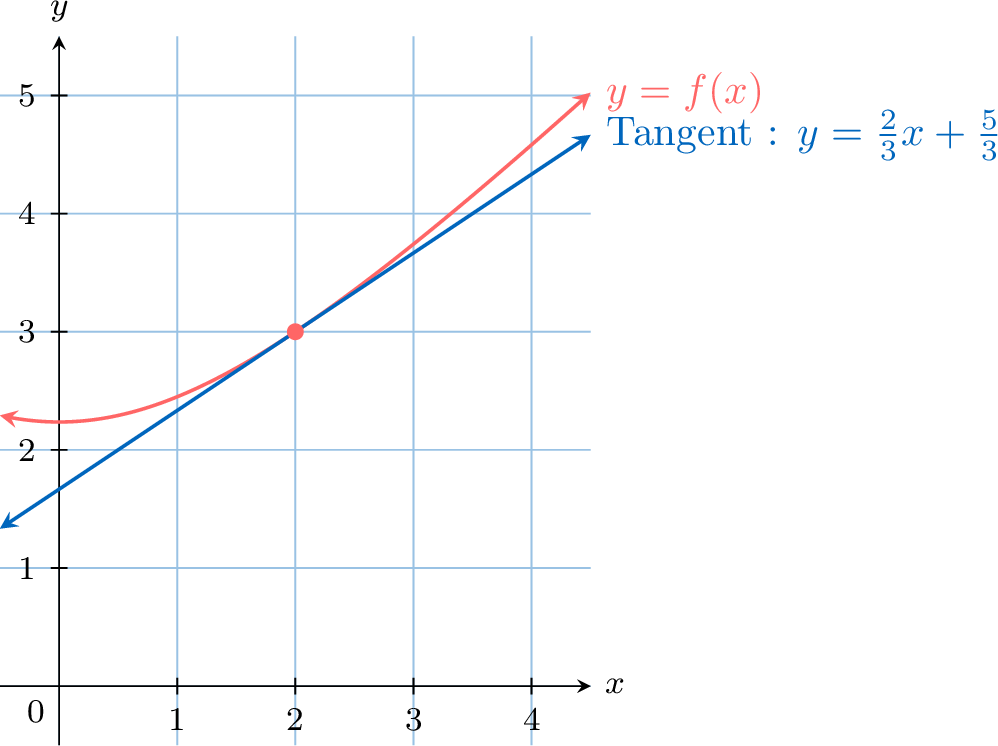
Find the equation of the tangent to \(f(x)=\sqrt{x^{2}+5}\) at \(x=2\).
- Step 1: Find the derivative.
First, rewrite the function as \(f(x) = (x^2+5)^{1/2}\). Using the chain rule: $$\begin{aligned} f'(x) &= \frac{1}{2}(x^2+5)^{-1/2} \cdot (2x)\\ &= \frac{x}{\sqrt{x^2+5}}\end{aligned}$$ - Step 2: Find the coordinates of the point.
At \(x=2\), the \(y\)-coordinate is \(f(2) = \sqrt{2^2+5} = \sqrt{9} = 3\). The point is \((2,3)\). - Step 3: Find the slope of the tangent.
The slope is the value of the derivative at \(x=2\): $$ m = f'(2) = \frac{2}{\sqrt{2^2+5}} = \frac{2}{3}. $$ - Step 4: Write the equation of the line.
$$\begin{aligned} y &= f'(2)(x-2) + f(2)\\ y&=\frac{2}{3}(x-2)+3\\ y &= \frac{2}{3}x + \frac{5}{3}.\\ \end{aligned} $$
Increasing and Decreasing Functions
When we draw the graph of a function, we may notice that the function is increasing or decreasing over particular intervals.
Definition Increasing and Decreasing Functions
Let \(I\) be an interval contained in the domain of a function \(f\).
- \(f\) is increasing on \(I\) if for all \(x_1, x_2 \in I\) such that \(x_1 < x_2\), we have \(f(x_1) < f(x_2)\).
- \(f\) is decreasing on \(I\) if for all \(x_1, x_2 \in I\) such that \(x_1 < x_2\), we have \(f(x_1) > f(x_2)\).
Example
The function \(f(x) = x^2\) is decreasing on the interval \((-\infty, 0)\) and increasing on the interval \((0, \infty)\).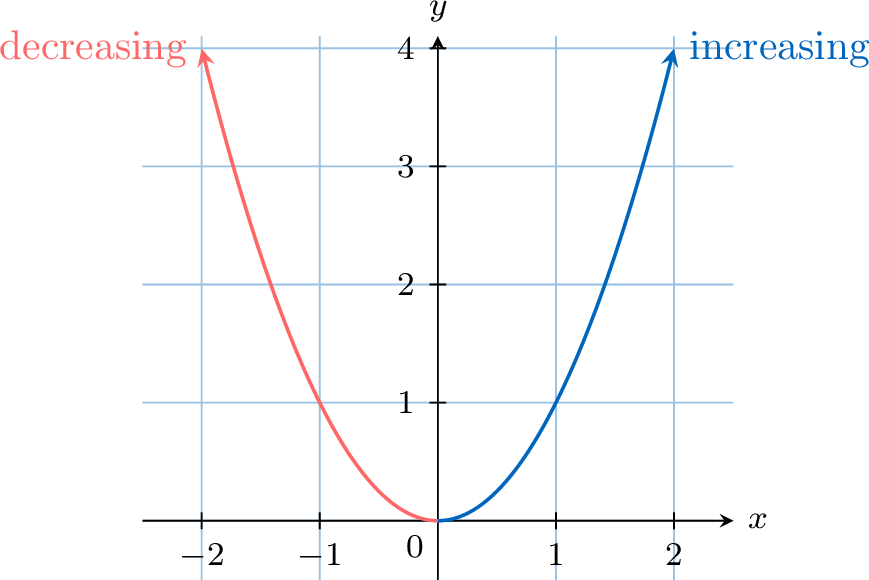
The derivative of a function, \(f'\), gives the slope of the tangent at any point on the curve \(y=f(x)\). This allows us to determine the intervals where the function is increasing or decreasing.
A function is increasing where the slope of its tangent is positive, and decreasing where the slope of its tangent is negative.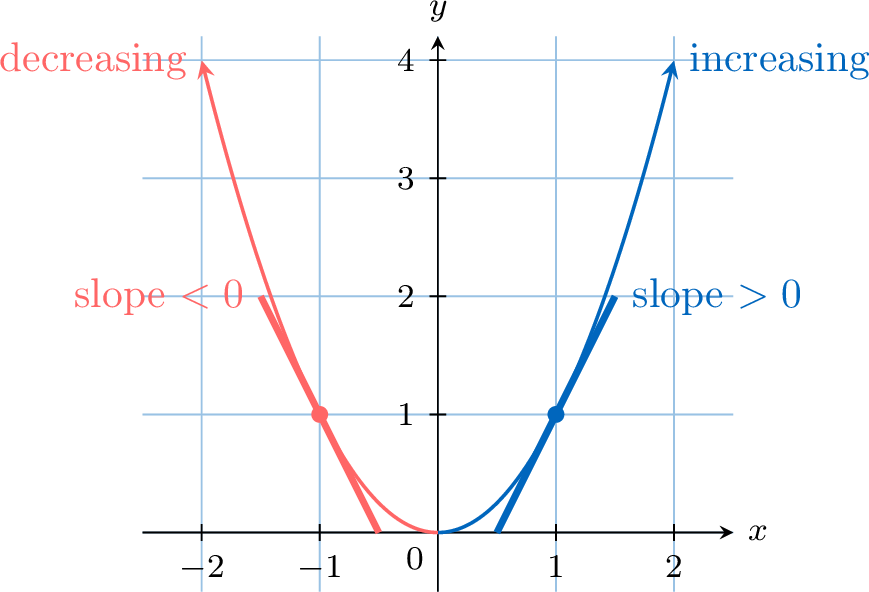
A function is increasing where the slope of its tangent is positive, and decreasing where the slope of its tangent is negative.
Proposition First Derivative Test
For a function \(f\) that is differentiable on an interval \(I\):
- If \(f'(x) > 0\) for all \(x \in I\), then \(f\) is increasing on \(I\).
- If \(f'(x) < 0\) for all \(x \in I\), then \(f\) is decreasing on \(I\).
Method Sign Diagram and Table of Variations
A sign diagram for the derivative, \(f'\), shows where the function is increasing or decreasing. This information is organized in a table of variations.
Example
Find the variations of the function \(f(x)=x^2\).
The derivative of the function \(f(x)=x^2\) is \(f'(x)=2x\).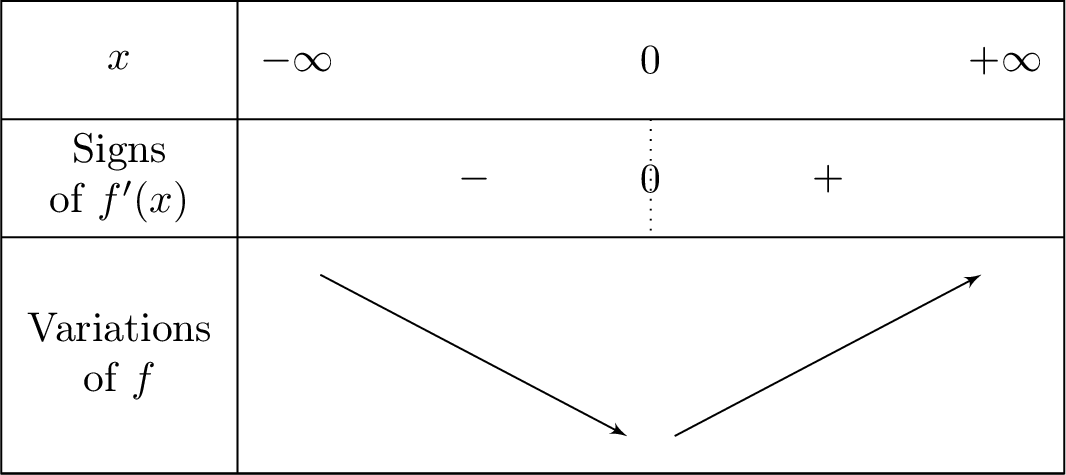
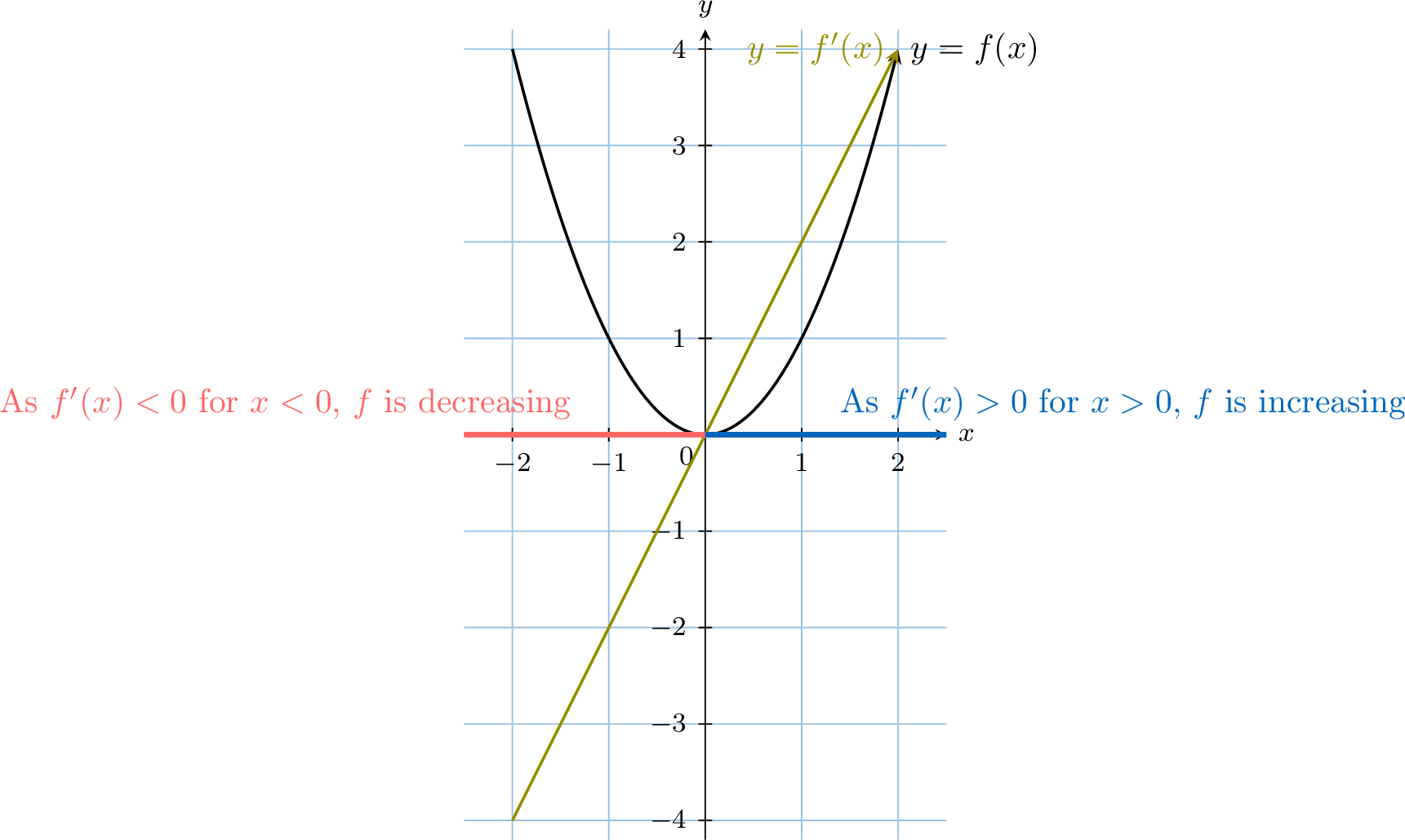
- The derivative \(f'(x)\) is negative on \((-\infty, 0)\), so the function \(f(x)\) is decreasing on \((-\infty, 0)\).
- The derivative \(f'(x)\) is positive on \((0,+\infty)\), so the function \(f(x)\) is increasing on \((0,+\infty)\).
Extrema of Functions
Definition Global Extrema
Let \(f\) be a function with domain \(D\).
- \(f\) has a global maximum at \(x=c\) if \(f(c) \ge f(x)\) for all \(x\) in \(D\). The value \(f(c)\) is the maximum value of \(f\).
- \(f\) has a global minimum at \(x=c\) if \(f(c) \le f(x)\) for all \(x\) in \(D\). The value \(f(c)\) is the minimum value of \(f\).
Example
For \(f(x)=(x-1)^2-1\), the point \((1,-1)\) is a global minimum, since \(f(x) \ge f(1)\) for all \(x \in \mathbb{R}\).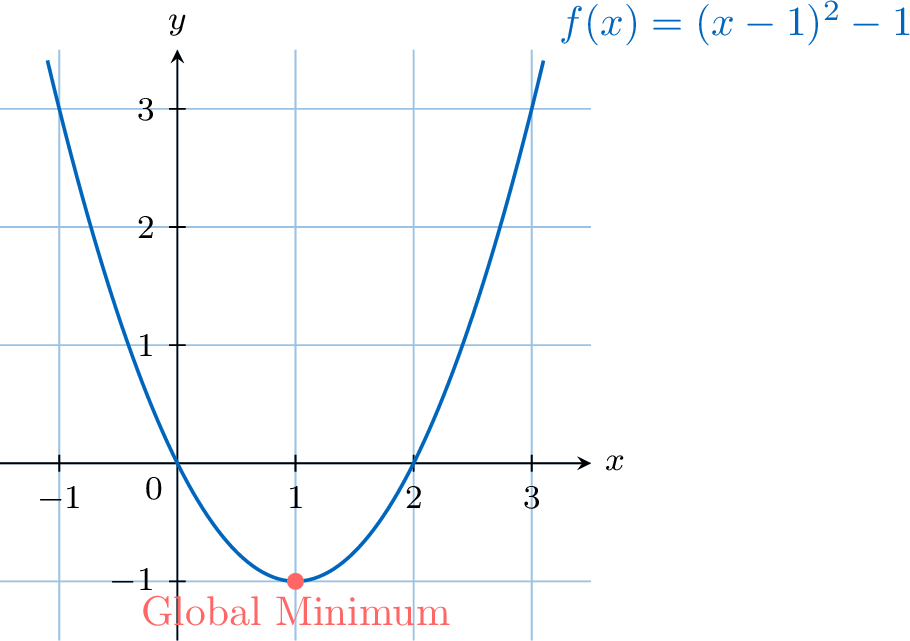
Definition Local Extrema
Let \(f\) be a function.
- \(f\) has a local maximum at \(x=c\) if there is an open interval \(I\) containing \(c\) such that \(f(c) \ge f(x)\) for all \(x\) in \(I\).
- \(f\) has a local minimum at \(x=c\) if there is an open interval \(I\) containing \(c\) such that \(f(c) \le f(x)\) for all \(x\) in \(I\).
Example
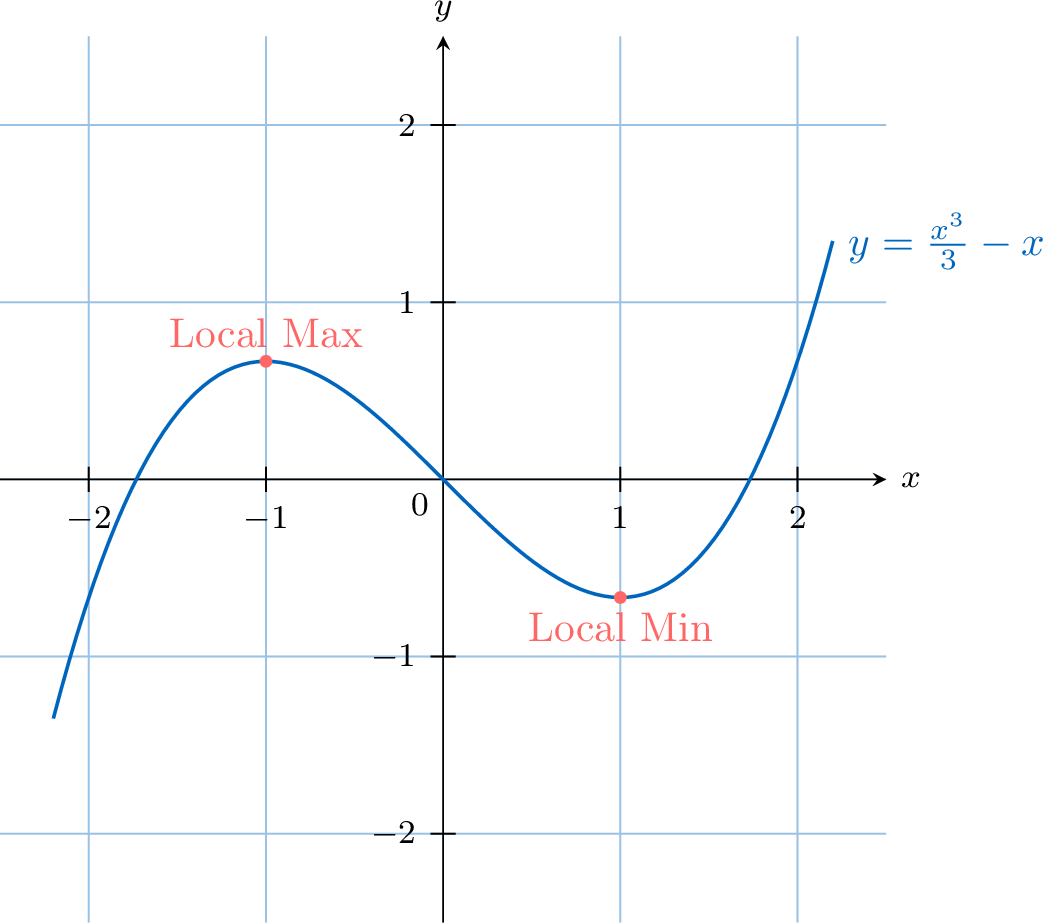
The function \(f(x) = \frac{x^3}{3} - x\) has a local maximum at \(x=-1\) and a local minimum at \(x=1\).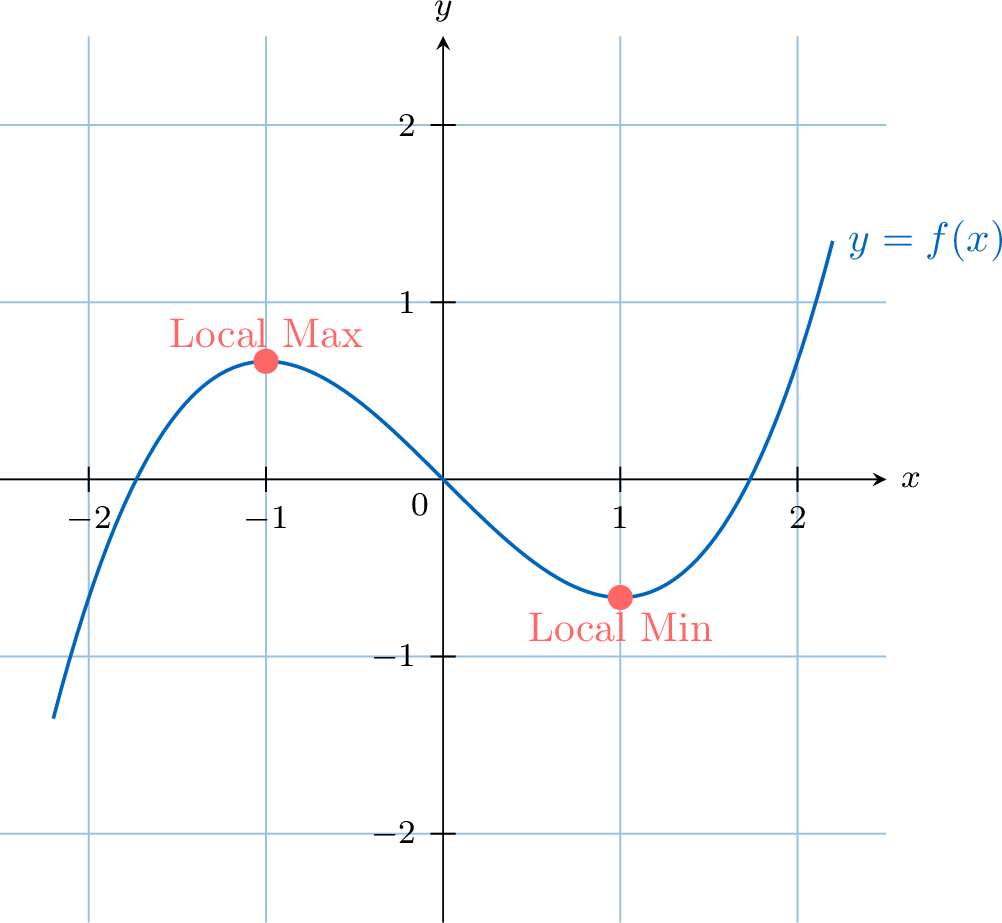
Definition Stationary Point
A stationary point of a function \(f\) is a point \((c, f(c))\) on the curve where the tangent is horizontal, which means \(f^{\prime}(c)=0\).
Proposition Local Extrema and Stationary Points
Let \(f\) be a function defined on an open interval \(I\), and let \(c\in I\).
If \(f\) has a local maximum or a local minimum at \(x=c\) and if \(f\) is differentiable at \(c\), then$$ f'(c)=0. $$
If \(f\) has a local maximum or a local minimum at \(x=c\) and if \(f\) is differentiable at \(c\), then$$ f'(c)=0. $$
This proposition shows that any local maximum or minimum of a differentiable function (at an interior point of the interval) must occur at a stationary point, that is, a point where \(f'(c)=0\).
In practice, this means that stationary points are candidates for local maxima and minima:
In practice, this means that stationary points are candidates for local maxima and minima:
- First, solve \(f'(x)=0\) to find all stationary points.
- Then, for each stationary point, use the sign of \(f'\) (or a table of variations, or the second derivative) to decide whether it is a local maximum, a local minimum, or neither (for example, a point of inflection).
Proposition First Derivative Test for Local Extrema
Let \(c\) be a stationary point such that \(f'(c)=0\).
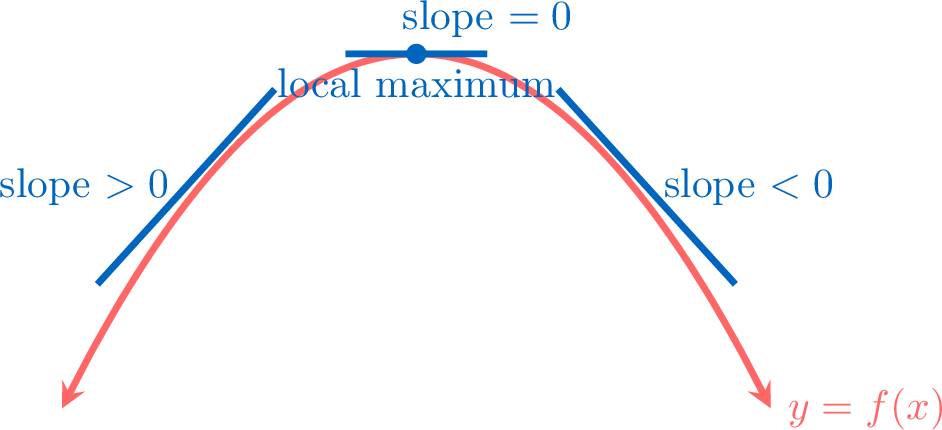
- If \(f^{\prime}(x)\) changes sign from positive to negative at \(x=c\), then \(f\) has a local maximum at \(c\).
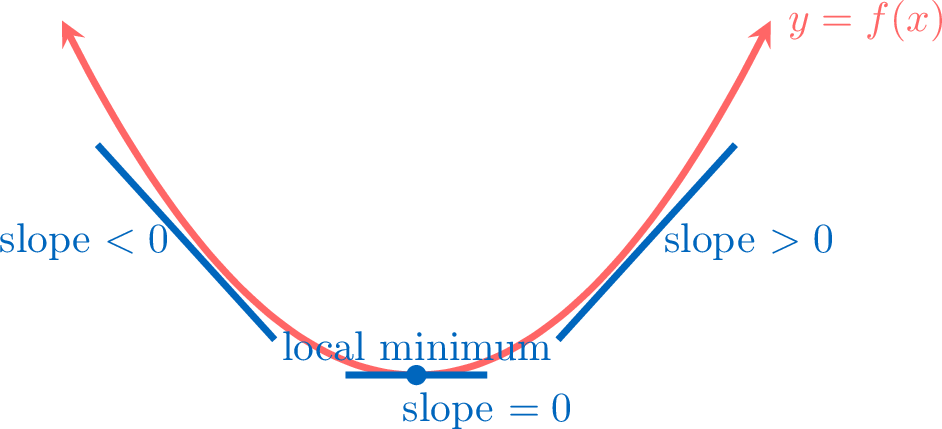
- If \(f^{\prime}(x)\) changes sign from negative to positive at \(x=c\), then \(f\) has a local minimum at \(c\).
Example
Find and classify the stationary points of \(f(x) = \frac{1}{3}x^3 - x\).
- Find the derivative:$$ f'(x) = x^2 - 1. $$
- Find stationary points by solving \(f'(x)=0\):$$ \begin{aligned} x^2 - 1 &= 0 \\ (x-1)(x+1) &= 0.\end{aligned}$$The stationary points are at \(x=-1\) and \(x=1\).
- Create the sign diagram for \(f'(x)\):
The derivative \(f'(x)=x^2-1\) is an upward-opening parabola with roots at \(-1\) and \(1\). It is positive outside the roots and negative between them. - Draw the table of variations and classify points:
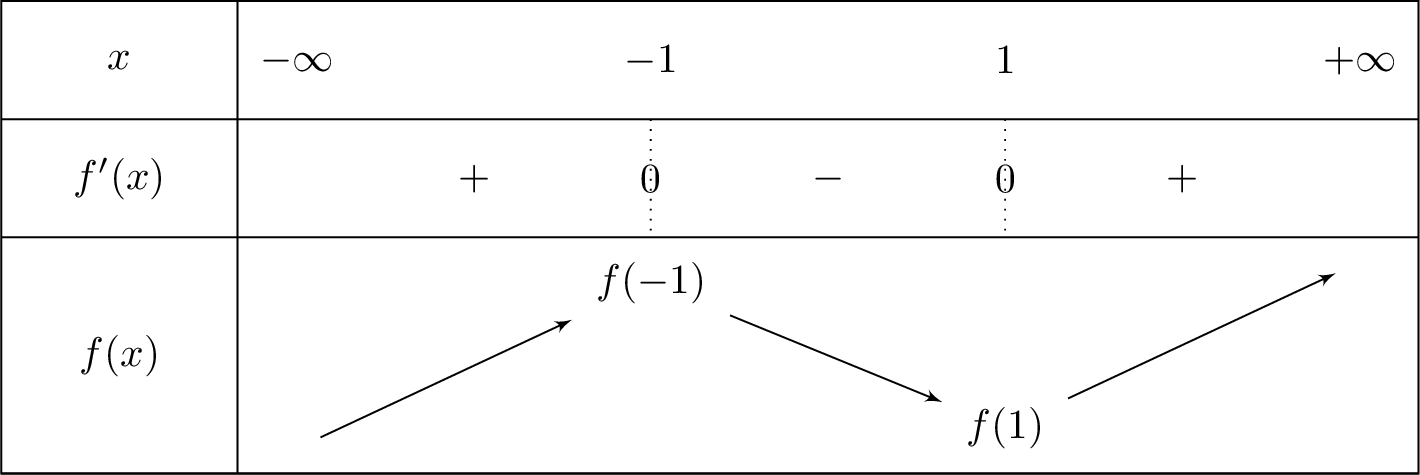
- At \(x=-1\), the sign of \(f'(x)\) changes from \(+\) to \(-\). Thus, there is a local maximum at \(x=-1\).$$f(-1) = \frac{1}{3}(-1)^3 - (-1) = \frac{2}{3}.$$
- At \(x=1\), the sign of \(f'(x)\) changes from \(-\) to \(+\). Thus, there is a local minimum at \(x=1\).$$f(1) = \frac{1}{3}(1)^3 - 1 = -\frac{2}{3}.$$