Trigonometric Functions
Trigonometric functions are real-valued functions that relate the measure of an angle in a right triangle to the ratios of two of its sides. They play a fundamental role in geometry and are widely used in many scientific fields, such as navigation, mechanics, astronomy, geodesy, and more. Trigonometric functions are also among the simplest examples of periodic functions, making them essential for modeling periodic phenomena (such as waves) and for applications like Fourier analysis.
Periodic Function
A function \(f\) is periodic if it repeats itself in regular intervals.
Definition Periodic Function
A function \(f\) is periodic if there exists a constant \(P>0\) such that$$f(x+P) = f(x), \forall x$$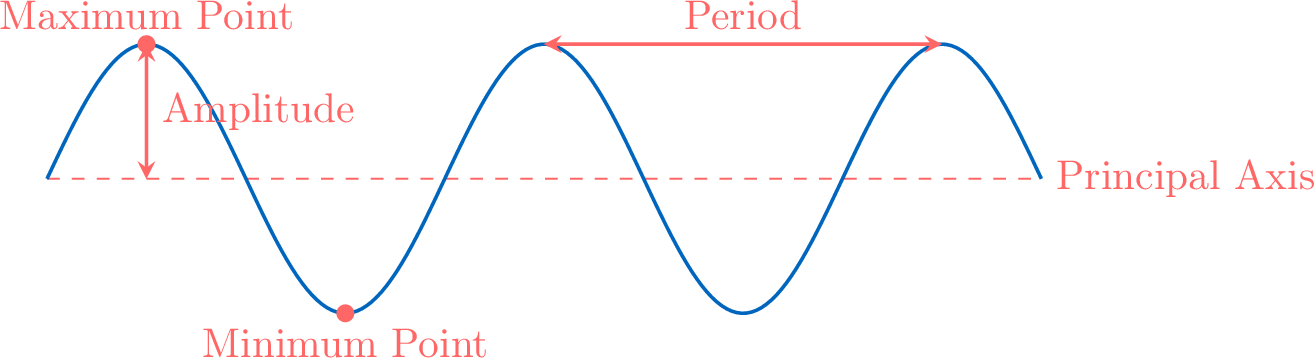
- The period is the length of one full repetition or cycle. It is the smallest positive value \(p\) such that \(f(x+p) = f(x)\) for all \(x\).
- The principal axis or mean line is the horizontal line about which the wave oscillates, given by $$y = \frac{\text{maximum value} + \text{minimum value}}{2}$$
- The amplitude is the distance from the principal axis to a maximum or minimum point, given by $$\frac{\text{maximum value} - \text{minimum value}}{2}$$
Among the many types of periodic functions, this chapter will focus on those that exhibit a smooth, wave-like pattern. To model these sinusoidal functions, we will use the sine and cosine trigonometric functions.
Sine and Cosine Function
Let \(M(\cos x, \sin x)\) be the point on the unit circle corresponding to an angle \(x\) (in radians).
See for example: \href{https://www.geogebra.org/m/j7w29vj4}{GeoGebra demo}.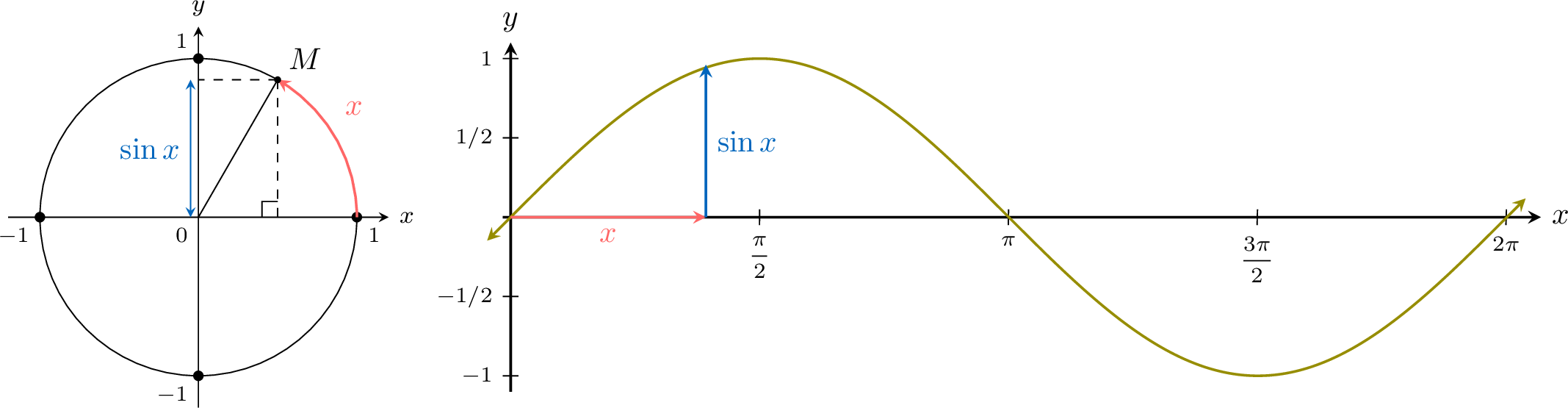
- The angle \(x\) on the unit circle corresponds to the input for the sine function.
- The \(y\)-coordinate of point \(M\) on the unit circle, \(\sin x\), gives the output of the sine function.
See for example: \href{https://www.geogebra.org/m/j7w29vj4}{GeoGebra demo}.
Definition Sine Function
The sine function, denoted \(\sin\), is defined by \(x\mapsto \sin(x)\), where \(x\) is interpreted as an angle in radians.
Example
Complete the following table with the values of the sine function at key angles:
| \(x\) | 0 | \(\dfrac{\pi}{6}\) | \(\dfrac{\pi}{4}\) | \(\dfrac{\pi}{3}\) | \(\dfrac{\pi}{2}\) | \(\dfrac{2 \pi}{3}\) | \(\dfrac{3 \pi}{4}\) | \(\dfrac{5 \pi}{6}\) | \(\pi\) |
| \(\sin (x)\) |
| \(x\) | 0 | \(\dfrac{\pi}{6}\) | \(\dfrac{\pi}{4}\) | \(\dfrac{\pi}{3}\) | \(\dfrac{\pi}{2}\) | \(\dfrac{2 \pi}{3}\) | \(\dfrac{3 \pi}{4}\) | \(\dfrac{5 \pi}{6}\) | \(\pi\) |
| \(\sin (x)\) | 0 | \(\dfrac{1}{2}\) | \(\dfrac{\sqrt{2}}{2}\) | \(\dfrac{\sqrt{3}}{2}\) | 1 | \(\dfrac{\sqrt{3}}{2}\) | \(\dfrac{\sqrt{2}}{2}\) | \(\dfrac{1}{2}\) | \(0\) |
If we instead project the values of \(\cos x\) from the unit circle onto a graph, we obtain the graph of the cosine function \(x \mapsto \cos x\).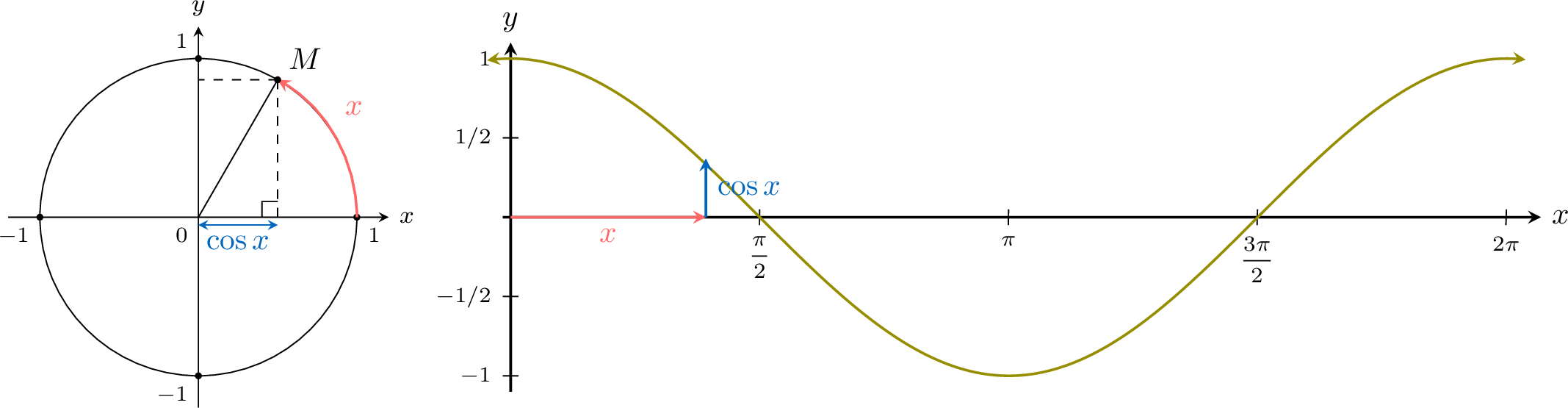
Definition Cosine Function
The cosine function, denoted \(\cos\), is defined by \(x\mapsto\cos(x)\), where \(x\) is interpreted as an angle in radians.
Example
Complete the following table with the values of the cosine function at key angles:
| \(x\) | 0 | \(\dfrac{\pi}{6}\) | \(\dfrac{\pi}{4}\) | \(\dfrac{\pi}{3}\) | \(\dfrac{\pi}{2}\) | \(\dfrac{2 \pi}{3}\) | \(\dfrac{3 \pi}{4}\) | \(\dfrac{5 \pi}{6}\) | \(\pi\) |
| \(\cos (x)\) |
| \(x\) | \(0\) | \(\dfrac{\pi}{6}\) | \(\dfrac{\pi}{4}\) | \(\dfrac{\pi}{3}\) | \(\dfrac{\pi}{2}\) | \(\dfrac{2 \pi}{3}\) | \(\dfrac{3 \pi}{4}\) | \(\dfrac{5 \pi}{6}\) | \(\pi\) |
| \(\cos (x)\) | \(1\) | \(\dfrac{\sqrt{3}}{2}\) | \(\dfrac{\sqrt{2}}{2}\) | \(\dfrac{1}{2}\) | \(0\) | \(-\dfrac{1}{2}\) | \(-\dfrac{\sqrt{2}}{2} \) | \(-\dfrac{\sqrt{3}}{2}\) | \(-1\) |
Proposition Properties of Sine and Cosine
- Periodicity: Both functions are periodic with a period of \(2\pi\). \(\sin(x+2\pi) = \sin(x)\) and \(\cos(x+2\pi) = \cos(x)\).
- Domain and Range: The domain is \(\mathbb{R}\). The range is \([-1, 1]\).
- Symmetry: Cosine is an even function (\(\cos(-x)=\cos(x)\)). Sine is an odd function (\(\sin(-x)=-\sin(x)\)).
- Amplitude: The amplitude of the base functions is 1.
General Sine and Cosine Functions
Now that we are familiar with the graphs of \(y = \sin x\) and \(y = \cos x\), we can use transformations to graph more complicated trigonometric functions.
Definition General Sine and Cosine Function
For functions of the form \(y = a\sin(b(x-c)) + d\) and \(y = a\cos(b(x-c)) + d\): 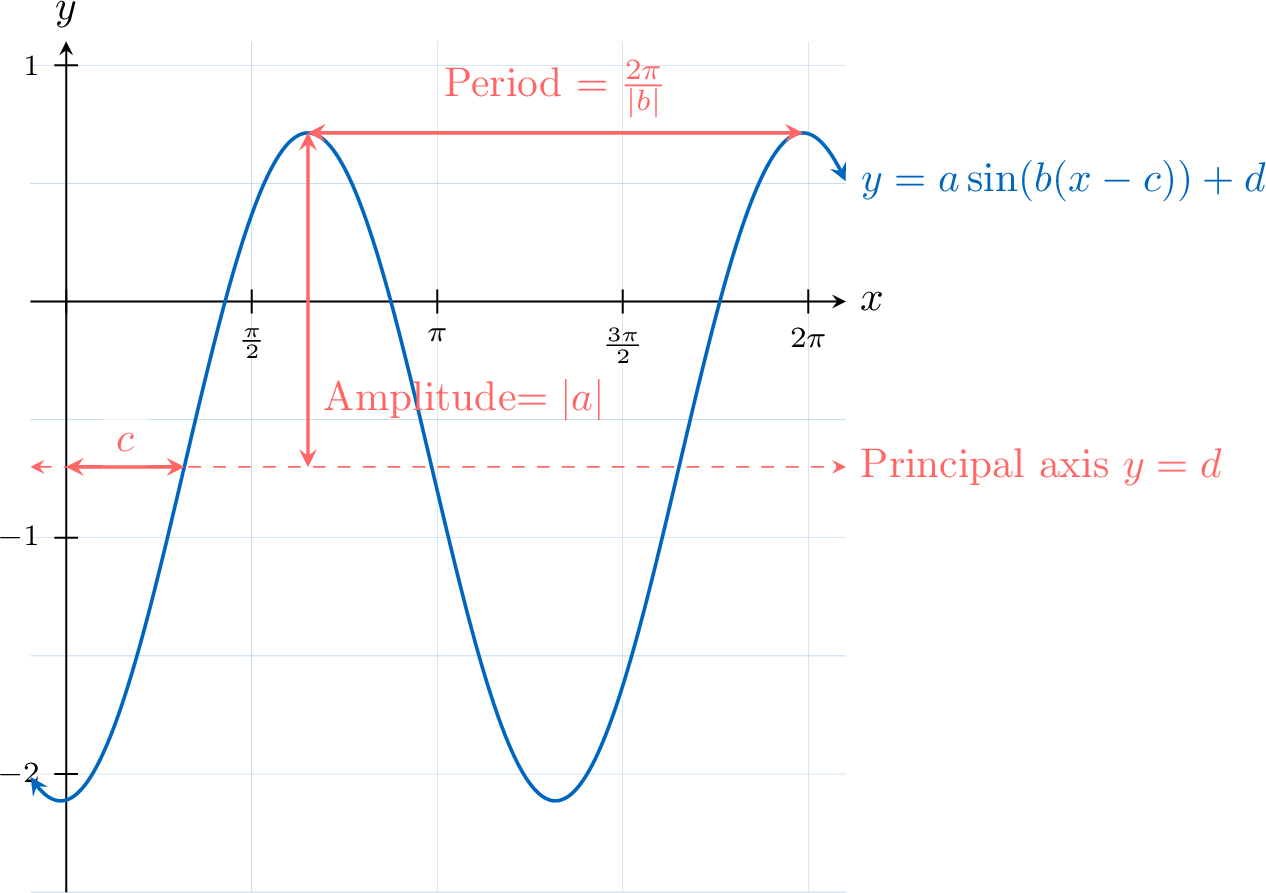
- \(|a|\) is the amplitude.
- \(\frac{2\pi}{|b|}\) is the period.
- \(c\) is the phase shift (horizontal translation).
- \(d\) is the vertical shift (the principal axis is \(y=d\)).
Proposition Transformations of Trigonometric Functions
For real parameters \(a,b,c,d\) with \(b\neq 0\), the graph of \(y = a\sin\!\big(b(x-c)\big) + d\) is obtained from the graph of \(y=\sin x\) by:
- a vertical stretch by factor \(|a|\); if \(a<0\), there is also a reflection across the horizontal axis,
- a horizontal stretch by factor \(\dfrac{1}{|b|}\); if \(b<0\), there is also a reflection across the vertical axis,
- a horizontal translation by \(c\) units (to the right if \(c>0\), left if \(c<0\)) and a vertical translation by \(d\) units (up if \(d>0\), down if \(d<0\)).
Example
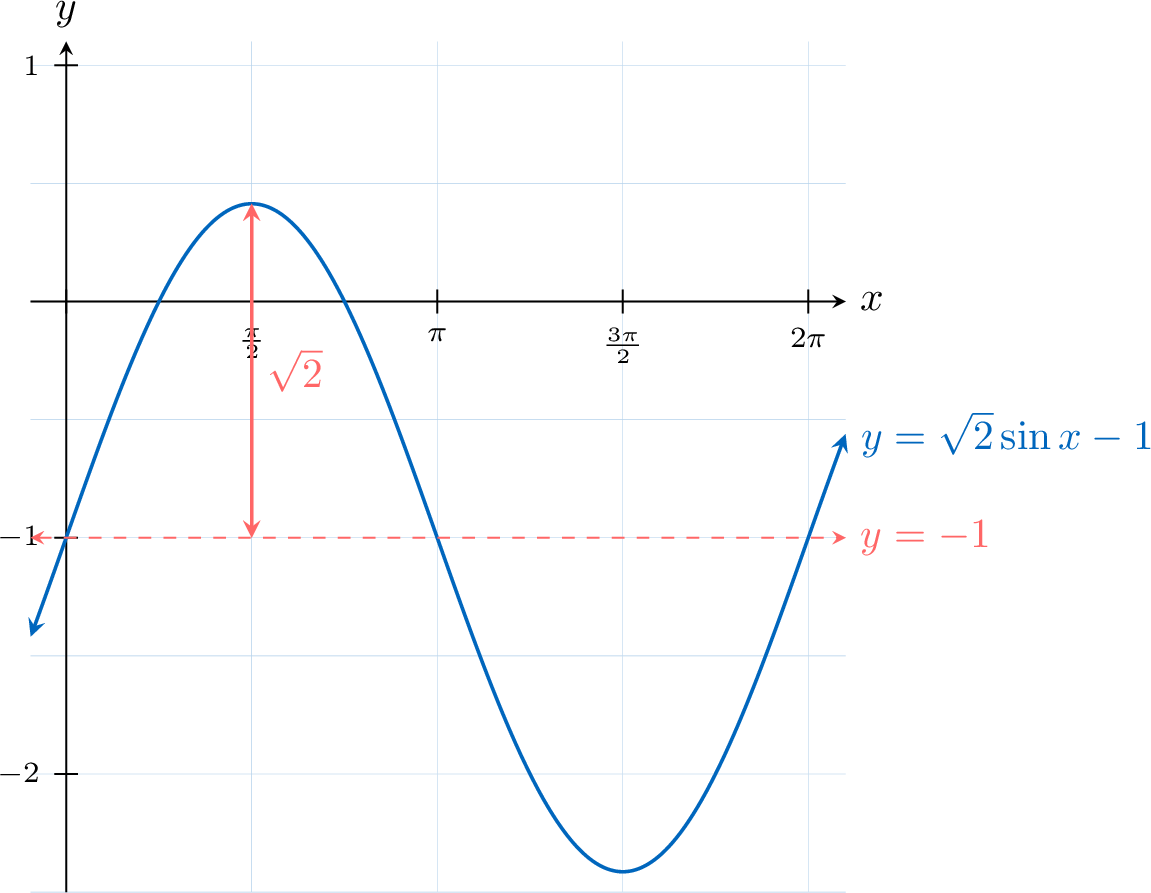
Sketch the graph of \(y=\sqrt{2} \sin x-1\) for \(0 \leqslant x \leqslant 2 \pi\).
- The graph of \(y=\sqrt{2} \sin x\) is the vertical dilation of the graph \(y=\sin x\) with scale factor \(\sqrt{2}\).
- The graph of \(y=\sqrt{2} \sin x-1\) is the vertical translation of graph \(y=\sqrt{2}\sin x\) by \(-1\)
Tangent Function
Definition Tangent Function
The tangent function is defined by the ratio:$$\textcolor{colordef}{\tan(x) = \frac{\sin x}{\cos x}}$$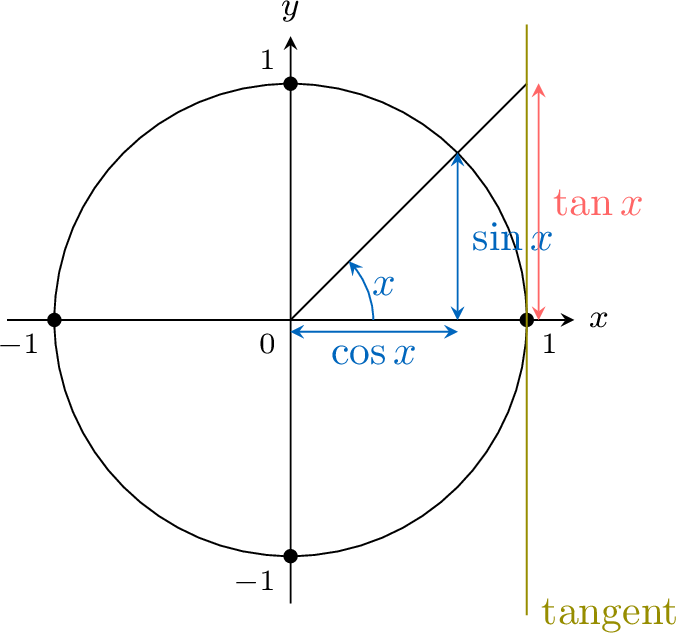
Proposition Graph of the Tangent Function
The graph of \(y = \tan(x) = \frac{\sin x}{\cos x}\) has: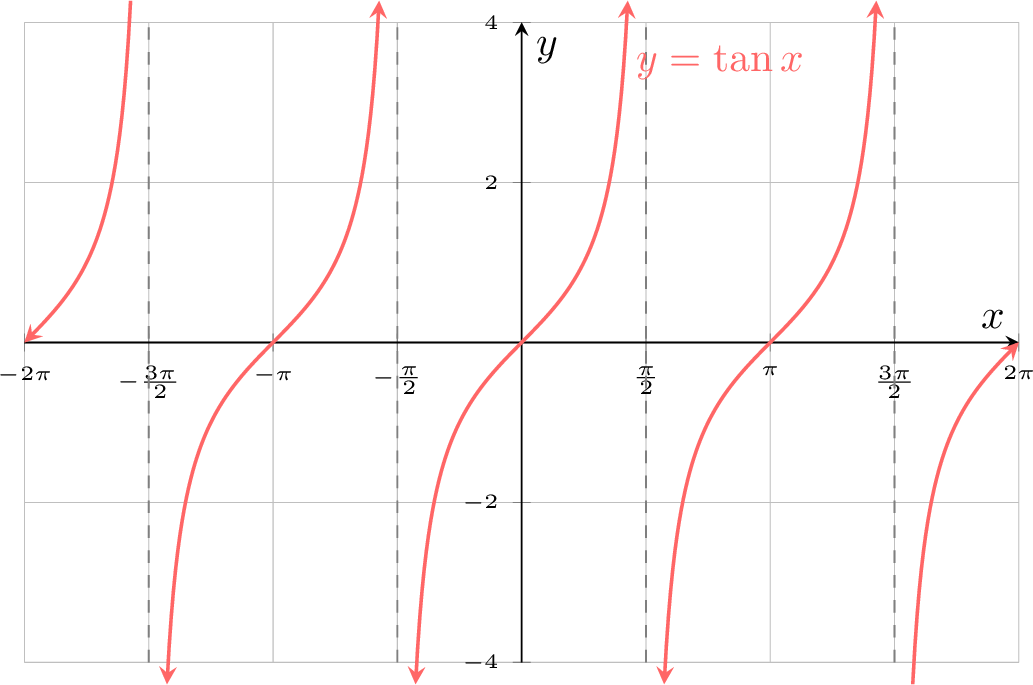
- Domain: \(\{x \in \mathbb{R} \mid x \neq \frac{\pi}{2} + k\pi,\forall k\in\mathbb{Z}\}\) (all real numbers \(x\) except those for which \(\cos x = 0\))
- Period: \(\pi\).
- Vertical Asymptotes: at \(x = \frac{\pi}{2} + k\pi\) for any integer \(k\).
- Range: \(\mathbb{R}\).
Reciprocal Trigonometric Functions
Definition Reciprocal Trigonometric Functions
- The cosecant is \(\csc(x) = \frac{1}{\sin(x)}\), for \(\sin(x) \neq 0\).
- The secant is \(\sec(x) = \frac{1}{\cos(x)}\), for \(\cos(x) \neq 0\).
- The cotangent is \(\cot(x) = \frac{1}{\tan(x)} = \frac{\cos(x)}{\sin(x)}\), for \(\sin(x) \neq 0\).
Proposition Graph of the Cosecant Function
The graph of \(y = \csc(x) = \frac{1}{\sin(x)}\) is shown below.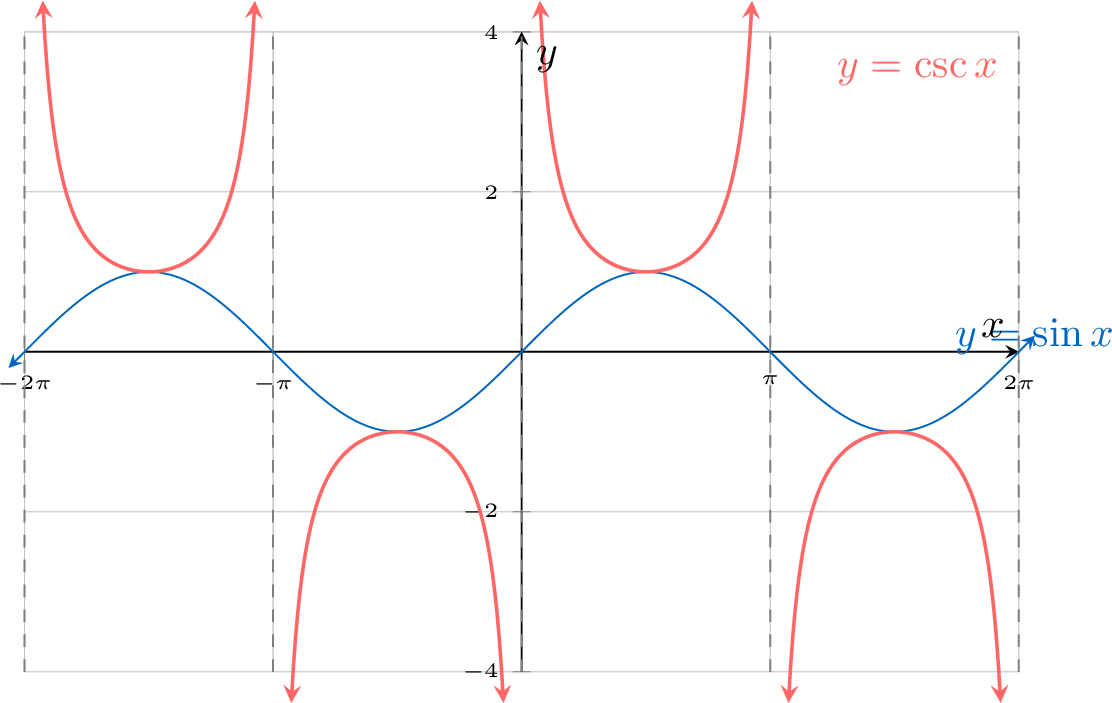
- Period: \(2\pi\).
- Vertical Asymptotes: At \(x = k\pi\) (where \(\sin x = 0\)).
- Range: \(({-\infty}, -1] \cup [1, \infty)\).
Proposition Graph of the Secant Function
The graph of \(y = \sec(x) = \frac{1}{\cos(x)}\) is shown below.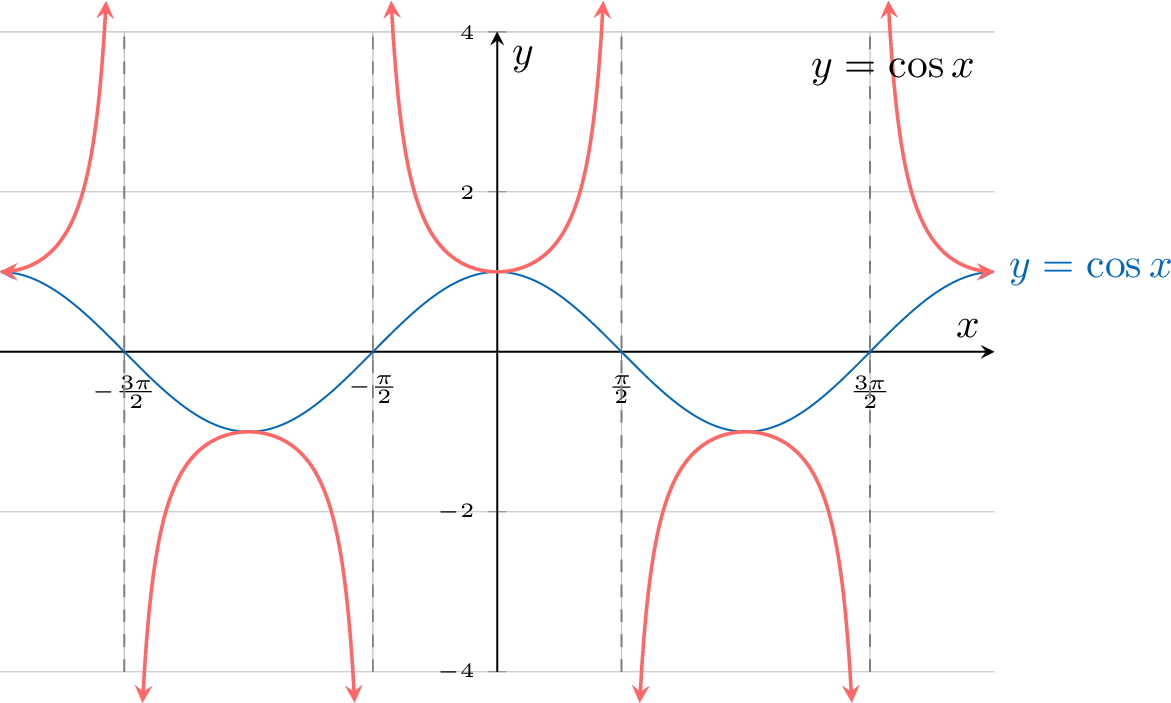
- Period: \(2\pi\).
- Vertical Asymptotes: At \(x = \frac{\pi}{2} + k\pi\) (where \(\cos x = 0\)).
- Range: \(({-\infty}, -1] \cup [1, \infty)\).
Proposition Graph of the Cotangent Function
The graph of \(y = \cot(x) = \frac{1}{\tan(x)}\) is shown below.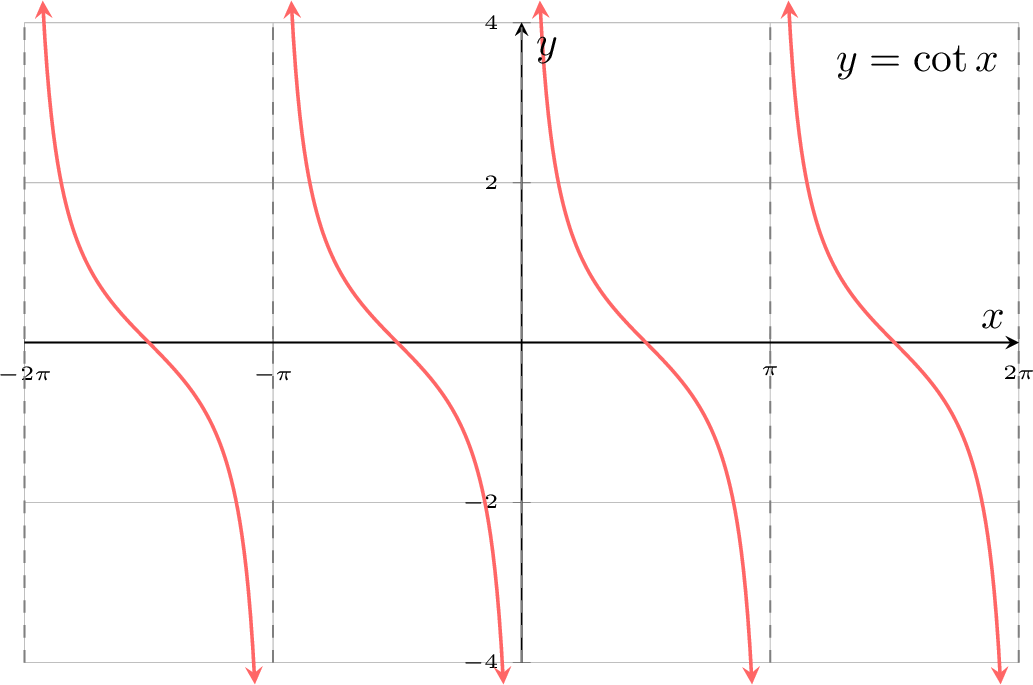
- Period: \(\pi\).
- Vertical Asymptotes: At \(x = k\pi\) (where \(\sin x = 0\)).
- Range: \(\mathbb{R}\).
Inverse Trigonometric Functions
The inverse trigonometric functions, also known as arc functions, allow us to find the angle given the value of a trigonometric ratio. They are the inverses of the sine, cosine, and tangent functions, but with restricted domains to make them one-to-one.
Definition Inverse Sine Function
The inverse sine function, denoted \(\arcsin\) or \(\sin^{-1}\), is defined as the function that returns the angle \(x\) such that \(\sin x = y\), where \(-1 \le y \le 1\) and \(-\frac{\pi}{2} \le x \le \frac{\pi}{2}\).
- Domain: \([-1, 1]\)
- Range: \(\left[-\frac{\pi}{2}, \frac{\pi}{2}\right]\)
Proposition Graph of the Inverse Sine Function
The graph of \(\textcolor{colordef}{y = \arcsin x}\) is the reflection of \(\textcolor{colorprop}{y = \sin x}\) over the line \(\textcolor{olive}{y = x}\), restricted to the principal branch.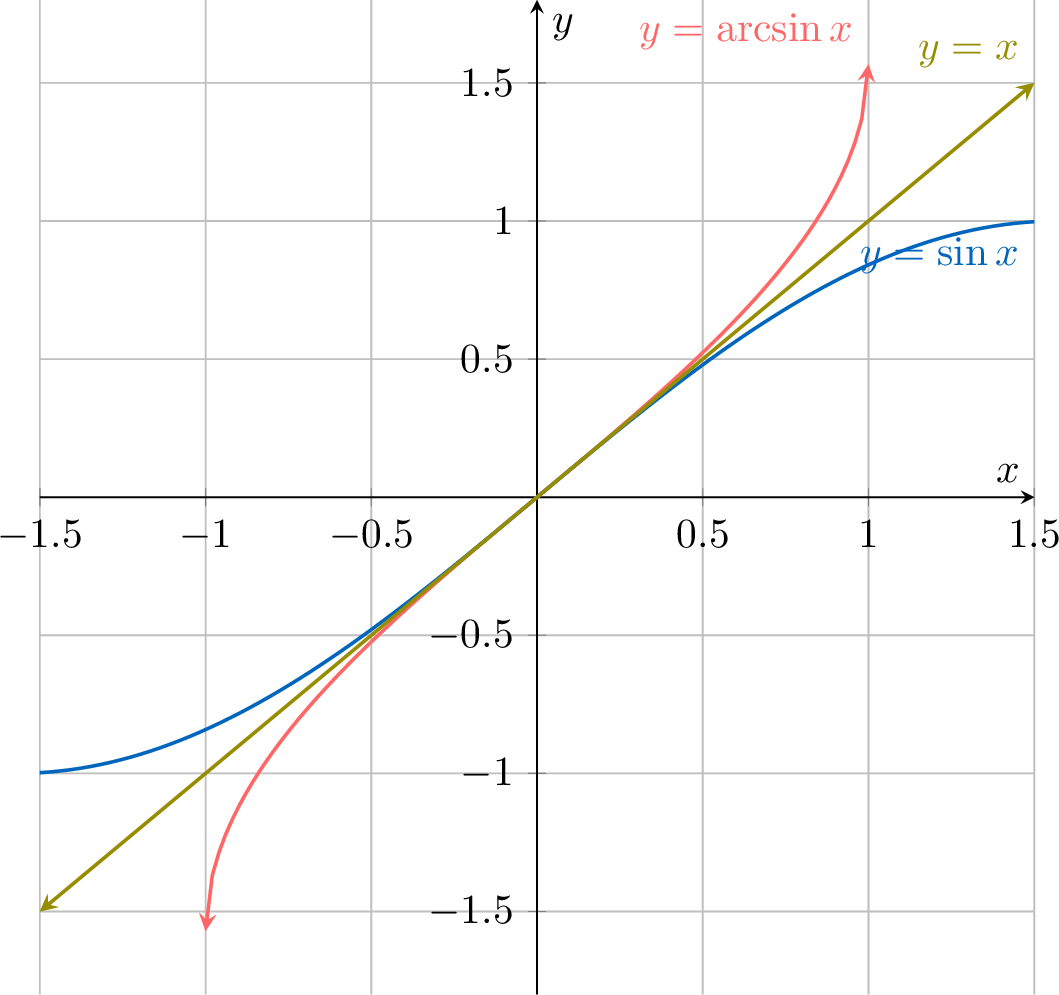
Definition Inverse Cosine Function
The inverse cosine function, denoted \(\arccos\) or \(\cos^{-1}\), is defined as the function that returns the angle \(x\) such that \(\cos x = y\), where \(-1 \le y \le 1\) and \(0 \le x \le \pi\).
- Domain: \([-1, 1]\)
- Range: \([0, \pi]\)
Proposition Graph of the Inverse Cosine Function
The graph of \(\textcolor{colordef}{y = \arccos x}\) is the reflection of \(\textcolor{colorprop}{y = \cos x}\) over the line \(\textcolor{olive}{y = x}\), restricted to the principal branch.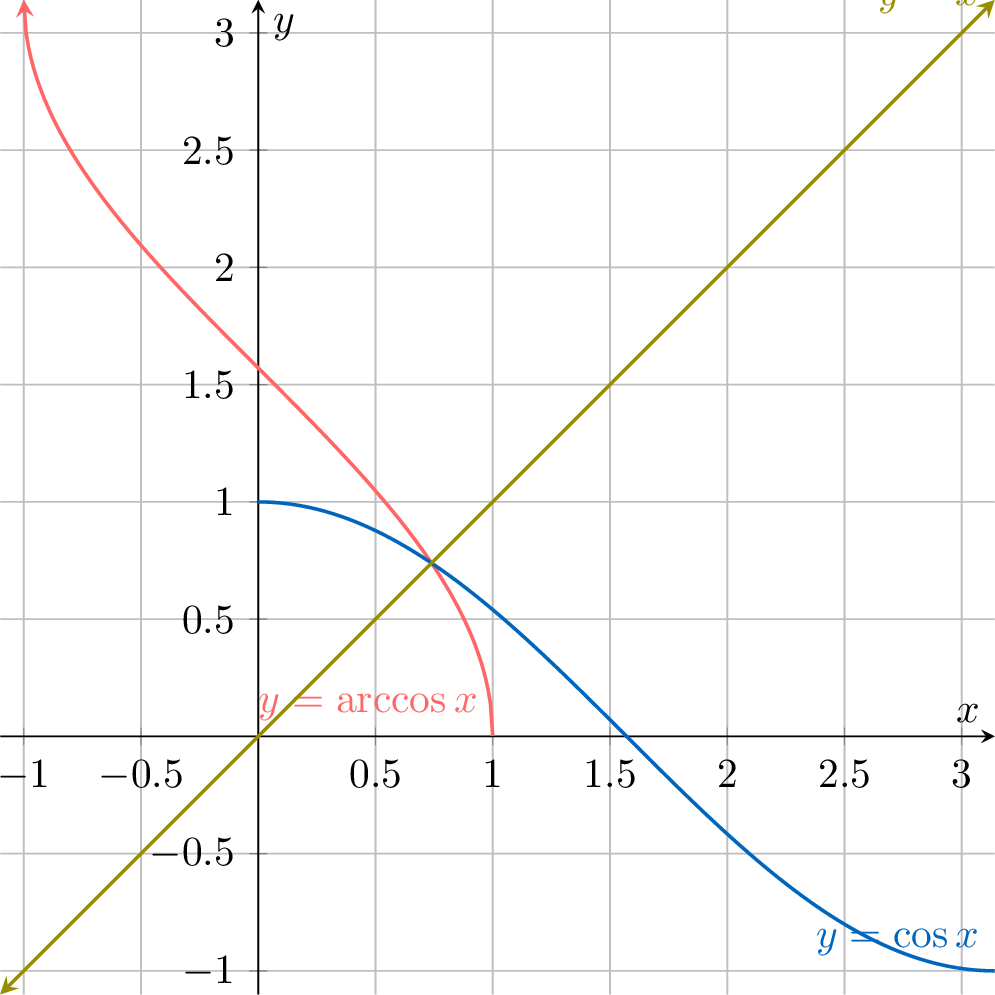
Definition Inverse Tangent Function
The inverse tangent function, denoted \(\arctan\) or \(\tan^{-1}\), is defined as the function that returns the angle \(x\) such that \(\tan x = y\), where \(y \in \mathbb{R}\) and \(-\frac{\pi}{2} < x < \frac{\pi}{2}\).
- Domain: \(\mathbb{R}\)
- Range: \(\left(-\frac{\pi}{2}, \frac{\pi}{2}\right)\)
Proposition Graph of the Inverse Tangent Function
The graph of \(y = \arctan x\) is the reflection of \(y = \tan x\) over the line \(y = x\), restricted to the principal branch.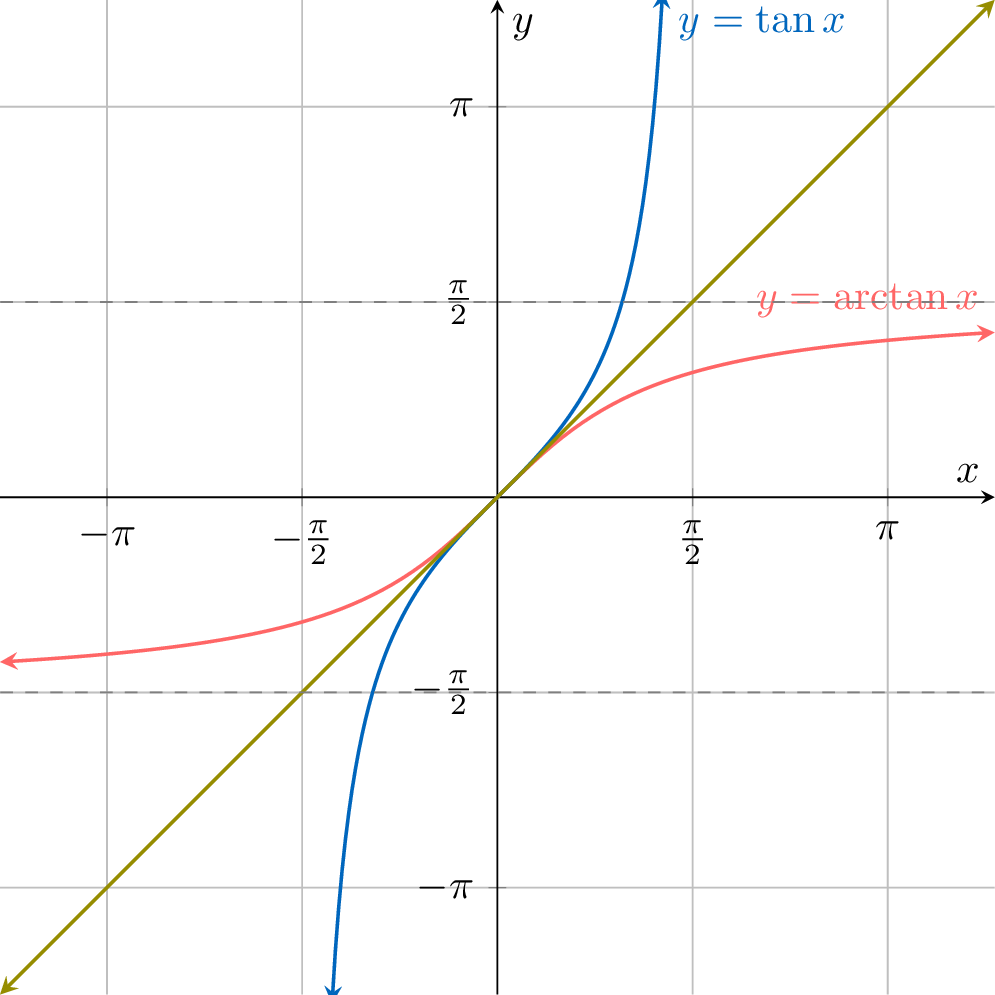
Proposition Properties of Inverse Trigonometric Functions
- \(\arcsin(\sin x) = x\) for \(x \in \left[-\frac{\pi}{2}, \frac{\pi}{2}\right]\)
- \(\arccos(\cos x) = x\) for \(x \in [0, \pi]\)
- \(\arctan(\tan x) = x\) for \(x \in \left(-\frac{\pi}{2}, \frac{\pi}{2}\right)\)
Example
Evaluate \(\arcsin\left(\frac{\sqrt{3}}{2}\right)\).
\(\arcsin\left(\frac{\sqrt{3}}{2}\right) = \frac{\pi}{3}\)
Solving Trigonometric Equations
Method Solving a Trigonometric Equation
- Use identities to simplify the equation into a form involving a single trigonometric function, e.g., \(\sin(X)=k\).
- Find the principal value (the first solution) using an inverse function, \(X = \arcsin(k)\).
- Use the symmetry and periodicity of the function to find all solutions within one period.
- Add multiples of the period (\(2k\pi\) or \(k\pi\)) to find the general solution or all solutions in a specified domain.
Example
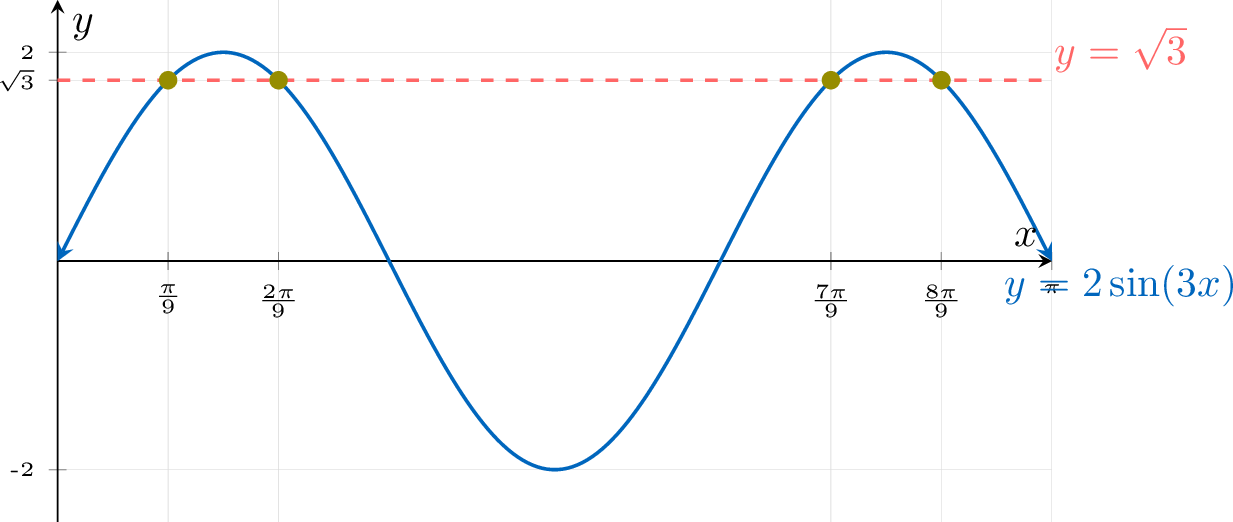
Find the general solution to the equation \(2\sin(3x) = \sqrt{3}\), and hence find all solutions in the interval \(0 \le x \le \pi\).
- Simplify the equation: We first isolate the trigonometric function. $$ \sin(3x) = \frac{\sqrt{3}}{2} $$ Let \(u = 3x\). We are now solving \(\sin(u) = \frac{\sqrt{3}}{2}\).
- Find the principal value: The first solution for \(u\) is the principal value: $$ u = \arcsin\left(\frac{\sqrt{3}}{2}\right) = \frac{\pi}{3} $$
- Find all solutions for \(u\) in one period: For the sine function, a second solution exists at \(\pi - u\). $$ \text{Second solution: } u = \pi - \frac{\pi}{3} = \frac{2\pi}{3} $$
- Find the general solution for \(u\): Since the period of sine is \(2\pi\), we add multiples of \(2\pi\) to our initial solutions. Let \(k\) be any integer (\(k \in \mathbb{Z}\)). $$ u = \frac{\pi}{3} + 2k\pi \quad \text{or} \quad u = \frac{2\pi}{3} + 2k\pi $$
- Solve for \(x\): Now we substitute back \(u=3x\) to find the general solution for \(x\). $$ 3x = \frac{\pi}{3} + 2k\pi \implies \boldsymbol{x = \frac{\pi}{9} + \frac{2k\pi}{3}} $$ $$ 3x = \frac{2\pi}{3} + 2k\pi \implies \boldsymbol{x = \frac{2\pi}{9} + \frac{2k\pi}{3}} $$
- Find solutions in the specified domain \(0 \le x \le \pi\): We test integer values for \(k\).
- For \(k=0\): \(x = \frac{\pi}{9}\) and \(x = \frac{2\pi}{9}\). (Both are in the domain)
- For \(k=1\): \(x = \frac{\pi}{9} + \frac{2\pi}{3} = \frac{7\pi}{9}\) and \(x = \frac{2\pi}{9} + \frac{2\pi}{3} = \frac{8\pi}{9}\). (Both are in the domain)
- For \(k=2\): \(x = \frac{\pi}{9} + \frac{4\pi}{3} = \frac{13\pi}{9}\). (This is outside the domain \(x \le \pi\))
- We can verify our solutions by plotting the graphs of \(y=2\sin(3x)\) and \(y=\sqrt{3}\) on the same set of axes for the domain \(0 \le x \le \pi\). The x-coordinates of the intersection points correspond to the solutions of the equation.
Modeling Periodic Data with a Sine Function
Method Modelling Periodic Data with a Sine Function
To find a sinusoidal model of the form \(y = a\sin(b(x-c)) + d\) that fits a set of periodic data:
- Find the vertical shift, \(d\): Calculate the principal axis, which is the average of the maximum and minimum values. $$d = \frac{\text{max value} + \text{min value}}{2}$$
- Find the amplitude, \(a\): Calculate half the distance between the maximum and minimum values. $$a = \frac{\text{max value} - \text{min value}}{2}$$
- Find the period and the parameter \(b\): Determine the period, \(P\), which is the length of one full cycle of the data. Use the formula \(P = \frac{2\pi}{b}\) to solve for \(b\). $$b = \frac{2\pi}{P}$$
- Find the phase shift, \(c\): Substitute a data point \((x,y)\) into the equation \(y = a\sin(b(x-c))+d\) and solve for the horizontal shift \(c\). It is often easiest to choose a point where the function crosses its principal axis, as this corresponds to a point where the sine function is zero.
Example
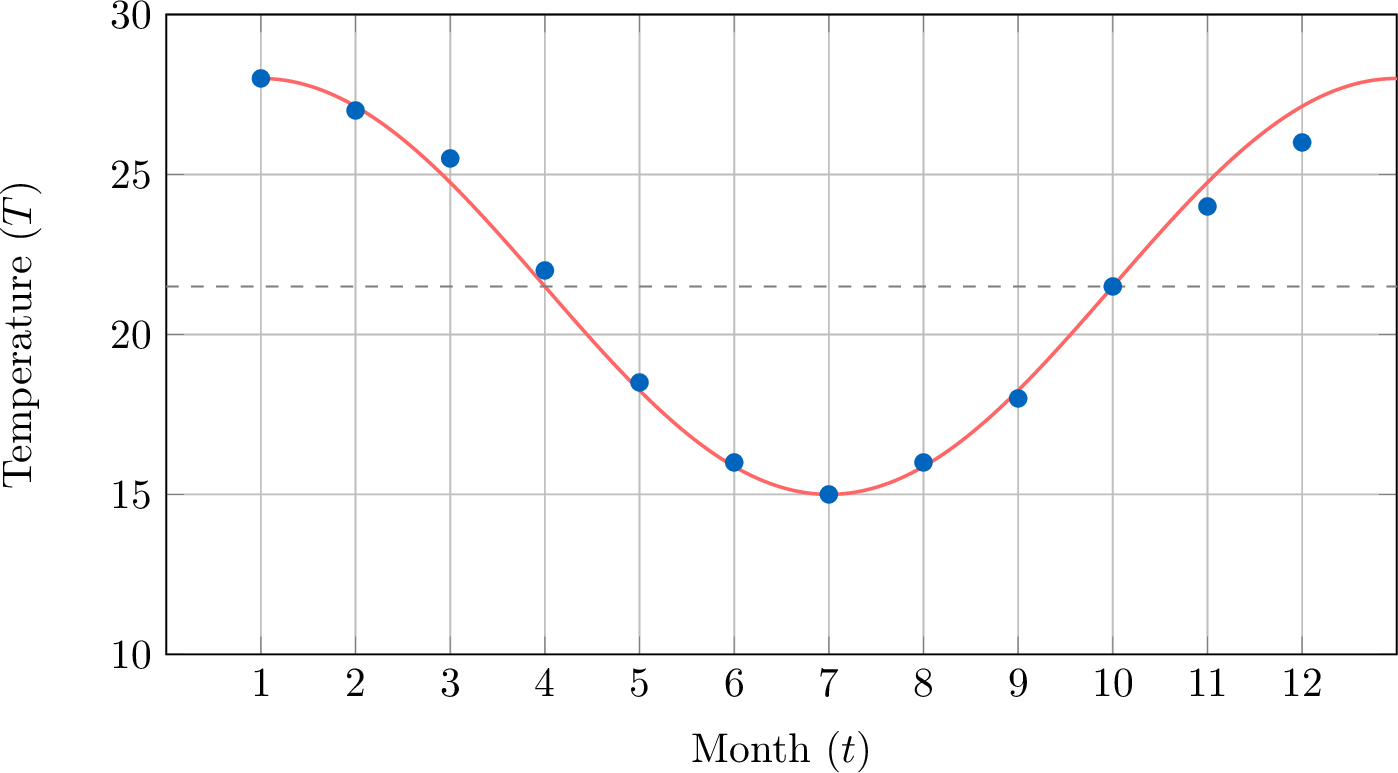
The mean monthly maximum temperatures for Cape Town, South Africa are shown below:
| Month (\(t\)) | 1 | 2 | 3 | 4 | 5 | 6 | 7 | 8 | 9 | 10 | 11 | 12 |
| Temp (\(T\)) | 28 | 27 | 25.5 | 22 | 18.5 | 16 | 15 | 16 | 18 | 21.5 | 24 | 26 |
- Find Vertical Shift (\(d\)): The max value is 28 and the min value is 15. $$ d = \frac{28+15}{2} = \frac{43}{2} = 21.5 $$
- Find Amplitude (\(a\)): $$ a = \frac{28-15}{2} = \frac{13}{2} = 6.5 $$
- Find Period (\(b\)): The data repeats every 12 months, so the period \(P=12\). $$ b = \frac{2\pi}{P} = \frac{2\pi}{12} = \frac{\pi}{6} $$
- Find Phase Shift (\(c\)): Our model so far is \(T = 6.5\sin(\frac{\pi}{6}(t-c)) + 21.5\). A standard sine function starts at its principal axis and goes up. From the data, the temperature is 21.5 (the principal axis value) at \(t=10\) and is increasing. We can therefore choose the phase shift to be \(c=10\).
- Final Model: $$ T(t) = 6.5\sin\left(\frac{\pi}{6}(t-10)\right) + 21.5 $$