Function Variations and Extrema
Variations of a Function
Definition Increasing and Decreasing Functions
Let \(f\) be a function defined on an interval \(I\).
- \(f\) is increasing on \(I\) if for all \(u\) and \(v\) in \(I\): $$\text{if } u \leq v, \text{ then } f(u) \leq f(v)$$ An increasing function preserves the order.
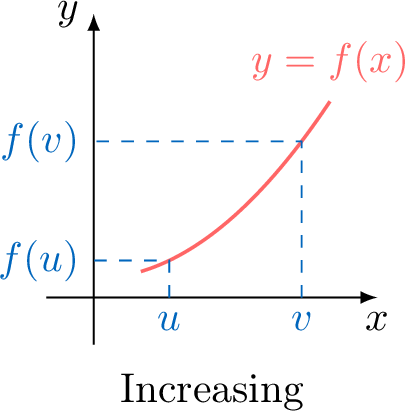
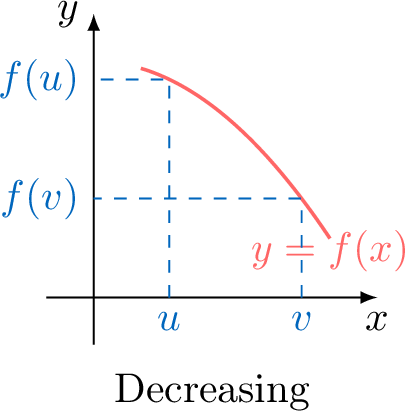
- \(f\) is decreasing on \(I\) if for all \(u\) and \(v\) in \(I\): $$\text{if } u \leq v, \text{ then } f(u) \geq f(v)$$ A decreasing function reverses the order.
Definition Variation Table
To summarize the variations of a function, we use a variation table. Arrows are used to indicate whether the function is increasing (\(\nearrow\)) or decreasing (\(\searrow\)).
Example
The function \(f\) is defined on \([-2, 1]\) by the graph below. Construct its variation table.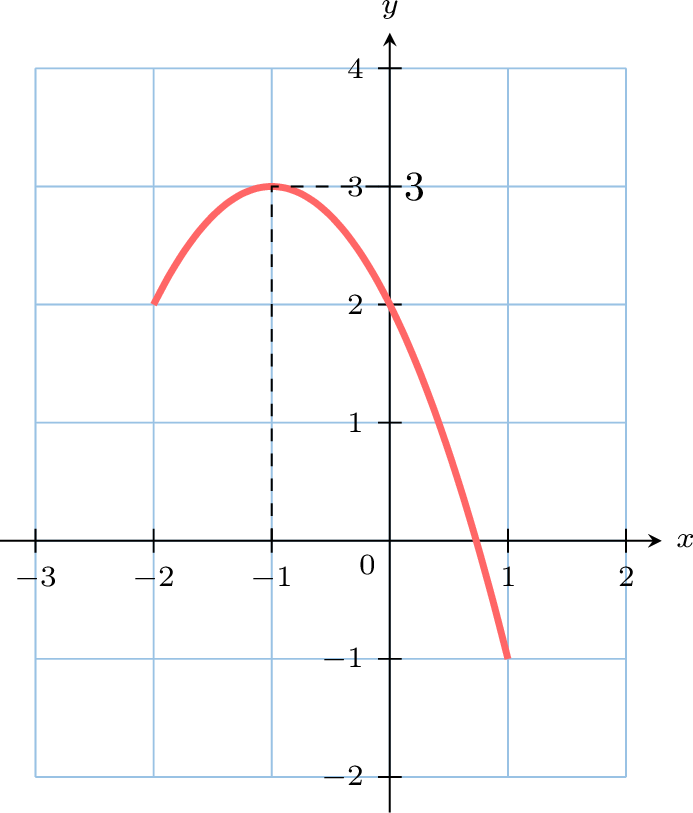
The function increases from \(x=-2\) to \(x=-1\), then decreases from \(x=-1\) to \(x=1\).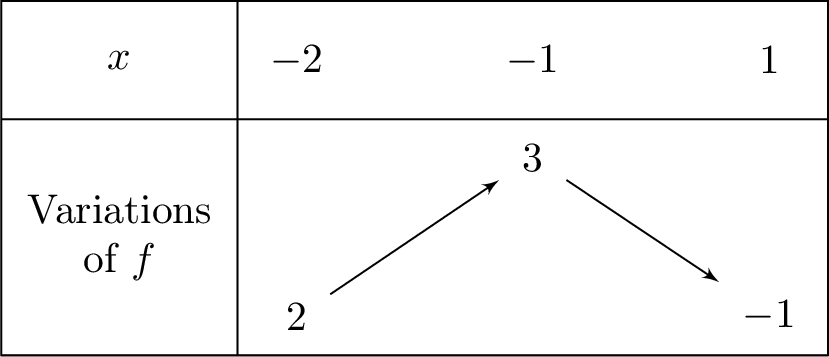
Extrema: Maximum and Minimum
Definition Maximum and Minimum
Let \(f\) be a function defined on an interval \(I\), and let \(a\) be a number in \(I\).
- \(f(a)\) is the maximum of \(f\) on \(I\) if for all \(x\) in \(I\): \(f(x) \leq f(a)\).
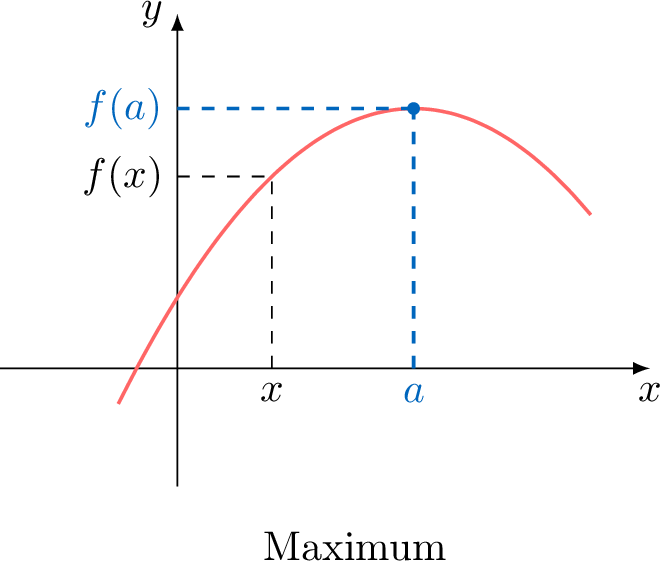
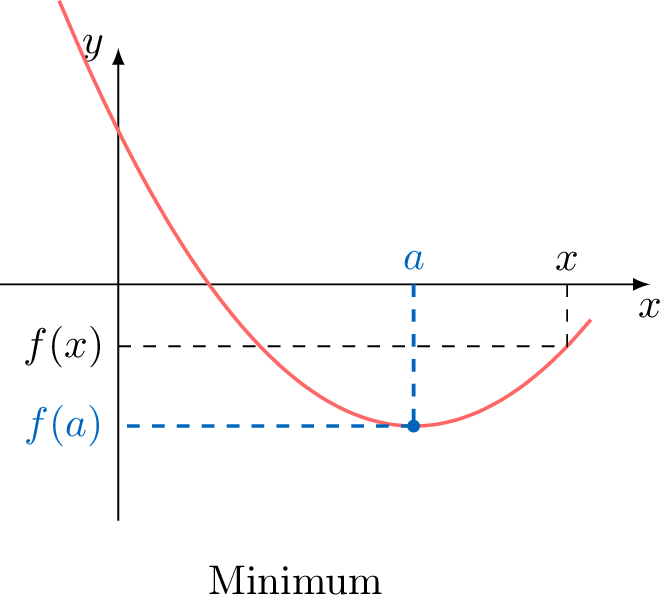
- \(f(a)\) is the minimum of \(f\) on \(I\) if for all \(x\) in \(I\): \(f(x) \geq f(a)\).
Example
The function \(f\) is defined on \([-2, 1]\) by the graph below.