Cartesian Equation of a Plane
Exercise
In a cube \(ABCDEFGH\), consider the plane \((BDE)\) and the diagonal \([AG]\).
Show that \(\Vect{AG}\) is a normal vector to the plane \((BDE)\).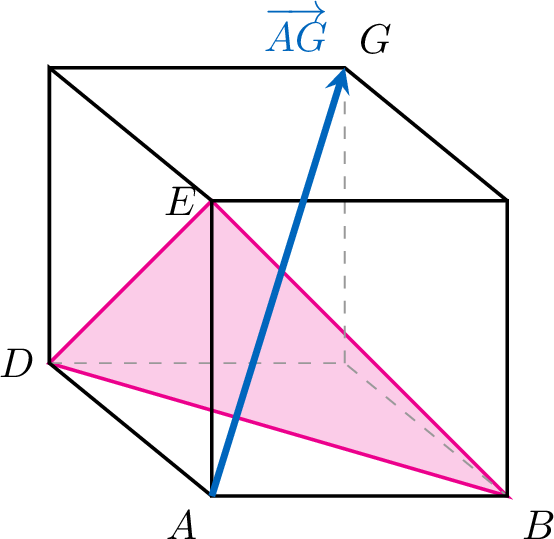
Show that \(\Vect{AG}\) is a normal vector to the plane \((BDE)\).
- Set up the system: In the cube \(ABCDEFGH\), we use the orthonormal basis \((A; \Vect{AB}, \Vect{AD}, \Vect{AE})\). The coordinates of the points are:
\(A(0,0,0)\), \(B(1,0,0)\), \(D(0,1,0)\), \(E(0,0,1)\), and \(G(1,1,1)\). - Vector coordinates: $$ \Vect{AG} = \begin{pmatrix} 1 \\ 1 \\ 1 \end{pmatrix}, \quad \Vect{BD} = \begin{pmatrix} -1 \\ 1 \\ 0 \end{pmatrix}, \quad \Vect{BE} = \begin{pmatrix} -1 \\ 0 \\ 1 \end{pmatrix} $$
- Orthogonality check:
We calculate the scalar products of \(\Vect{AG}\) with two non-collinear vectors of the plane \((BDE)\): $$ \begin{aligned} \Vect{AG} \cdot \Vect{BD} &= (1 \times -1) + (1 \times 1) + (1 \times 0) = -1 + 1 + 0 = 0 \\ \Vect{AG} \cdot \Vect{BE} &= (1 \times -1) + (1 \times 0) + (1 \times 1) = -1 + 0 + 1 = 0 \end{aligned} $$ Since \(\Vect{AG}\) is orthogonal to two non-collinear vectors of the plane \((BDE)\), \(\Vect{AG}\) is a normal vector to the plane \((BDE)\).
Exercise
In a cube \(ABCDEFGH\), consider the plane \((ACH)\) and the diagonal \([DF]\).
Show that \(\Vect{DF}\) is a normal vector to the plane \((ACH)\).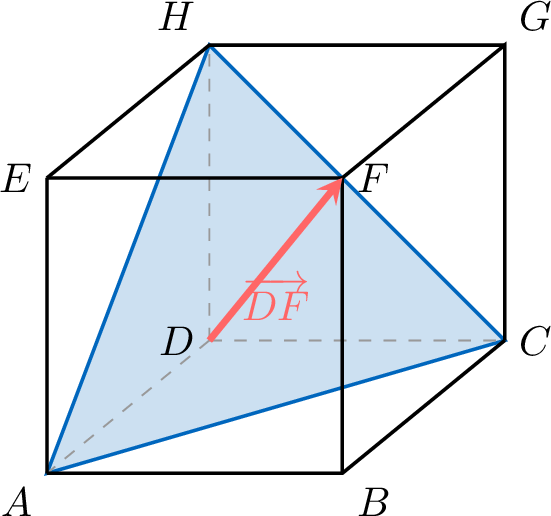
Show that \(\Vect{DF}\) is a normal vector to the plane \((ACH)\).
- Basis: We work in the orthonormal basis \((A; \Vect{AB}, \Vect{AD}, \Vect{AE})\). The coordinates are: \(A(0,0,0)\), \(C(1,1,0)\), \(D(0,1,0)\), \(F(1,0,1)\), and \(H(0,1,1)\).
- Vector coordinates: $$ \Vect{DF} = \begin{pmatrix} 1-0 \\ 0-1 \\ 1-0 \end{pmatrix} = \begin{pmatrix} 1 \\ -1 \\ 1 \end{pmatrix}, \quad \Vect{AC} = \begin{pmatrix} 1 \\ 1 \\ 0 \end{pmatrix}, \quad \Vect{AH} = \begin{pmatrix} 0 \\ 1 \\ 1 \end{pmatrix} $$
- Orthogonality check:
Using the dot product: $$ \begin{aligned} \Vect{DF} \cdot \Vect{AC} &= (1 \times 1) + (-1 \times 1) + (1 \times 0) = 1 - 1 + 0 = 0 \\ \Vect{DF} \cdot \Vect{AH} &= (1 \times 0) + (-1 \times 1) + (1 \times 1) = 0 - 1 + 1 = 0 \end{aligned} $$ Since \(\Vect{DF}\) is orthogonal to two non-collinear vectors \(\Vect{AC}\) and \(\Vect{AH}\) of the plane \((ACH)\), \(\Vect{DF}\) is a normal vector to the plane \((ACH)\).