Number Sets
Number Sets
Number sets are collections of numbers defined by shared properties and they form a foundation of mathematics. We begin with the natural numbers (\(\N\)), used for counting. By including negative numbers, we obtain the integers (\(\Z\)). Allowing quotients of integers (with nonzero denominator) leads to the rational numbers (\(\Q\)). Among real numbers (\(\R\)), we also find irrational numbers (such as \(\sqrt{2}\) and \(\pi\)), which together with the rationals fill the entire number line. Each of these sets contains the previous ones.
Definition Number Sets
- The natural numbers, denoted \(\N\), are the counting numbers, starting from zero:$$\N = \{0, 1, 2, 3, 4, 5, 6, \dots\}$$
- The integers, denoted \(\Z\), include all integers (negative, zero, positive):$$\Z = \{\dots, -3, -2, -1, 0, 1, 2, 3, \dots\}$$
- The decimal numbers, denoted \(\mathbb{D}\), are numbers that can be written as a fraction where the denominator is a power of 10:$$\mathbb{D} = \left\{ \frac{a}{10^n} \mid a \in \Z,\, n \in \N \right\}$$
- The rational numbers, denoted \(\Q\), are all numbers that can be written as a fraction \(\frac{p}{q}\), where \(p\) and \(q\) are integers and \(q \neq 0\):$$\Q = \left\{ \frac{p}{q} \mid p, q \in \Z,\, q \neq 0 \right\}$$
- The real numbers, denoted \(\R\), include all points on the number line: rational and irrational numbers (such as \(\sqrt{2}\) and \(\pi\)).
Example
- \(1\in \N, 1\in \Z, 1\in \mathbb{D},1\in \Q, 1\in\R\)
- \(-5 \in \Z\), \(-5 \notin \N\)
- \(0.25 = \frac{25}{100} = \frac{1}{4} \in \mathbb{D}\) (and also in \(\Q\) and \(\R\))
- \(\frac{1}{3} \in \Q\) but \(\frac{1}{3} \notin \mathbb{D}\)
- \(\sqrt{2} \in \R\) but \(\sqrt{2} \notin \Q\) (irrational)
Proposition Finite Decimal Expansion
A decimal number has a finite decimal representation.
Example
\(\frac{3}{4} = 0.75\) (finite, so decimal).\(\frac{1}{3} = 0.3333\dots\) (infinite, so not decimal).
Proposition Periodic Decimal Expansion
A rational number has a periodic decimal representation starting from some digit onward.
Example
\(\frac{1}{7} = 0.142857142857\dots\) (the sequence 142857 repeats).
Proposition Relationships Between Number Sets
The number sets are nested as follows:$$\N \subset \Z \subset \mathbb{D} \subset \Q \subset \R$$This means: every natural number is an integer, every integer is a decimal number, every decimal number is a rational number, and every rational number is a real number.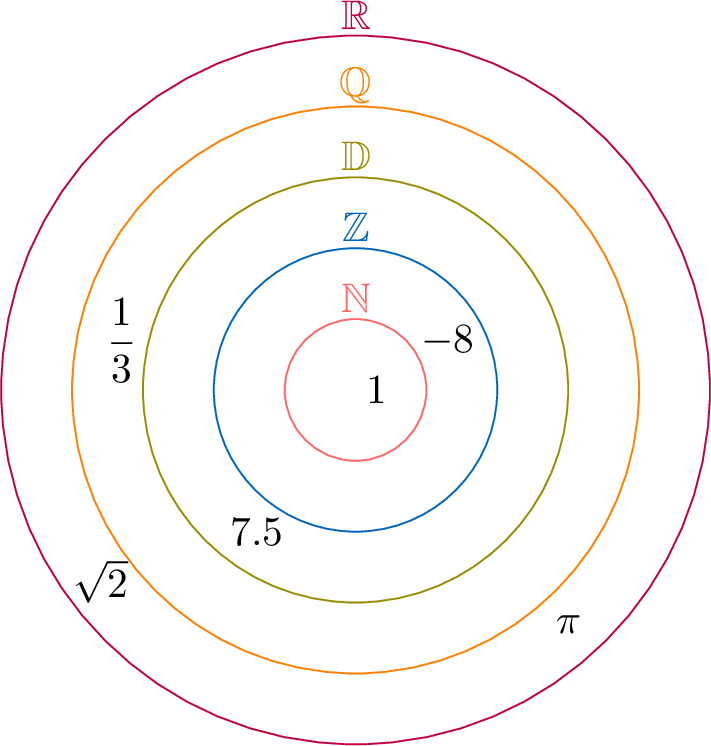
Proposition Characterization of Decimal Numbers
A number is a decimal number if and only if it can be written in the form \(\frac{a}{2^m \times 5^p}\) with \(a \in \mathbb{Z}, m \in \mathbb{N}, p \in \mathbb{N}\).
- \(\Rightarrow\) If \(x\) is a decimal number, by definition \(x = \frac{a}{10^n}\). Since \(10 = 2 \times 5\), we have \(10^n = 2^n \times 5^n\). Thus \(x = \frac{a}{2^n \times 5^n}\), which fits the form (where \(m=n\) and \(p=n\)).
- \(\Leftarrow\) Conversely, suppose \(x = \frac{a}{2^m \times 5^p}\). Let \(n = \max(m, p)\) be the larger of the two exponents. We can multiply the numerator and denominator by powers of 2 or 5 to make the exponents equal to \(n\).
$$ x = \frac{a \times 2^{n-m} \times 5^{n-p}}{2^n \times 5^n} = \frac{A}{10^n} $$Since the denominator is a power of 10, \(x\) is a decimal number.
Example
Consider the number \(\frac{7}{40}\).
- We factorize the denominator: \(40 = 8 \times 5 = 2^3 \times 5^1\).
- Since the prime factors are only 2 and 5, it is a decimal number.
- To write it with a denominator of \(10^n\) (here \(n=3\) is the highest exponent), we multiply top and bottom by \(5^2\): $$\frac{7}{40} = \frac{7}{2^3 \times 5^1} = \frac{7 \times 5^2}{2^3 \times 5^1 \times 5^2} = \frac{7 \times 25}{2^3 \times 5^3} = \frac{175}{10^3} = 0.175$$
Proposition Irrationality of \(\sqrt{2}\)
\(\sqrt{2}\) is an irrational number.
Assume \(\sqrt{2}\) is rational. Then \(\sqrt{2} = \frac{p}{q}\) where \(\frac{p}{q}\) is an irreducible fraction.
Squaring both sides: \(2 = \frac{p^2}{q^2} \implies p^2 = 2q^2\).
This implies \(p^2\) is even, so \(p\) must be even. Let \(p = 2k\).
Substitute back: \((2k)^2 = 2q^2 \implies 4k^2 = 2q^2 \implies 2k^2 = q^2\).
This implies \(q^2\) is even, so \(q\) must be even.If both \(p\) and \(q\) are even, they have a common factor of 2, contradicting that the fraction is irreducible.
Thus, \(\sqrt{2}\) cannot be rational.
Squaring both sides: \(2 = \frac{p^2}{q^2} \implies p^2 = 2q^2\).
This implies \(p^2\) is even, so \(p\) must be even. Let \(p = 2k\).
Substitute back: \((2k)^2 = 2q^2 \implies 4k^2 = 2q^2 \implies 2k^2 = q^2\).
This implies \(q^2\) is even, so \(q\) must be even.If both \(p\) and \(q\) are even, they have a common factor of 2, contradicting that the fraction is irreducible.
Thus, \(\sqrt{2}\) cannot be rational.
Intervals
Definition Interval
An interval is a set of all real numbers between two endpoints, which may or may not be included in the set.
Example
The set of all real numbers between \(0\) and \(1\), including \(1\) but not \(0\), is an interval. It is written as \(\{x \in \R \mid 0 < x \leq 1\}\).
Method Representing Intervals on a Number Line
Intervals are often shown on a number line using these conventions:
- An open point (empty circle) or a parenthesis/bracket facing outwards, means the endpoint is not included.
- A closed point (filled circle) or a bracket facing inwards, means the endpoint is included.
- An arrow shows that the interval extends indefinitely (to \(+\infty\) or \(-\infty\)).
Example
The number line representation of \(\{x \in \R \mid 0 < x \leq 1\}\) is:
Definition Interval Notation
| Interval Notation | Set-builder notation | Number line representation |
| \(\CloseBracketLeft a, b \CloseBracketRight\) | \(\{x \in \R \mid a \leqslant x \leqslant b\}\) |  |
| \(\CloseBracketLeft a, b \OpenBracketRight\) | \(\{x \in \R \mid a \leqslant x < b\}\) |  |
| \(\OpenBracketLeft a, b \CloseBracketRight\) | \(\{x \in \R \mid a < x \leqslant b\}\) |  |
| \(\OpenBracketLeft a, b \OpenBracketRight\) | \(\{x \in \R \mid a < x < b\}\) |  |
| \(\CloseBracketLeft a, +\infty\OpenBracketRight \) | \(\{x \in \R \mid a \leqslant x\}\) |  |
| \(\OpenBracketLeft a, +\infty \OpenBracketRight \) | \(\{x \in \R \mid a < x\}\) |  |
| \(\OpenBracketLeft -\infty, a\CloseBracketRight\) | \(\{x \in \R \mid x \leqslant a\}\) |  |
| \(\OpenBracketLeft -\infty, a\OpenBracketRight\) | \(\{x \in \R \mid x < a\}\) |  |
Absolute Value and Distance
Definition Absolute Value of a real number
The absolute value of a real number \(x\), denoted \(|x|\), is the distance of \(x\) from 0 on the number line.$$|x| = \begin{cases} x & \text{if } x \geqslant 0 \\
-x & \text{if } x < 0 \end{cases}$$
Example
\(|5| = 5\), \(|-5| = 5\), \(|0| = 0\), \(|\pi - 4| = 4 - \pi\) (since \(\pi \approx 3.14 < 4\)).
Definition Distance between two reals
The distance between two real numbers \(a\) and \(b\) on the number line is given by \(|b-a|\) (which is equal to \(|a-b|\)).
Example
The distance between -2 and 3 is \(|3 - (-2)| = |5| = 5\).
Proposition Interval defined by absolute value
Let \(a\) and \(r\) be two real numbers with \(r>0\).The inequality \(|x-a| \leqslant r\) is equivalent to \(x \in[a-r ; a+r]\).This represents the set of points whose distance from the center \(a\) is at most the radius \(r\).
Example
\(|x-3| \leqslant 2\) means the distance from \(x\) to 3 is less than or equal to 2.This corresponds to the interval \([3-2, 3+2] = [1, 5]\).
Definition Bounding a real number
To bound a real number \(x\) means to find two decimal numbers \(a\) and \(b\) such that \(a \leqslant x \leqslant b\). The difference \(b-a\) is called the amplitude of the bound.
Example
For \(\pi \approx 3.14159...\):
- Bound of amplitude 1: \(3 \leqslant \pi \leqslant 4\)
- Bound of amplitude 0.1: \(3.1 \leqslant \pi \leqslant 3.2\)
- Bound of amplitude \(10^{-2}\): \(3.14 \leqslant \pi \leqslant 3.15\)