Properties of Integers
Division with Remainders
Theorem Division with Remainder
For any two whole numbers, a \(\textcolor{olive}{\text{dividend}}\) and a non-zero \(\textcolor{colordef}{\text{divisor}}\), there exist unique \(\textcolor{colorprop}{\text{quotient}}\) and \(\textcolor{orange}{\text{remainder}}\) that are also whole numbers such that$$\begin{array}{ccccccccl} \textcolor{olive}{\text{Dividend}} &=& \textcolor{colordef}{\text{Divisor}} & \times & \textcolor{colorprop}{\text{Quotient}} & + & \textcolor{orange}{\text{Remainder}} & \text{with } & \textcolor{orange}{\text{Remainder}} \lt \textcolor{colordef}{\text{Divisor}}\\
\textcolor{olive}{13} &=& \textcolor{colordef}{3} & \times & \textcolor{colorprop}{4} & + & \textcolor{orange}{1} & \text{with } & \textcolor{orange}{1} \lt \textcolor{colordef}{3} \\
\end{array}$$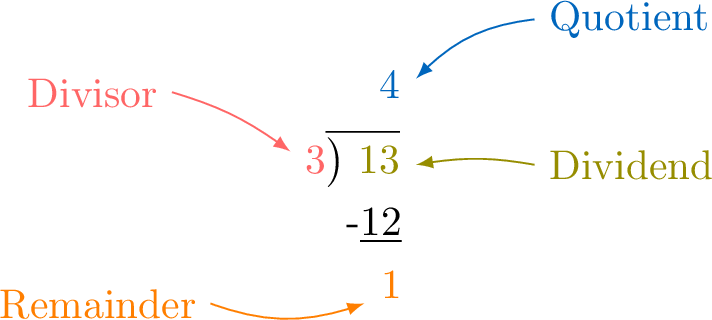
Divisibility
Definition Divisibility Relationships
We say that a non-zero natural integer \(b\) divides a natural integer \(a\) if \(a\) can be obtained by multiplying \(b\) by another integer \(k\):$$ a = k \times b $$In other words, the number \(a\) appears in the multiplication table of \(b\).
We can also use the following formulations:
We can also use the following formulations:
- \(b\) is a divisor of \(a\)
- \(b\) is a factor of \(a\)
- \(a\) is divisible by \(b\)
- \(a\) is a multiple of \(b\)
Example
Consider the numbers \(10\) and \(5\).
Since we can write \(\textcolor{olive}{10} = \textcolor{colorprop}{2} \times \textcolor{colordef}{5}\), we can say that:
Since we can write \(\textcolor{olive}{10} = \textcolor{colorprop}{2} \times \textcolor{colordef}{5}\), we can say that:
- \(\textcolor{colordef}{5}\) divides \(\textcolor{olive}{10}\).
- \(\textcolor{colordef}{5}\) is a divisor (or factor) of \(\textcolor{olive}{10}\).
- \(\textcolor{olive}{10}\) is divisible by \(\textcolor{colordef}{5}\).
- \(\textcolor{olive}{10}\) is a multiple of \(\textcolor{colordef}{5}\).
Method Check divisibility
To check if a number \(a\) is divisible by a number \(b\), perform the division with Remainder of \(a\) by \(b\).
- If the remainder is zero, then \(a\) is divisible by \(b\).
- If the remainder is not zero, then \(a\) is not divisible by \(b\).
Example
Is \(13\) divisible by \(5\)?
We perform the division of \(13\) by \(5\):$$\textcolor{olive}{13} = \textcolor{colordef}{5} \times \textcolor{colorprop}{2} + \textcolor{orange}{3}$$The remainder is \(\textcolor{orange}{3}\) (which is not zero). Therefore, \(\textcolor{olive}{13}\) is not divisible by \(\textcolor{colordef}{5}\).
Divisibility Criteria
Divisibility criteria are methods that allow us to quickly determine whether a whole number is divisible by another whole number without performing long division. These rules are useful for simplifying calculations and for understanding properties of numbers. Here are some common divisibility criteria:
Proposition Divisibility Criteria for 2 and 5
- A number is divisible by \(2\) if its last digit is even (\(0,2,4,6\) or \(8\)).
- A number is divisible by \(5\) if its last digit is \(0\) or \(5\).
Example
Determine whether \(946\) is divisible by \(2\).
\(946\) is divisible by \(2\) because its last digit is \(6\), which is even.
Example
Determine whether \(947\) is divisible by \(5\).
\(947\) is not divisible by \(5\) because its last digit is \(7\), which is not \(0\) or \(5\).
Proposition Divisibility Criteria for 3 and 9
- A number is divisible by \(3\) if the sum of its digits is divisible by \(3\).
- A number is divisible by \(9\) if the sum of its digits is divisible by \(9\).
Example
Determine whether \(948\) is divisible by \(3\).
\(948\) is divisible by \(3\) because the sum of its digits, \(9 + 4 + 8 = 21\), is divisible by \(3\) (\(21 = 3 \times 7\)).
Example
Determine whether \(948\) is divisible by \(9\).
\(948\) is not divisible by \(9\) because the sum of its digits, \(9 + 4 + 8 = 21\), is not divisible by \(9\) (\(21 = 9 \times 2 + 3\)).
Proposition Divisibility Criteria for 4
A number is divisible by \(4\) if the number formed by its last two digits is divisible by \(4\).
Example
Determine whether \(917\) is divisible by \(4\).
\(917\) is not divisible by \(4\) because the number formed by its last two digits, \(17\), is not divisible by \(4\) (\(17 = 4 \times 4 + 1\)).