Time
Time is a fundamental part of our world. It helps us measure and organize our lives. Understanding time allows us to plan our days, coordinate with others, and explore history. As we learn more about time, we can answer important questions such as:
- What time does the school bus arrive?
- How long until my birthday?
- How do we convert hours into minutes?
- When did the ancient Egyptians build the pyramids?
Units of Time
A unit of time is a standard way to measure how long something lasts. We choose the best unit based on the duration of the event.
Definition Common Units of Time
Here are the most common units, from smallest to largest:
- Second (s): For very short moments, like blinking an eye.
- Minute (min): For short durations, like the time it takes to brush your teeth.
- Hour (h): For longer activities, like a lesson at school or a movie.
- Day (d): A full cycle of daytime and nighttime.
- Week (wk): A group of 7 days.
- Month (mo): Used to divide a year into parts, such as the months in a season.
- Year (yr): A long period, used to measure our age or the time between holidays.
Example
Which unit of time is most appropriate for measuring how long it takes to run a 100-meter sprint?
A 100-meter sprint is a very fast event, usually lasting only a few seconds.
- An hour or a minute would be far too long.
- The best unit for this quick action is seconds (s).
Converting Units of Time
Definition Converting Units of Time
To convert between units, we must know their relationships: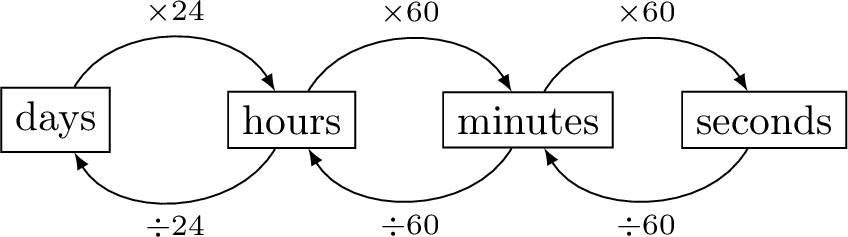
- 1 minute = 60 seconds
- 1 hour = 60 minutes
- 1 day = 24 hours
- 1 week = 7 days
- 1 year = 12 months \(\approx 52\) weeks = 365 days
Method How to Convert Units
- To convert from a larger unit to a smaller one, you multiply. (There are many smaller units in one larger unit.)
- To convert from a smaller unit to a larger one, you divide. (You are putting many small units together to make a bigger unit.)
Example
Convert 2 minutes to seconds.
We are going from a larger unit (minutes) to a smaller one (seconds), so we multiply.
Since 1 minute = 60 seconds:$$\begin{aligned}[t]2 \, \text{min} &= 2 \times 60 \, \text{s} \\ &= 120 \, \text{s}\end{aligned}$$So, 2 minutes is 120 seconds.
Since 1 minute = 60 seconds:$$\begin{aligned}[t]2 \, \text{min} &= 2 \times 60 \, \text{s} \\ &= 120 \, \text{s}\end{aligned}$$So, 2 minutes is 120 seconds.
Example
Convert 120 seconds to minutes.
We are going from a smaller unit (seconds) to a larger one (minutes), so we divide.
Since 1 minute = 60 seconds:$$\begin{aligned}[t]120 \div 60 &= 2 \\ 120 \, \text{s} &= 2 \, \text{min}\end{aligned}$$So, 120 seconds is 2 minutes.
Since 1 minute = 60 seconds:$$\begin{aligned}[t]120 \div 60 &= 2 \\ 120 \, \text{s} &= 2 \, \text{min}\end{aligned}$$So, 120 seconds is 2 minutes.
The 24-Hour Clock
Definition 24-Hour Time
The 24-hour clock is a system for telling time that avoids using AM and PM. The day runs from 00:00 (midnight) to 23:59. Sometimes 24:00 is used to show midnight at the very end of the day; it is the same moment as 00:00 on the next day. This format is used in many parts of the world, in the military, and for travel schedules to avoid confusion.
Example
Write 6:15 PM in 24-hour format.
To convert a PM time to 24-hour format, you add 12 to the hour.$$\begin{aligned}[t]6:15 \, \text{PM} &= 12 \, \text{h} + 6 \, \text{h} + 15 \, \text{min} \\
&= 18 \, \text{h} + 15 \, \text{min} \\
&= 18:15\end{aligned}$$So, 6:15 PM becomes 18:15.
Reading an Analog Clock
Method Reading to the Nearest 5 Minutes
- The Hour Hand (Short Hand): This hand moves slowly from one hour to the next. The hour is the number that the hand has just passed.
- The Minute Hand (Long Hand): This hand moves faster. To read the minutes, we skip-count by 5s starting from the 12. The number 1 is 5 minutes, 2 is 10 minutes, 3 is 15 minutes, and so on. The 12 represents 0 minutes, or "o'clock".
Example
What time does this clock show? It is morning.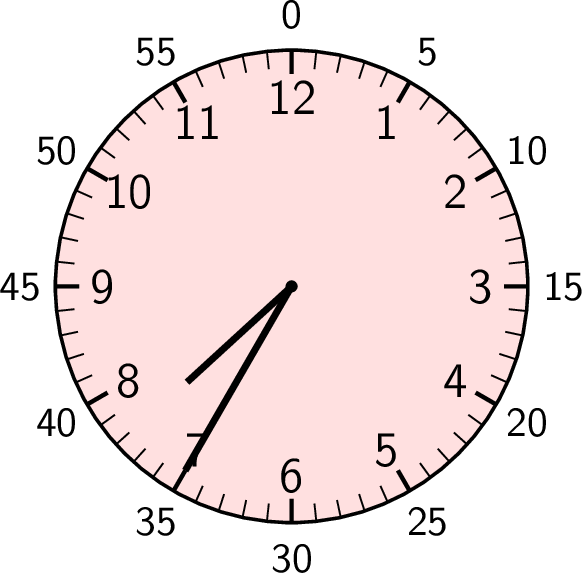
- The short hour hand has passed the 7 but has not reached the 8. Therefore, the hour is 7.
- The long minute hand is pointing at the 7. We skip-count by 5s: 5, 10, 15, 20, 25, 30, 35. The minutes are 35.
- The time is 7:35 in the morning.