Monotonicity of Sequences
Bounded Sequences
Definition Upper and Lower Bounds
Let \((u_n)\) be a sequence.
- \((u_n)\) is upper bounded if there exists a real \(M\) such that for all \(n\), \(\boldsymbol{u_n \le M}\). \(M\) is an upper bound.
- \((u_n)\) is lower bounded if there exists a real \(m\) such that for all \(n\), \(\boldsymbol{u_n \ge m}\). \(m\) is a lower bound.
- \((u_n)\) is bounded if it is both upper and lower bounded.
Example
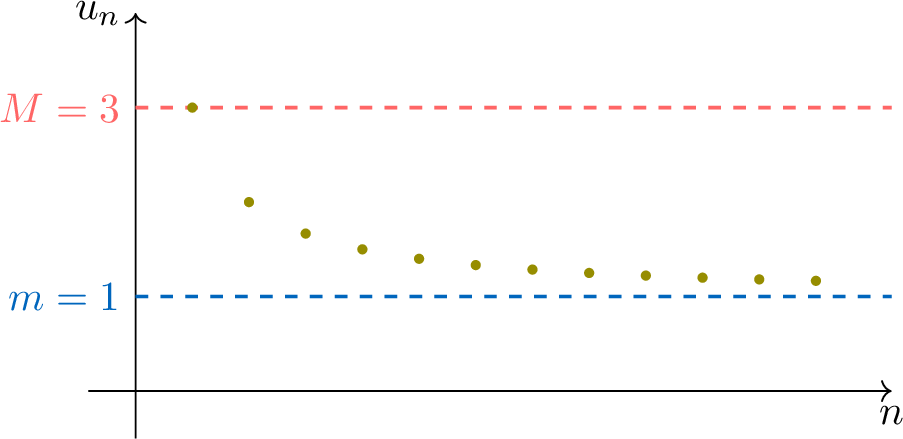
Consider \(u_n = 1 + \frac{2}{n}\) for \(n \ge 1\).
- Show that \((u_n)\) is bounded above by \(3\).
- Show that \((u_n)\) is bounded below by \(1\).
- Conclude that \((u_n)\) is bounded.
- For \(n \ge 1\), we have $$ \begin{aligned} n &\ge 1 \\ \frac{n}{n} &\ge \frac{1}{n} \\ \frac{1}{n} &\le 1 \\ \frac{2}{n} &\le 2 \\ 1+\frac{2}{n} &\le 1+2 \\ u_n &\le 3. \end{aligned} $$ Therefore, the sequence \((u_n)\) is bounded above by \(3\) (i.e. \(3\) is an upper bound).
- For \(n \ge 1\), we have$$\begin{aligned}n &\ge 1 \\ n &> 0 \\ \frac{1}{n} &> 0 \quad (\text{the reciprocal has the same sign})\\ \frac{2}{n} &> 0 \\ 1+\frac{2}{n} &> 1 \\ u_n &> 1.\end{aligned}$$Therefore, the sequence \((u_n)\) is bounded below by \(1\) (i.e. \(1\) is a lower bound).
- Therefore, \((u_n)\) is bounded.
Monotonicity and Convergence
Proposition Unbounded Monotonic Sequences
- If a sequence is increasing and not upper bounded, then it diverges to \(+\infty\).
- If a sequence is decreasing and not lower bounded, then it diverges to \(-\infty\).
Theorem Monotone Convergence Theorem
- If a sequence is increasing and upper bounded, then it converges.
- If a sequence is decreasing and lower bounded, then it converges.
Attention!
This theorem proves that a limit exists, but it does not necessarily give the value of the limit.
Example
Let \((u_n)\) be the sequence defined for \(n \ge 0\) by \(u_{n}=\dfrac{n-1}{n+4}\).
- Show that \((u_n)\) is upper bounded by \(1\).
- Show that \((u_n)\) is increasing.
- Conclude that \((u_n)\) converges.
- Boundedness (upper bound): $$\begin{aligned}1 - u_n &= 1 - \dfrac{n-1}{n+4}\\ 1 - u_n&= \dfrac{n+4}{n+4} - \dfrac{n-1}{n+4}\\ 1 - u_n&= \dfrac{n+4 - (n-1)}{n+4}\\ 1 - u_n&= \dfrac{5}{n+4}\\ 1 - u_n&>0\\ 1 &>u_n\\ \end{aligned}$$ For \(n\ge 0\), \(n+4>0\), hence \(\dfrac{5}{n+4}>0\), so \(1-u_n>0\), i.e. \(u_n<1\). So, \((u_n)\) is upper bounded by \(1\).
- Monotonicity: $$ \begin{aligned} u_{n+1}-u_n &= \frac{(n+1)-1}{(n+1)+4}-\frac{n-1}{n+4}\\ &= \frac{n}{n+5}-\frac{n-1}{n+4}\\ &= \frac{n(n+4)-(n-1)(n+5)}{(n+5)(n+4)}\\ &= \frac{n^2+4n-\bigl(n^2+5n-n-5\bigr)}{(n+5)(n+4)}\\ &= \frac{n^2+4n-(n^2+4n-5)}{(n+5)(n+4)}\\ &= \frac{5}{(n+5)(n+4)}\\ &>0\\ \end{aligned} $$ So, \((u_n)\) is increasing.
- Conclusion:
Since \((u_n)\) is increasing and upper bounded by \(1\), the Monotone Convergence Theorem implies that \((u_n)\) converges.
