Limits of Sequences
Infinite Limits
Definition Limit equal to \(+\infty\)
We say that a sequence \((u_n)\) has a limit of \(+\infty\) if every interval \((A, +\infty)\) (where \(A\) is a real number) contains all terms of the sequence from a certain index onwards. We write:$$\lim_{n \to +\infty} u_n = +\infty$$
Graphical Illustration
No matter how large the real number \(A\) is, we can find a natural number \(n_0\) such that for all \(n \ge n_0\), \(u_n > A\).
In intuitive terms: "no matter how high the horizontal barrier \(A\) is placed, the terms \(u_n\) eventually manage to stay above it permanently."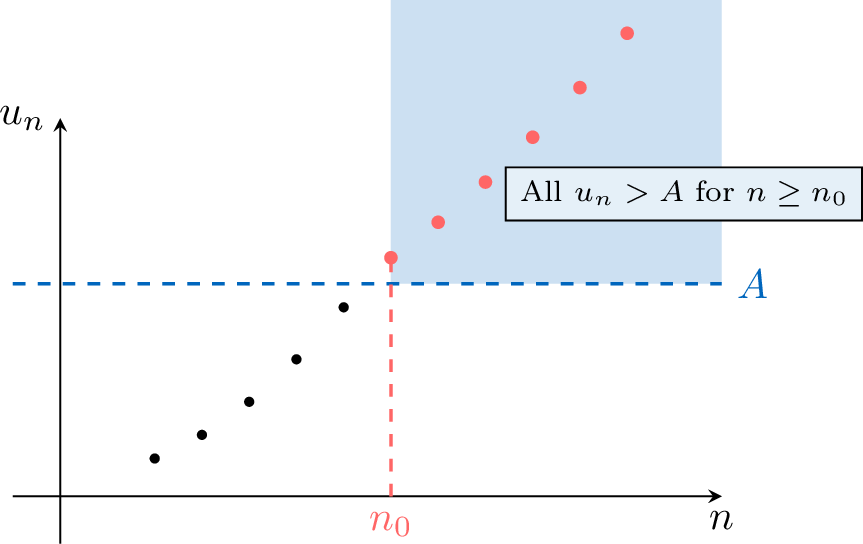
In intuitive terms: "no matter how high the horizontal barrier \(A\) is placed, the terms \(u_n\) eventually manage to stay above it permanently."
Example
The sequences \((n)\), \((n^2)\), \((\sqrt{n})\), and \((e^n)\) all have limit \(+\infty\).
Definition Limit equal to \(-\infty\)
We say that a sequence \((u_n)\) has a limit of \(-\infty\) if every interval \((-\infty, A)\) (where \(A\) is a real number) contains all terms of the sequence from a certain index onwards. We write:$$\lim_{n \to +\infty} u_n = -\infty$$
Graphical Illustration
No matter how small (negative) the real number \(A\) is, we can find a natural number \(n_0\) such that for all \(n \ge n_0\), \(u_n < A\).In intuitive terms: "no matter how low the horizontal barrier \(A\) is placed, the terms \(u_n\) eventually manage to stay below it permanently."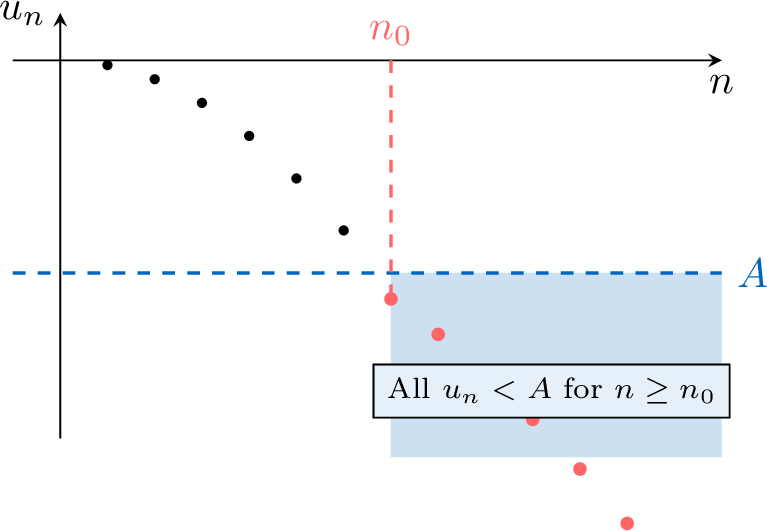
Example
The sequences \((-2n)\), \((-n^2)\) and \((-5\sqrt{n})\) all have limit \(-\infty\).
Finite Limits and Convergence
Definition Limit equal to a Real Number \(\ell\)
We say that a sequence \((u_n)\) converges to a real number \(\ell\) if every open interval containing \(\ell\) contains all the terms from some index onwards. We write:$$\lim_{n \to +\infty} u_n = \ell$$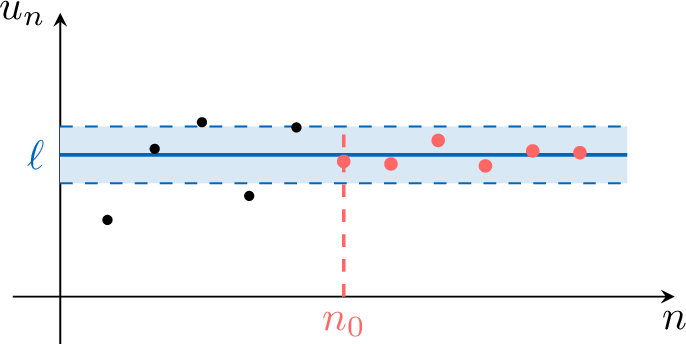
Definition Divergent Sequence
A sequence that does not have a finite limit is called a divergent sequence. This includes sequences that tend to \(\pm\infty\) and sequences that have no limit at all.
Example
The sequence defined by \(u_n = (-1)^n\) has no limit. It alternates between \(-1\) and \(1\) and never settles toward a specific value. It is therefore a divergent sequence.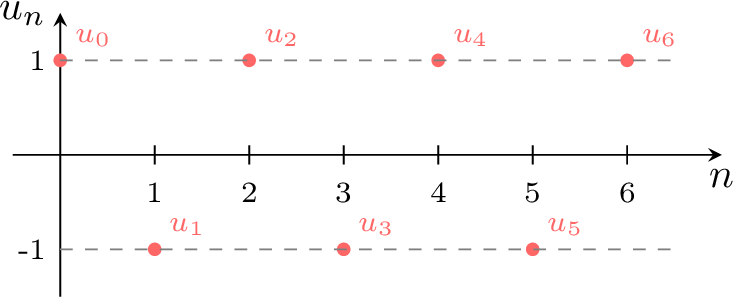
Operations on Limits
Proposition Sum and Product Rules
Let \(\ell\) and \(\ell'\) be real numbers.
- Sum:
\(\displaystyle \lim_{n \to +\infty} u_n\) \(\ell\) \(\ell\) \(+\infty\) \(-\infty\) \(+\infty\) \(-\infty\) \(\displaystyle \lim_{n \to +\infty} v_n\) \(\ell'\) \(+\infty\) \(+\infty\) \(-\infty\) \(-\infty\) \(+\infty\) \(\displaystyle \lim_{n \to +\infty} (u_n+v_n)\) \(\ell+\ell'\) \(+\infty\) \(+\infty\) \(-\infty\) IF IF - Product:
\(\displaystyle \lim_{n \to +\infty} u_n\) \(\ell\) \(\ell \neq 0\) \(\pm\infty\) \(0\) \(\displaystyle \lim_{n \to +\infty} v_n\) \(\ell'\) \(\pm\infty\) \(\pm\infty\) \(\pm\infty\) \(\displaystyle \lim_{n \to +\infty} (u_n \times v_n)\) \(\ell\ell'\) \(\pm\infty\) (sign rule) \(\pm\infty\) (sign rule) IF
Proposition Quotient Rule
Let \((u_n)\) and \((v_n)\) be two sequences such that for all \(n\), \(v_n \neq 0\).
- Case where \(\lim v_n = \ell' \neq 0\) or \(\pm\infty\)
\(\displaystyle \lim_{n \to +\infty} u_n\) \(\ell\) \(\ell\) \(+\infty\) \(+\infty\) \(-\infty\) \(-\infty\) \(\pm\infty\) \(\displaystyle \lim_{n \to +\infty} v_n\) \(\ell' \neq 0\) \(\pm\infty\) \(\ell'>0\) \(\ell'<0\) \(\ell'>0\) \(\ell'<0\) \(\pm\infty\) \(\displaystyle \lim_{n \to +\infty} \left(\frac{u_n}{v_n}\right)\) \(\frac{\ell}{\ell'}\) \(0\) \(+\infty\) \(-\infty\) \(-\infty\) \(+\infty\) IF - Case where \(\lim v_n = 0\)
\(\displaystyle \lim_{n \to +\infty} u_n\) \(\ell>0\) or \(+\infty\) \(\ell<0\) or \(-\infty\) \(\ell>0\) or \(+\infty\) \(\ell<0\) or \(-\infty\) \(0\) \(\displaystyle \lim_{n \to +\infty} v_n\) \(0\) (pos.) \(0\) (pos.) \(0\) (neg.) \(0\) (neg.) \(0\) \(\displaystyle \lim_{n \to +\infty} \left(\frac{u_n}{v_n}\right)\) \(+\infty\) \(-\infty\) \(-\infty\) \(+\infty\) IF
Proposition Limits of Arithmetic Sequences
Let \((u_n)\) be an arithmetic sequence with common difference \(d\).
- If \(\boldsymbol{d > 0}\), then \(\displaystyle \lim_{n \to +\infty} u_n = +\infty\).
- If \(\boldsymbol{d < 0}\), then \(\displaystyle \lim_{n \to +\infty} u_n = -\infty\).
An arithmetic sequence is defined by its general term: \(u_n = u_0 + n \times d\).
To find the limit, we apply the rules for operations on limits:
To find the limit, we apply the rules for operations on limits:
- Case \(d > 0\):
- We know the reference limit: \(\displaystyle \lim_{n \to +\infty} n = +\infty\).
- Since \(d\) is a strictly positive constant, by the product rule: $$\displaystyle \lim_{n \to +\infty} (n \times d) = +\infty$$
- Adding the constant \(u_0\), by the sum rule: $$\displaystyle \lim_{n \to +\infty} (u_0 + nd) = +\infty$$
- Case \(d < 0\):
- We know: \(\displaystyle \lim_{n \to +\infty} n = +\infty\).
- Since \(d\) is a strictly negative constant, by the product rule: \(\displaystyle \lim_{n \to +\infty} (n \times d) = -\infty\).
- Adding the constant \(u_0\), by the sum rule: \(\displaystyle \lim_{n \to +\infty} (u_0 + nd) = -\infty\).
Example
- Let \(u_n = 5 + 3n\). Since \(d=3 > 0\), \(\displaystyle\lim_{n \to +\infty} u_n = +\infty\).
- Let \(v_n = 10 - 2n\). Since \(d=-2 < 0\), \(\displaystyle\lim_{n \to +\infty} v_n = -\infty\).
Comparison and Squeeze Theorems
Theorem Comparison for Infinite Limits
Let \((u_n)\) and \((v_n)\) be two sequences.
If (1) from a certain index \(n_0\) onwards, \(u_n \ge v_n\), and if (2) \(\displaystyle \lim_{n \to +\infty} v_n = +\infty\),
then:$$\lim_{n \to +\infty} u_n = +\infty$$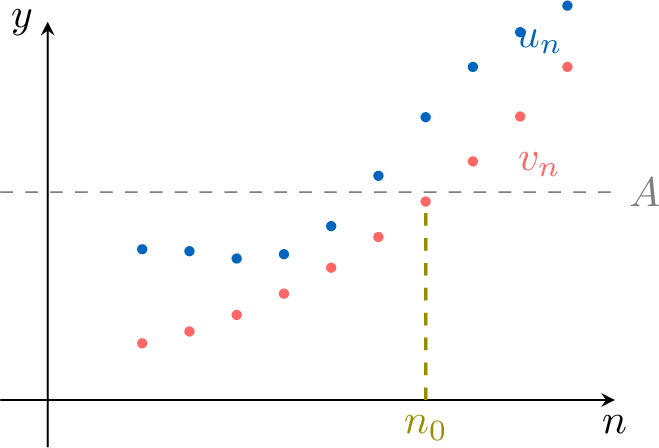
If (1) from a certain index \(n_0\) onwards, \(u_n \ge v_n\), and if (2) \(\displaystyle \lim_{n \to +\infty} v_n = +\infty\),
then:$$\lim_{n \to +\infty} u_n = +\infty$$
Theorem Squeeze Theorem / Sandwich Theorem
Let \((u_n)\), \((v_n)\), and \((w_n)\) be three sequences.
If (1) from a certain index onwards, \(\textcolor{colordef}{v_n} \leqslant \textcolor{olive}{u_n} \leqslant \textcolor{colorprop}{w_n}\), and (2) \(\displaystyle \lim_{n \to +\infty} v_n = \lim_{n \to +\infty} w_n = \ell\),
then the sequence \((u_n)\) converges and \(\displaystyle\lim_{n \to +\infty} u_n = \ell\).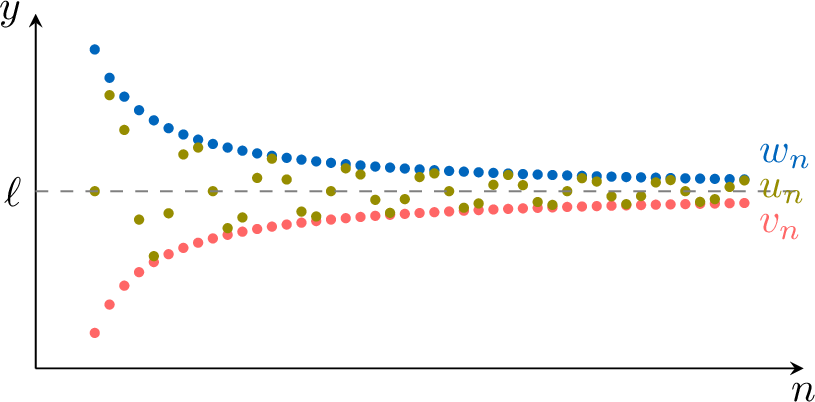
If (1) from a certain index onwards, \(\textcolor{colordef}{v_n} \leqslant \textcolor{olive}{u_n} \leqslant \textcolor{colorprop}{w_n}\), and (2) \(\displaystyle \lim_{n \to +\infty} v_n = \lim_{n \to +\infty} w_n = \ell\),
then the sequence \((u_n)\) converges and \(\displaystyle\lim_{n \to +\infty} u_n = \ell\).
Example
Calculate the limit of the sequence \((u_n)\) defined for \(n \ge 1\) by \(u_n = \dfrac{(-1)^n}{n}\).
For all \(n \ge 1\), we know that \(-1 \le (-1)^n \le 1\).
Since \(n > 0\), we can divide all parts of the inequality by \(n\) without changing the signs:$$-\frac{1}{n} \le \frac{(-1)^n}{n} \le \frac{1}{n}$$We know that: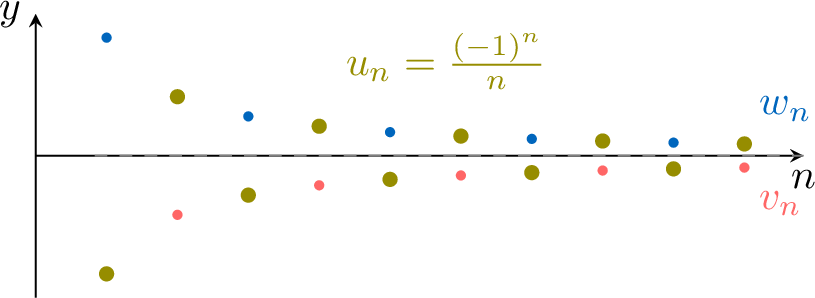
Since \(n > 0\), we can divide all parts of the inequality by \(n\) without changing the signs:$$-\frac{1}{n} \le \frac{(-1)^n}{n} \le \frac{1}{n}$$We know that:
- \(\displaystyle \lim_{n \to +\infty} -\frac{1}{n} = 0\)
- \(\displaystyle \lim_{n \to +\infty} \frac{1}{n} = 0\)
Limits of Geometric Sequences
Proposition Limits of Geometric Sequences
Let \(q\) be a real number. The limit of the sequence \((q^n)\) depends on the value of \(q\):
- If \(\boldsymbol{q > 1}\), then \(\displaystyle \lim_{n \to +\infty} q^n = +\infty\).
- If \(\boldsymbol{-1 < q < 1}\), then \(\displaystyle \lim_{n \to +\infty} q^n = 0\).
- If \(\boldsymbol{q = 1}\), then the sequence is constant and \(\displaystyle \lim_{n \to +\infty} q^n = 1\).
- If \(\boldsymbol{q \le -1}\), then the sequence has no limit (it diverges).
- (\(q > 1\)):
We use Bernoulli's Inequality: for all \(a > 0\) and \(n \in \mathbb{N}\), \((1+a)^n \ge 1 + na\).
Let \(q = 1 + a\) where \(a = q - 1 > 0\).
Then \(q^n = (1 + a)^n \ge 1 + na\).
We know that \(\displaystyle \lim_{n \to +\infty} (1 + na) = +\infty\) because \(a > 0\).
By the Comparison Theorem, since \(q^n \ge 1 + na\), we conclude:$$\lim_{n \to +\infty} q^n = +\infty$$ - (\(-1 < q < 1\)):
If \(q = 0\), the limit is obviously 0.
If \(0 < |q| < 1\), let \(Q = \frac{1}{|q|}\). Then \(Q > 1\).
From the previous proof, we know \(\displaystyle \lim_{n \to +\infty} Q^n = +\infty\).
Since \(|q|^n = \frac{1}{Q^n}\), then \(\displaystyle \lim_{n \to +\infty} |q|^n = 0\).
By the Squeeze Theorem (-\(|q|^n\leq q^n\leq |q|^n\)), we conclude:$$\lim_{n \to +\infty} q^n = 0$$
Example
- \(\displaystyle \lim_{n \to +\infty} 1.05^n = +\infty\) because \(1.05 > 1\).
- \(\displaystyle \lim_{n \to +\infty} \left(\frac{1}{2}\right)^n = 0\) because \(-1 < 0.5 < 1\).
- The sequence \(((-2)^n)\) has no limit because \(-2 \le -1\).