Writing in Prime Factors: level 2
Prime Factorization
Method Prime Factorization
Prime factorization of a number is writing that number as a product of prime numbers only. In other words, it is finding which prime numbers you need to multiply together to get the original number.
Example
Find the prime factorization of \(12\).
The prime factorization is \(12 = 2 \times 2 \times 3\).
The order is not important. You can write \(12 = 3 \times 2 \times 2\).
The prime factorization is not \(12 = 2 \times 6\) because \(6\) is a composite number.
The order is not important. You can write \(12 = 3 \times 2 \times 2\).
The prime factorization is not \(12 = 2 \times 6\) because \(6\) is a composite number.
Method Factor Tree
The factor tree method involves breaking down a composite number into smaller factors, then breaking down those factors further until you have only prime factors.
- Place the number at the top of the factor tree.
- Check if the number is prime.
- If the number is prime: Circle it. You are done with this branch.
- If the number is composite: Factor it into two smaller factors. Write these two factors as branches below the number. Repeat step 2 for each of these new factors.
- The prime factorization is the product of all circled prime numbers on the tree.
Example
Find a prime factorization of \(24\).
- Step 1:

- Step 2: \(24\) is a composite number. \(24 = 2 \times 12\).
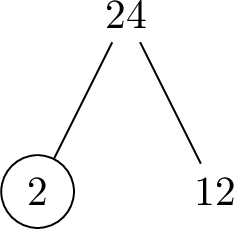
- Step 3: \(12\) is a composite number. \(12 = 2 \times 6\).
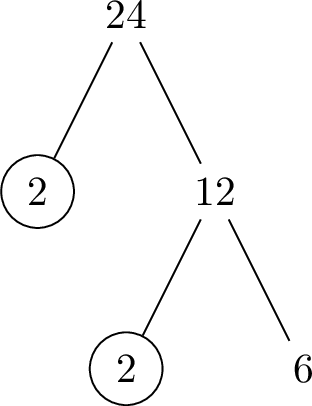
- Step 4: \(6\) is a composite number. \(6 = 2 \times 3\).
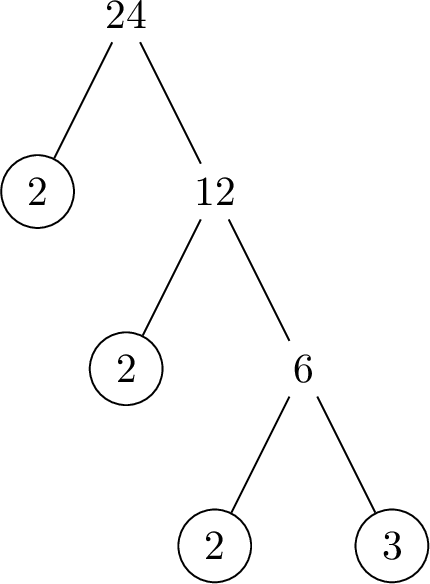
Prime Factorization
Exercise
Write the number as a product of prime factors :\(12=\)
- Solution 1:
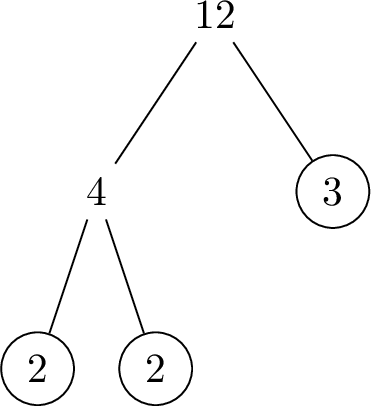
- Solution 2:
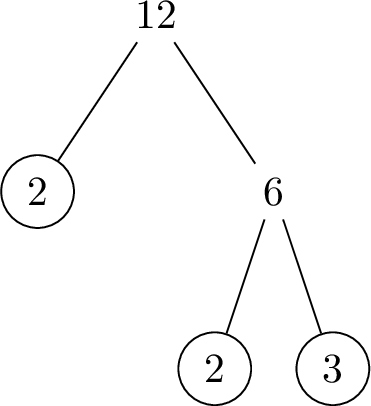
Exercise
Write the number as a product of prime factors :\(18=\)
- Solution 1:
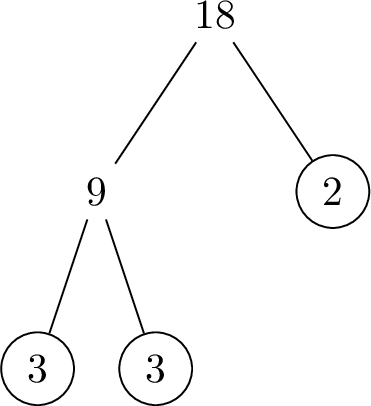
- Solution 2:
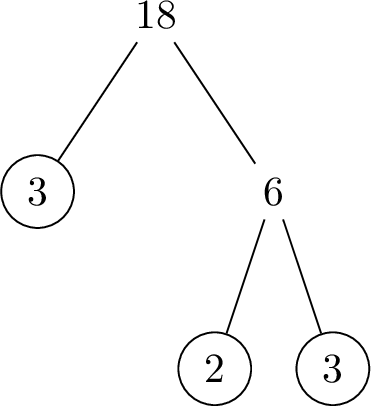
Exercise
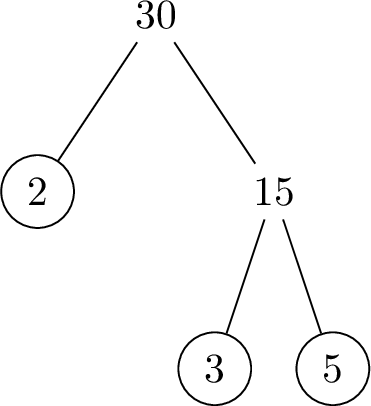
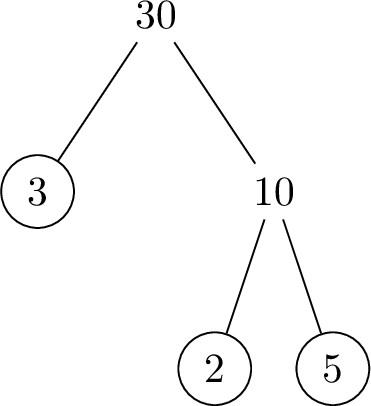
Write the number as a product of prime factors :\(30=\)
- Solution 1:
- Solution 2:
Exercise
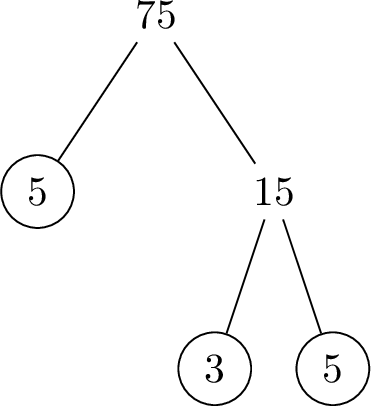
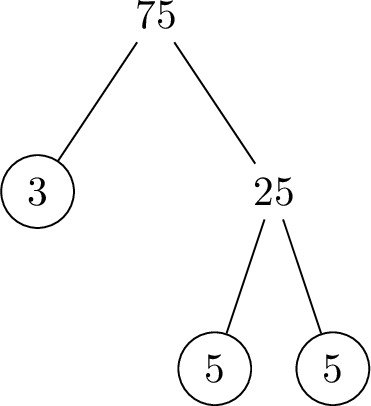
Write the number as a product of prime factors :\(75=\)
- Solution 1:
- Solution 2: