Quadratic Functions
In previous studies, you explored linear functions, whose graphs are straight lines. We now move to the next level of complexity: quadratic functions. These are functions containing an \(x^2\) term, and their graphs are elegant, symmetrical curves called parabolas. Quadratic functions are essential in mathematics and science for modeling everything from the path of a thrown ball to the shape of a satellite dish. In this chapter, you will learn to identify, write in different forms, graph, and solve these important functions.
Forms of the Quadratic Function
A quadratic function can be expressed in three main forms. Each form highlights different key features of its graph, the parabola. Being able to recognize and convert between these forms is a fundamental skill.
Standard Form
Definition Quadratic Function
A quadratic function is a function that can be written in the form $$f(x) = ax^2 + bx + c$$ where \(a, b,\) and \(c\) are real numbers and \(\boldsymbol{a \neq 0}\).
Vertex Form
Definition Vertex Form
The vertex form of a quadratic function is:$$ f(x) = a(x-h)^2 + k $$where \(a, h,\) and \(k\) are real numbers and \(\boldsymbol{a \neq 0}\).
Method Converting from Vertex to Standard Form
To convert from vertex to standard form, expand the squared term and collect like terms.
Example
Convert \(f(x) = 2(x-3)^2 + 1\) to standard form.$$ \begin{aligned}f(x) &= 2(x^2 - 6x + 9) + 1 &&\color{gray}{(\text{Expand }(x-3)^2)} \\
&= 2x^2 - 12x + 18 + 1 &&\color{gray}{(\text{Distribute the 2})} \\
&= \boldsymbol{2x^2 - 12x + 19} &&\color{gray}{(\text{Combine constants})}\end{aligned} $$
$$ \begin{aligned}f(x) &= 2(x^2 - 6x + 9) + 1 &&\color{gray}{(\text{Expand }(x-3)^2}) \\
&= 2x^2 - 12x + 18 + 1 &&\color{gray}{(\text{Distribute the 2})} \\
&= \boldsymbol{2x^2 - 12x + 19} &&\color{gray}{(\text{Combine constants})}\end{aligned} $$
Method Converting from Standard to Vertex Form
There are two common methods to convert a quadratic function from standard form, \(f(x)=ax^2+bx+c\), to vertex form, \(f(x)=a(x-h)^2+k\).
- Method 1: Completing the Square
- Factor out the coefficient \(a\) from the \(x^2\) and \(x\) terms: \(a(x^2 + \frac{b}{a}x) + c\).
- Inside the parentheses, add and subtract the square of half the coefficient of \(x\): \(a\left(x^2 + \frac{b}{a}x + \left(\frac{b}{2a}\right)^2 - \left(\frac{b}{2a}\right)^2\right) + c\).
- Factor the perfect square trinomial: \(a\left(\left(x + \frac{b}{2a}\right)^2 - \left(\frac{b}{2a}\right)^2\right) + c\).
- Distribute \(a\) to the constant term and simplify to get the form \(a(x-h)^2 + k\).
- Method 2: Using the Vertex Formula
- Find the x-coordinate of the vertex using the formula: \(\boldsymbol{h = -\frac{b}{2a}}\).
- Find the y-coordinate of the vertex by substituting \(h\) back into the function: \(\boldsymbol{k = f(h)}\).
- Substitute the values of \(a\), \(h\), and \(k\) into the vertex form: \(f(x) = a(x-h)^2 + k\).
Example
Convert \(f(x) = 2x^2 - 12x + 19\) to vertex form.
- Method 1: Completing the Square$$ \begin{aligned}f(x) &= 2(x^2 - 6x) + 19 && \color{gray}\text{(Factor out 2)} \\ &= 2(x^2 - 6x + 9 - 9) + 19 && \color{gray}\text{(Add and subtract } (6/2)^2 = 9) \\ &= 2\left((x-3)^2 - 9\right) + 19 && \color{gray}\text{(Factor perfect square)} \\ &= 2(x-3)^2 - 18 + 19 && \color{gray}\text{(Distribute 2)} \\ &= \boldsymbol{2(x-3)^2 + 1}\end{aligned} $$
- Method 2: Using the Vertex Formula
For \(f(x)=2x^2 - 12x + 19\), we have \(a=2, b=-12, c=19\).- Find h: \(h = -\dfrac{b}{2a} = -\dfrac{-12}{2(2)} = \dfrac{12}{4} = 3\).
- Find k: \(k = f(3) = 2(3)^2 - 12(3) + 19 = 2(9) - 36 + 19 = 18 - 36 + 19 = 1\).
- Write in vertex form: With \(a=2, h=3, k=1\), the function is \(\boldsymbol{f(x) = 2(x-3)^2 + 1}\).
Factored Form
Definition Factored Form
The factored form of a quadratic function is:$$ f(x) = a(x-p)(x-q) $$where \(a, p,\) and \(q\) are real numbers and \(\boldsymbol{a \neq 0}\).
Method Converting from Factored to Standard Form
To convert from factored form to standard form, expand the brackets and collect like terms.
Example
Convert \(f(x) = 2(x-3)(x-1)\) to standard form.
$$ \begin{aligned}f(x) &=2(x-3)(x-1)\\
&= 2(x^2 - x - 3x + 3) \\
&= 2(x^2 - 4x + 3) \\
&= \boldsymbol{2x^2 - 8x + 6}\end{aligned} $$
Method Converting from Standard to Factored Form
To convert from standard form to factored form, find the roots of the function by solving \(f(x)=0\). If the roots are \(p\) and \(q\), the factored form is \(f(x)=a(x-p)(x-q)\). The value of \(a\) is the same as in the standard form.
Example
Convert \(f(x) = 2x^2 - 8x + 6\) to factored form.
We solve \(2x^2 - 8x + 6 = 0\). First, divide by 2: \(x^2 - 4x + 3 = 0\).
The roots are \(p=1, q=3\).
The factored form is \(\boldsymbol{f(x) = 2(x-1)(x-3)}\).
The roots are \(p=1, q=3\).
The factored form is \(\boldsymbol{f(x) = 2(x-1)(x-3)}\).
Analysis and Graphing of Parabolas
Each form of a quadratic function reveals key features of its parabolic graph. By understanding how to interpret each form, we can accurately sketch the graph and analyze the function's behavior. We begin with the simplest quadratic, \(y=x^2\), and use transformations to understand the other forms.
The Base Parabola: \(y\equal x^2\)
Proposition Key Features
The graph of the function \(f(x)=x^2\) is a parabola with the following properties: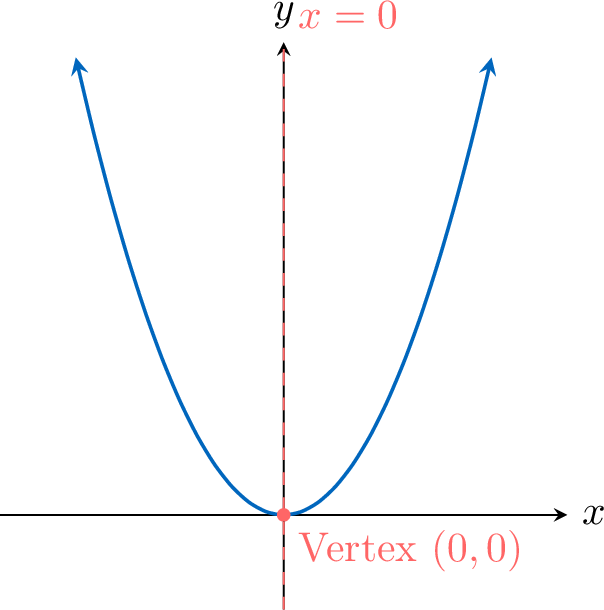
- It is concave up.
- Its axis of symmetry is the line \(x = 0\).
- Its vertex is at the point \((0, 0)\).
Vertex Form and Transformations
The vertex form \(f(x)=a(x-h)^2 + k\) is the result of applying transformations to the base graph of \(y=x^2\).
Proposition Key Features from Vertex Form
The graph of \(y=a(x-h)^2 + k\) is a parabola with: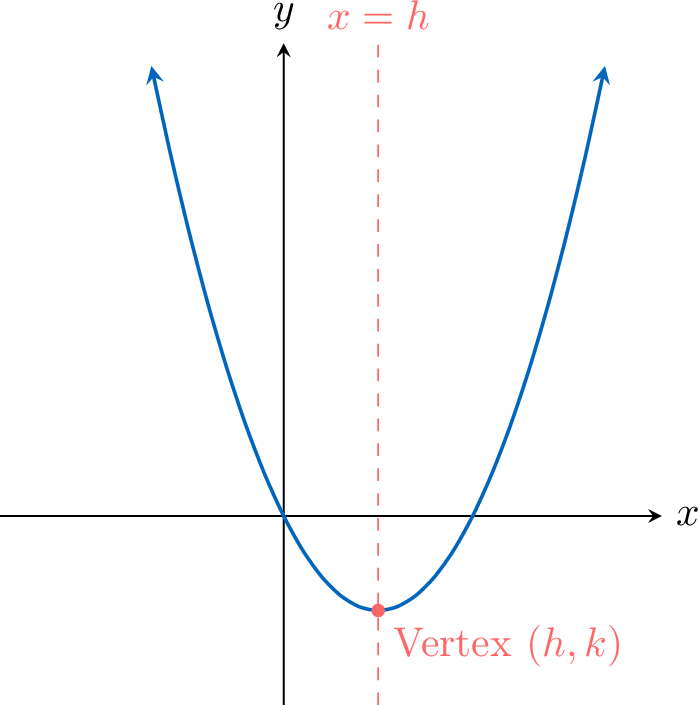
- Concavity: Determined by the sign of \(a\).
- If \(a > 0\), concave up.

- If \(a < 0\), concave down.

- If \(a > 0\), concave up.
- Axis of Symmetry: The line \(x = h\).
- Vertex: The point \((h, k)\).
The graph of \(y=a(x-h)^2+k\) is obtained by transforming the graph of \(y=x^2\) as follows:
- Horizontal translation by h: \(y=(x-h)^2\). This moves the vertex from \((0,0)\) to \((h,0)\).
- Vertical dilation by a: \(y=a(x-h)^2\). The concavity now depends on the sign of \(a\).
- Vertical translation by k: \(y=a(x-h)^2+k\). This moves the vertex from \((h,0)\) to \((h,k)\).
Factored Form and x-intercepts
Proposition Key Features from Factored Form
The graph of a quadratic function \(f(x)=a(x-p)(x-q)\) is a parabola with: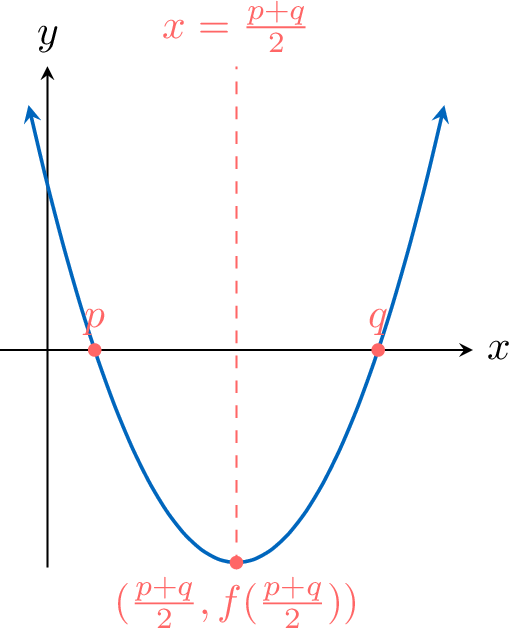
- Concavity: Determined by the sign of \(a\).
- If \(a > 0\), concave up.
- If \(a < 0\), concave down.
- If \(a > 0\), concave up.
- \(x\)-intercepts: The graph crosses the x-axis at \((p,0)\) and \((q,0)\).
- If \(p \neq q\), there are two distinct \(x\)-intercepts.
- If \(p=q\), there is only one \(x\)-intercept at \((p,0)\), which is also the vertex. The graph touches the x-axis at this point.
- Axis of Symmetry: The line \(x = \frac{p+q}{2}\).
- Vertex: The point \((\frac{p+q}{2},f(\frac{p+q}{2}))\).
- x-intercepts: The x-intercepts are found by solving \(f(x)=0\). $$ a(x-p)(x-q)=0 $$ By the null factor law, this is true if \(x-p=0\) or \(x-q=0\). Thus, the roots are \(\boldsymbol{x=p}\) and \(\boldsymbol{x=q}\).
- Axis of Symmetry and Vertex: An axis of symmetry at \(x=h\) requires that the function has the same value for any horizontal distance \(d\) to the left or right of the axis. Algebraically, this means \(f(h-d) = f(h+d)\) for any \(d\).
Let's test the proposed axis of symmetry \(h=\frac{p+q}{2}\). We need to show that \(f\left(\frac{p+q}{2} - d\right) = f\left(\frac{p+q}{2} + d\right)\).- Left side: $$ \begin{aligned} f\left(\frac{p+q}{2} - d\right) &= a\left(\left(\frac{p+q}{2} - d\right) - p\right)\left(\left(\frac{p+q}{2} - d\right) - q\right) \\ &= a\left(\frac{q-p}{2} - d\right)\left(\frac{p-q}{2} - d\right) \\ &= a\left(-\left(\frac{p-q}{2} + d\right)\right)\left(\frac{p-q}{2} - d\right) \\ &= -a\left(\left(\frac{p-q}{2}\right)^2 - d^2\right) \end{aligned} $$
- Right side: $$ \begin{aligned} f\left(\frac{p+q}{2} + d\right) &= a\left(\left(\frac{p+q}{2} + d\right) - p\right)\left(\left(\frac{p+q}{2} + d\right) - q\right) \\ &= a\left(\frac{q-p}{2} + d\right)\left(\frac{p-q}{2} + d\right) \\ &= a\left(-\left(\frac{p-q}{2} - d\right)\right)\left(\frac{p-q}{2} + d\right) \\ &= -a\left(\left(\frac{p-q}{2}\right)^2 - d^2\right) \end{aligned} $$
Standard Form and the Discriminant
Proposition Key Features from Standard Form
The graph of a quadratic function \(f(x)=ax^2+bx+c\) is a parabola with: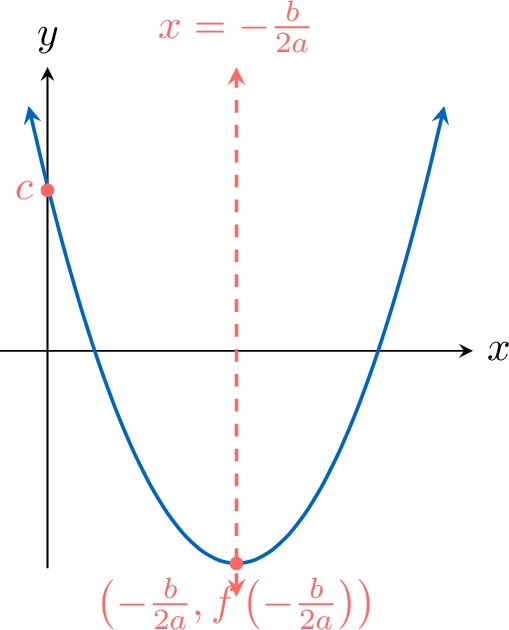
- Concavity: Determined by the sign of \(a\).
- If \(a > 0\), concave up.
- If \(a < 0\), concave down.
- If \(a > 0\), concave up.
- Axis of Symmetry: The line \(x = -\frac{b}{2a}\).
- Vertex: The point \(\left(-\frac{b}{2a}, f\left(-\frac{b}{2a}\right)\right)\).
- y-intercept: The point \((0, c)\).
By expanding the vertex form \(f(x) = a(x-h)^2+k\), we get:$$f(x) = a(x^2 - 2hx + h^2) + k = ax^2 - 2ahx + (ah^2+k)$$Comparing this to the standard form \(f(x)=ax^2+bx+c\), we can equate coefficients:$$b = -2ah \implies h = -\frac{b}{2a}$$This confirms the formulas for the axis of symmetry and the vertex.
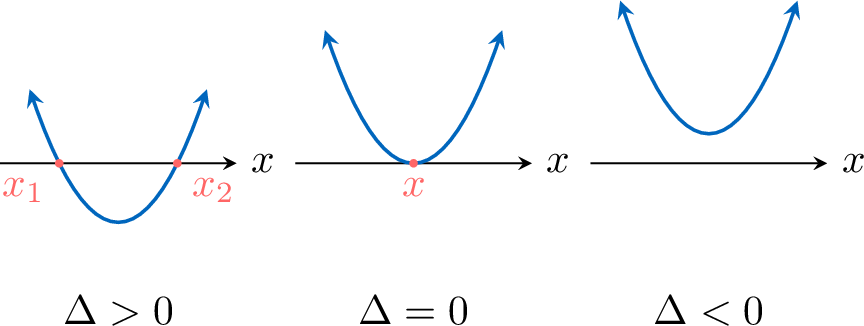
The discriminant of a quadratic function indicates the number of x-intercepts (real roots).
Definition Discriminant
For a quadratic function \(f(x) = ax^2 + bx + c\), the discriminant, denoted by \(\boldsymbol{\Delta}\), is:$$ \boldsymbol{\Delta = b^2 - 4ac} $$
Proposition Nature of Roots
- If \(\boldsymbol{\Delta > 0}\), there are two distinct x-intercepts. The roots are \(x_1 = \frac{-b - \sqrt{\Delta}}{2a}\) and \(x_2 = \frac{-b + \sqrt{\Delta}}{2a}\).
- If \(\boldsymbol{\Delta = 0}\), there is one x-intercept (at the vertex). The root is \(x = \frac{-b}{2a}\).
- If \(\boldsymbol{\Delta < 0}\), there are no x-intercepts.
Applications of Quadratic Functions
Intersection of Curves
A common problem is to find where the graphs of two functions meet. The intersection points are the points \((x,y)\) that satisfy both equations simultaneously. By setting the function rules equal to each other, we can create a new equation to solve for the x-coordinates of these points.
Method Finding Intersection Points
To find the points of intersection between the graphs of two functions \(f(x)\) and \(g(x)\):
- Set the functions equal to each other: \(\boldsymbol{f(x) = g(x)}\).
- Solve this equation for \(x\). The solutions are the \(x\)-coordinates of the intersection points.
- Substitute each \(x\)-coordinate back into either of the original functions (\(f\) or \(g\)) to find the corresponding y-coordinate.
Example
Find the coordinates of the intersection points of the parabola \(f(x) = x^2 - x - 2\) and the line \(g(x) = x+1\).
We find the intersection points by setting \(f(x) = g(x)\) and solving for \(x\).$$ \begin{aligned}f(x) &= g(x) \\
x^2 - x - 2 &= x+1 \\
x^2 - 2x - 3 &= 0 \\
(x-3)(x+1) &= 0\end{aligned} $$This gives two solutions for \(x\): \(x=3\) and \(x=-1\).
Now we find the corresponding \(y\)-coordinates by substituting these values into the linear function \(g(x)=x+1\):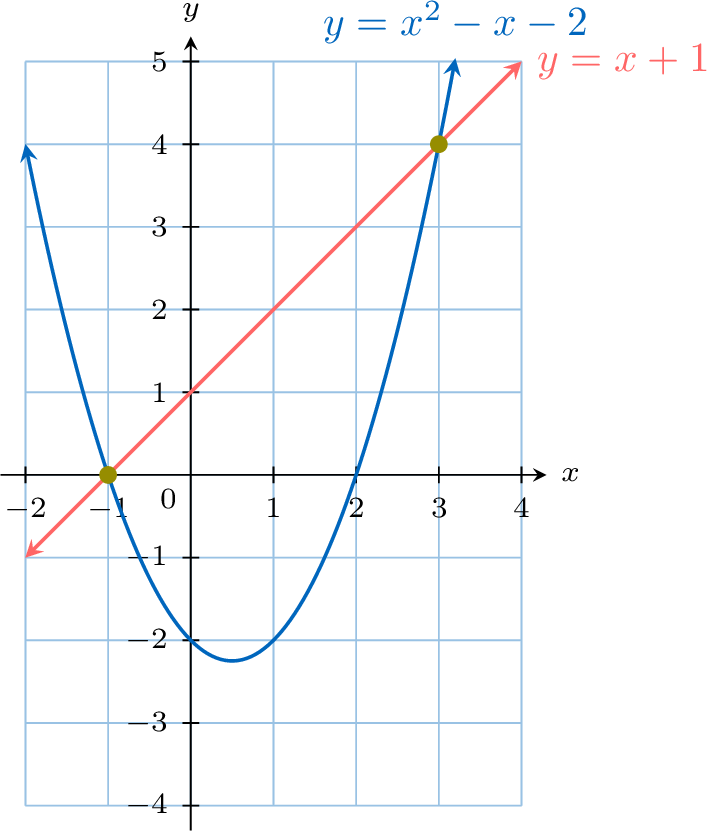
Now we find the corresponding \(y\)-coordinates by substituting these values into the linear function \(g(x)=x+1\):
- If \(x=3\), \(y = 3+1 = 4\).
- If \(x=-1\), \(y = -1+1 = 0\).
Quadratic Optimisation
Because the graph of a quadratic function has a vertex that is either the absolute highest point (maximum) or lowest point (minimum) on the graph, quadratic functions are extremely useful for solving **optimization problems**. These are problems where we want to find the maximum or minimum value of a certain quantity.
Method Solving Optimization Problems
- Read the problem to identify the quantity to be maximized or minimized.
- Define variables and write a quadratic function that models this quantity.
- Find the coordinates of the vertex \((h,k)\) of the parabola.
- \(h = -\frac{b}{2a}\) gives the input value (e.g., time, length, price) where the optimum occurs.
- \(k = f(h)\) gives the optimal (maximum or minimum) value itself.
- Answer the question in the context of the problem, making sure to include units.
Example
A farmer wants to fence a rectangular area next to a river. He has 120 m of fencing and does not need to fence the side along the river. What dimensions will maximize the area?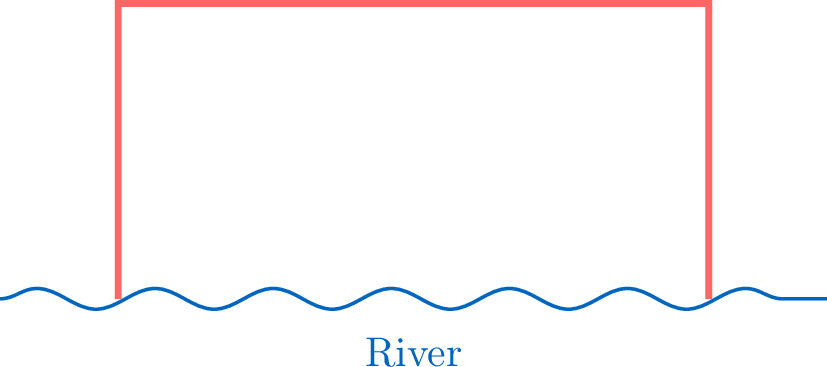
- Define variables and the function: Let \(x\) be the width of the rectangle (perpendicular to the river) and let \(y\) be the length (parallel to the river). The total fencing is 120 m, which covers the two sides of width \(x\) and the one side of length \(y\). The constraint equation is: $$\begin{aligned} 2x + y &= 120 \\ y &= 120 - 2x\end{aligned} $$ The area, \(A\), which we want to maximize, is given by the function: $$\begin{aligned}A(x) &= \text{width} \times \text{length}\\ &= x \cdot y \\ &= x(120 - 2x)\\ &= -2x^2 + 120x\end{aligned} $$
- Analyze the function: This is a quadratic function with \(a=-2\). Since \(a<0\), the parabola opens downwards and has a maximum value at its vertex.
- Find the vertex: The x-coordinate of the vertex gives the width that maximizes the area. $$ x_{vertex} = -\frac{b}{2a} = -\frac{120}{2(-2)} = -\frac{120}{-4} = 30 $$ This means the optimal width is 30 m.
- Find the dimensions:
- Width: \(x = 30\) m.
- Length: \(y = 120 - 2x = 120 - 2(30) = 60\) m.
- State the conclusion: The dimensions that maximize the area are 30 m by 60 m. The maximum area itself is \(A(30) = 30 \times 60 = 1800 \text{ m}^2\).