Limits
The ancient Greek philosopher Zeno of Elea famously argued that motion was impossible. In his paradox of Achilles and the Tortoise, the swift hero Achilles can never overtake a slow tortoise given a head start, because by the time Achilles reaches the tortoise's starting point, the tortoise has already moved a little further ahead. When Achilles covers that new distance, the tortoise has moved ahead again. This process repeats endlessly, suggesting Achilles can never close the gap.
This paradox highlights a profound mathematical problem: how do we handle the infinitely small and the concept of "approaching" a value? It took mathematicians like Augustin-Louis Cauchy and Karl Weierstrass over two millennia to formalize the answer with the concept of the limit. A limit describes the value a function "approaches" as its input gets closer and closer to a certain point. It is a foundational concept in calculus, because it underlies the definitions of both derivatives and integrals.
This paradox highlights a profound mathematical problem: how do we handle the infinitely small and the concept of "approaching" a value? It took mathematicians like Augustin-Louis Cauchy and Karl Weierstrass over two millennia to formalize the answer with the concept of the limit. A limit describes the value a function "approaches" as its input gets closer and closer to a certain point. It is a foundational concept in calculus, because it underlies the definitions of both derivatives and integrals.
Definition
Definition Limit
A function \(f\) has the limit \(L\) as \(x\) approaches \(a\) if the values of \(f(x)\) become arbitrarily close to the single real number \(L\) whenever \(x\) is sufficiently close to \(a\) (but not necessarily equal to \(a\)), from both sides. We write this as:$$ \textcolor{colordef}{\lim_{x \to a} f(x) = L}\quad\text{or}\quad\textcolor{colordef}{f(x) \xrightarrow[x \to a]{} L}\quad\text{or}\quad\textcolor{colordef}{\text{as } x \to a,\ f(x)\to L}$$
The crucial idea of a limit is that it describes the behaviour of a function near a point, not at the point itself. The value of \(f(a)\), or whether it even exists, is irrelevant to the value of the limit.
Consider the function \(f(x) = \dfrac{x^2-1}{x-1}\). At \(x=1\), the function is undefined. However, for any \(x \neq 1\), we can simplify:$$ f(x) = \dfrac{(x-1)(x+1)}{x-1} = x+1. $$The graph of \(f(x)\) is the line \(y=x+1\) with a "hole" at \(x=1\). As \(x\) gets very close to 1 from either side, the value of \(f(x)\) gets very close to 2. Therefore, \(\displaystyle\lim_{x \to 1} f(x) = 2\), even though \(f(1)\) is not defined.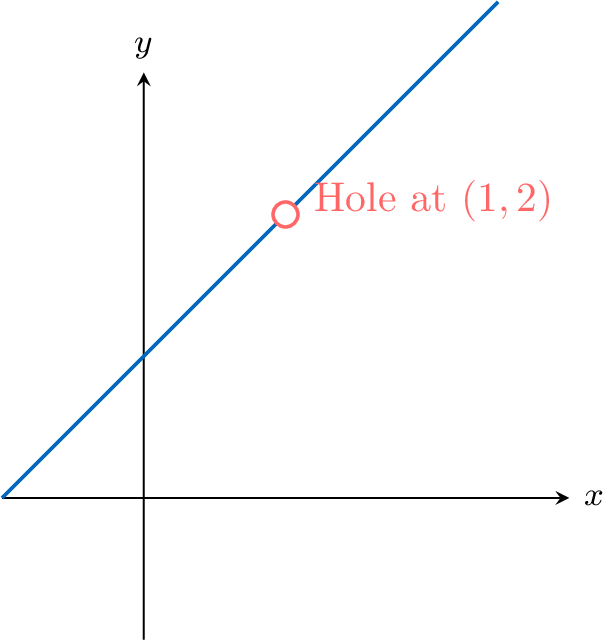
Consider the function \(f(x) = \dfrac{x^2-1}{x-1}\). At \(x=1\), the function is undefined. However, for any \(x \neq 1\), we can simplify:$$ f(x) = \dfrac{(x-1)(x+1)}{x-1} = x+1. $$The graph of \(f(x)\) is the line \(y=x+1\) with a "hole" at \(x=1\). As \(x\) gets very close to 1 from either side, the value of \(f(x)\) gets very close to 2. Therefore, \(\displaystyle\lim_{x \to 1} f(x) = 2\), even though \(f(1)\) is not defined.
Existence of a Limit
Definition One-Sided Limits
- The right-hand limit, \(\displaystyle\lim_{x \to a^+} f(x)\), is the value that \(f(x)\) approaches as \(x\) approaches \(a\) from values greater than \(a\).
- The left-hand limit, \(\displaystyle\lim_{x \to a^-} f(x)\), is the value that \(f(x)\) approaches as \(x\) approaches \(a\) from values less than \(a\).
Proposition Existence of a Limit
The two-sided limit \(\displaystyle\lim_{x \to a} f(x)\) exists if and only if the left-hand and right-hand limits both exist and are equal:$$ \displaystyle\lim_{x \to a} f(x) = L \iff \displaystyle\lim_{x \to a^-} f(x) = L \text{ and } \displaystyle\lim_{x \to a^+} f(x) = L $$
Example
Consider the piecewise function \(f(x) = \begin{cases} x, & x < 1 \\ x^2, & x \ge 1 \end{cases}\). Does \(\lim_{x \to 1} f(x)\) exist?
To determine if the limit exists, we must find the left-hand and right-hand limits and check if they are equal.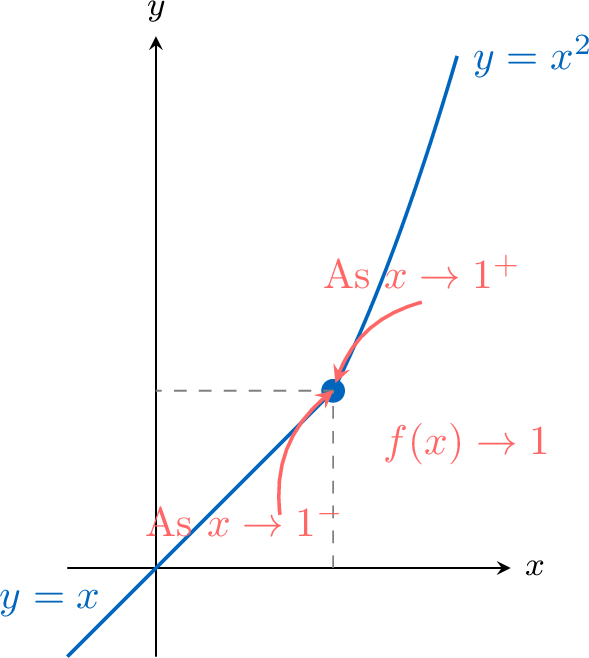
- Left-hand limit: As \(x \to 1^-\), we use the rule for \(x<1\).$$ \lim_{x \to 1^-} f(x) = \lim_{x \to 1^-} (x) = 1 $$
- Right-hand limit: As \(x \to 1^+\), we use the rule for \(x \ge 1\).$$ \lim_{x \to 1^+} f(x) = \lim_{x \to 1^+} (x^2) = 1^2 = 1 $$
Example
Consider the piecewise function \(f(x) = \begin{cases} x+1, & x < 1 \\ x^2, & x \ge 1 \end{cases}\). Does \(\lim_{x \to 1} f(x)\) exist?
To determine if the limit exists, we must find the left-hand and right-hand limits and check if they are equal.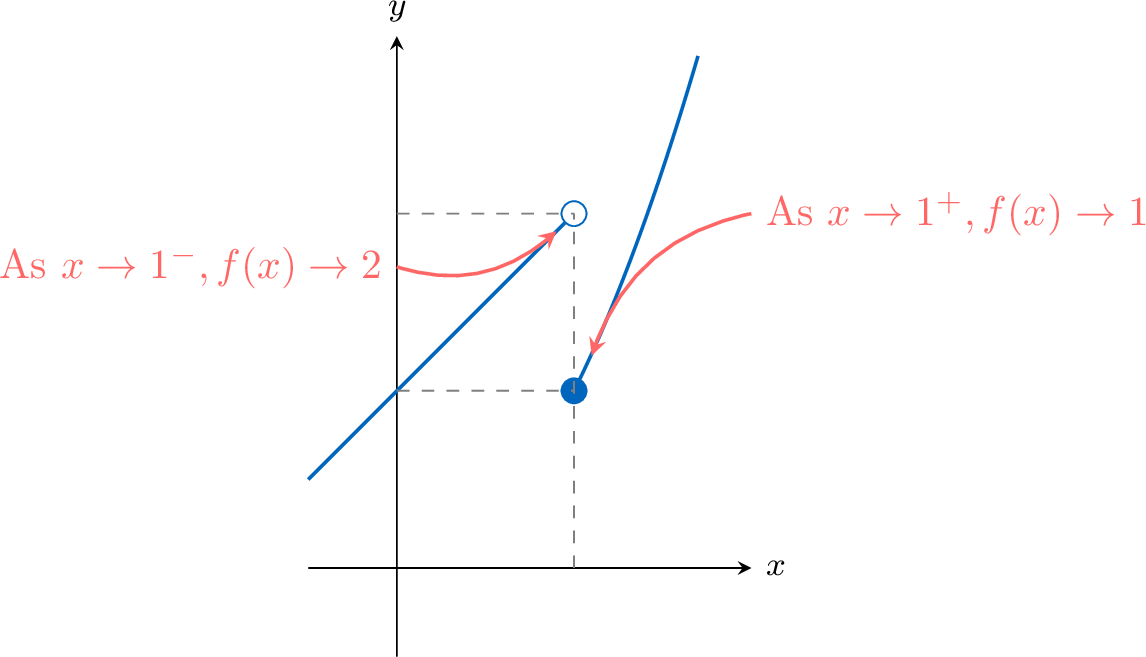
- Left-hand limit: As \(x \to 1^-\), we use the rule for \(x<1\).$$ \lim_{x \to 1^-} f(x) = \lim_{x \to 1^-} (x+1) = 1+1 = 2 $$
- Right-hand limit: As \(x \to 1^+\), we use the rule for \(x \ge 1\).$$ \lim_{x \to 1^+} f(x) = \lim_{x \to 1^+} (x^2) = 1^2 = 1 $$
Infinite Limits and Vertical Asymptotes
We have seen that a limit fails to exist if the function approaches different values from the left and right. Another way a limit can fail to exist is if the function's values grow without bound, approaching positive or negative infinity. While these limits do not technically exist as finite numbers, we use limit notation as a precise way to describe this "unbounded behaviour," which corresponds to a vertical asymptote on a graph.
Definition Infinite Limit
The notation \(\displaystyle\lim_{x \to a} f(x) = +\infty\) means that the values of \(f(x)\) can be made arbitrarily large and positive by taking \(x\) sufficiently close to \(a\) (from both sides).
Similarly for \(\displaystyle\lim_{x \to a} f(x) = -\infty\).
In this situation we say that the limit diverges to \(+\infty\) or \(-\infty\); it is not a finite real number.
Similarly for \(\displaystyle\lim_{x \to a} f(x) = -\infty\).
In this situation we say that the limit diverges to \(+\infty\) or \(-\infty\); it is not a finite real number.
Definition Vertical Asymptote
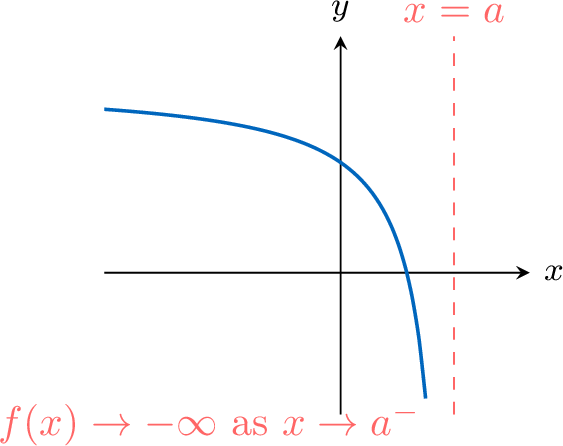
The line \(x=a\) is a vertical asymptote of the graph of the function \(f(x)\) if the function approaches \(+\infty\) or \(-\infty\) as \(x\) approaches \(a\) from the left or the right.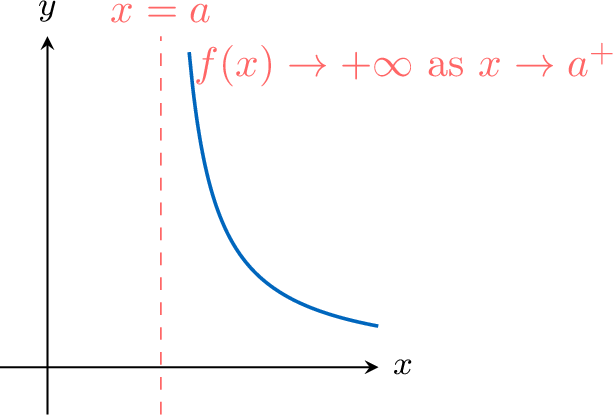
Example
Investigate \(\displaystyle\lim_{x \to 0} \dfrac{1}{x^2}\).
Direct substitution of \(x=0\) results in \(\dfrac{1}{0}\), which is undefined, suggesting a vertical asymptote at \(x=0\). We check the one-sided limits: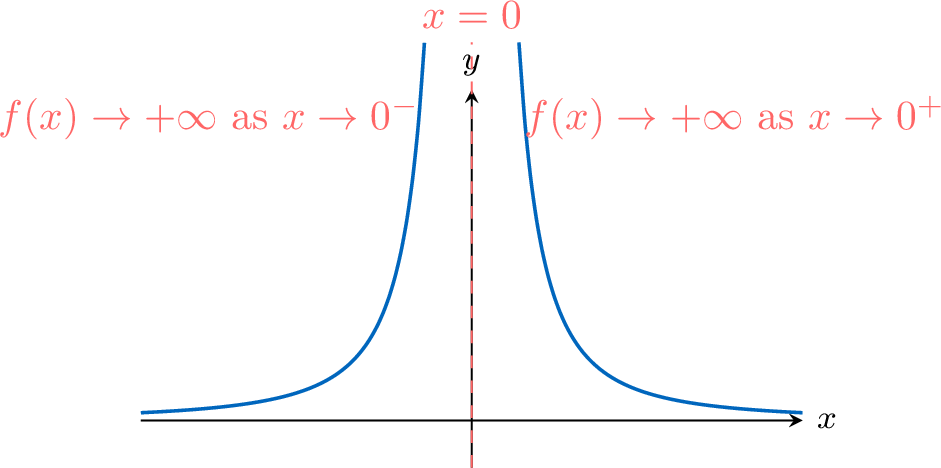
- As \(x \to 0^+\), \(x^2\) is a small positive number, so \(\dfrac{1}{x^2} \to +\infty\).
- As \(x \to 0^-\), \(x^2\) is also a small positive number, so \(\dfrac{1}{x^2} \to +\infty\).
Limits at Infinity
Limits at infinity describe the end behaviour of a function. When \(\displaystyle\lim_{x \to \infty} f(x) = L\) (or \(\displaystyle\lim_{x \to -\infty} f(x) = L\)), the line \(y=L\) is a horizontal asymptote of the graph.
Definition Limit at Infinity
A function \(f\) has the limit \(L\) as \(x\) approaches \(+\infty\) when the values of \(f(x)\) become arbitrarily close to the single real number \(L\) for all sufficiently large \(x\). We write:$$ \textcolor{colordef}{\lim_{x \to +\infty} f(x) = L}\quad\text{or}\quad\textcolor{colordef}{f(x) \xrightarrow[x \to +\infty]{} L}. $$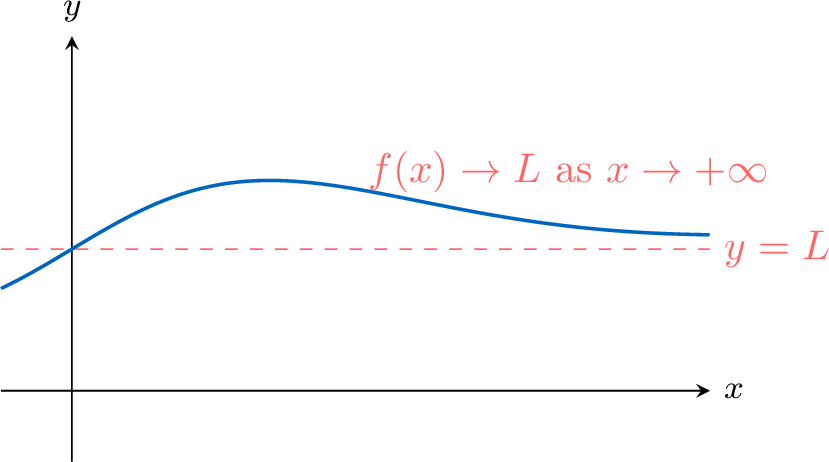
Definition Horizontal Asymptote
The line \(y=L\) is a horizontal asymptote of the graph of the function \(f(x)\) if either of the following limit conditions is met:$$ \lim_{x \to \infty} f(x) = L \quad \text{or} \quad \lim_{x \to -\infty} f(x) = L $$
Reference Limits and Operations
Proposition Reference Limits
The following limits for standard functions are used as building blocks for more complex calculations:
| Function | \(\mathbf{x \to -\infty}\) | \(\mathbf{x \to +\infty}\) | \(\mathbf{x \to 0^-}\) | \(\mathbf{x \to 0^+}\) |
| \(1/x\) | \(0\) | \(0\) | \(-\infty\) | \(+\infty\) |
| \(x^n\) (\(n \in \mathbb{N}^*\)) | \(+\infty\) (even) / \(-\infty\) (odd) | \(+\infty\) | 0 | 0 |
| \(e^x\) | \(0\) | \(+\infty\) | 1 | 1 |
| \(\sqrt{x}\) | Undefined | \(+\infty\) | Undefined | \(0\) |
| \(1/\sqrt{x}\) | Undefined | \(0\) | Undefined | \(+\infty\) |
While tables of values and graphs are useful for understanding the concept of a limit, they are not efficient for evaluation. Fortunately, limits follow a set of predictable algebraic rules, known as the Limit Laws, which allow us to calculate them directly.
Proposition Operations on Limits
Let \(L\) and \(L'\) be real numbers. The following tables summarize the rules for limits of sums, products, and quotients involving infinity.
- Sum and Product:
\(\lim f(x)\) \(\lim g(x)\) \(\lim (f(x)+g(x))\) \(\lim (f(x) \times g(x))\) \(L\) \(L'\) \(L+L'\) \(L \times L'\) \(L\neq 0\) \(\pm \infty\) \(\pm \infty\) \(\pm \infty\) (sign rule) \(\pm \infty\) \(\pm \infty\) \(\pm \infty\) (if same sign) \(\pm \infty\) (sign rule) \(0\) \(\pm \infty\) \(\pm \infty\) Indeterminate Form \(+\infty\) \(-\infty\) Indeterminate Form \(-\infty\) - Quotient:
\(\lim f(x)\) \(\lim g(x)\) \(\lim \dfrac{f(x)}{g(x)}\) \(L\) \(L' \neq 0\) \(\dfrac{L}{L'}\) \(L\) \(\pm \infty\) \(0\) \(L \neq 0\) \(0\) \(\pm \infty\) (sign rule) \(\pm \infty\) \(L' \neq 0\) \(\pm \infty\) (sign rule) \(0\) \(0\) Indeterminate Form \(\pm \infty\) \(\pm \infty\) Indeterminate Form
Method Evaluating Limits
- Direct Substitution (when applicable): Always start by substituting \(x=a\) into \(f(x)\).
- If the expression is defined at \(x=a\) (no division by \(0\), no square root of a negative number, etc.) and the function is continuous at \(a\) (as is the case for polynomials, rational functions where the denominator is nonzero, \(e^x\), \(\ln x\) on its domain, etc.), then:$$\lim_{x\to a} f(x)=f(a).$$
- If the expression is not defined, or if the function may have a discontinuity, direct substitution is not sufficient: we must transform the expression or study one-sided limits.
- Algebraic Manipulation: If substitution leads to an indeterminate form such as \(\dfrac{0}{0}\), simplify the expression by:
- factoring and cancelling common factors (when allowed);
- using a conjugate (for expressions with roots);
- rewriting the expression (common denominator, factoring out dominant terms, etc.).
Caution: Direct substitution is reliable for continuous functions. However, if a function has a discontinuity (a “jump”), a hole, or different formulas on either side of a point (such as the floor function \(\lfloor x \rfloor\)), substitution can be misleading. In that case, study one-sided limits or transform the expression first.
Limit of a Composite Function
Proposition Limit of a Composite Function
Let \(a, L\) and \(M\) be real numbers or \(\pm\infty\).
If \(\displaystyle\lim_{x \to a} g(x) = L\) and if \(\displaystyle\lim_{X \to L} f(X) = M\), then:$$ \lim_{x \to a} f(g(x)) = M. $$
If \(\displaystyle\lim_{x \to a} g(x) = L\) and if \(\displaystyle\lim_{X \to L} f(X) = M\), then:$$ \lim_{x \to a} f(g(x)) = M. $$
In practice, to find the limit of \(f(g(x))\), we first determine what the "inner" part \(g(x)\) approaches, and then find the limit of \(f\) at that value.
Example
Evaluate \(\displaystyle\lim_{x \to +\infty} e^{\frac{1}{x}}\).
We decompose the function into an inner part \(g(x)\) and an outer part \(f(X)\):
- Inner limit: \(\displaystyle\lim_{x \to +\infty} \dfrac{1}{x} = 0\).
- Outer limit: \(\displaystyle\lim_{X \to 0} e^X = e^0 = 1\).
The Squeeze Theorem
Some limits, particularly those involving oscillating functions like \(\sin(1/x)\), cannot be evaluated using direct substitution or standard algebraic manipulation alone. For these cases, we may be able to use the Squeeze Theorem (also known as the Sandwich Theorem). The idea is to find two simpler functions that "squeeze" or "sandwich" the more complex function between them. If these two outer functions approach the same limit, then the function trapped in the middle must also approach that same limit.
Proposition The Squeeze Theorem
Suppose that for all \(x\) in some interval around \(a\) (except possibly at \(x=a\)):$$ g(x) \le f(x) \le h(x). $$And suppose that:$$ \lim_{x \to a} g(x) = \lim_{x \to a} h(x) = L. $$Then, we can conclude that:$$ \lim_{x \to a} f(x) = L. $$
Example
Evaluate \(\displaystyle\lim_{x \to 0} x^2 \sin\left(\dfrac{1}{x}\right)\).
We cannot use direct substitution because \(\sin(1/0)\) is undefined. The function \(f(x) = x^2 \sin(1/x)\) is made of two parts: \(x^2\), which approaches \(0\), and \(\sin(1/x)\), which oscillates infinitely between \(-1\) and \(1\) as \(x \to 0\). This suggests using the Squeeze Theorem.
We start with the known range of the sine function:$$ -1 \le \sin\left(\dfrac{1}{x}\right) \le 1. $$Since \(x^2 \ge 0\), we can multiply the entire inequality by \(x^2\) without changing the direction of the inequality signs:$$ -x^2 \le x^2 \sin\left(\dfrac{1}{x}\right) \le x^2. $$We have now "squeezed" our function between \(g(x)=-x^2\) and \(h(x)=x^2\). Next, we find the limits of these outer functions as \(x \to 0\):$$ \lim_{x \to 0} (-x^2) = 0 \quad \text{and} \quad \lim_{x \to 0} (x^2) = 0. $$Since our function is trapped between two functions that both approach the limit \(0\), by the Squeeze Theorem, our limit must also be \(0\):$$ \lim_{x \to 0} x^2 \sin\left(\dfrac{1}{x}\right) = 0. $$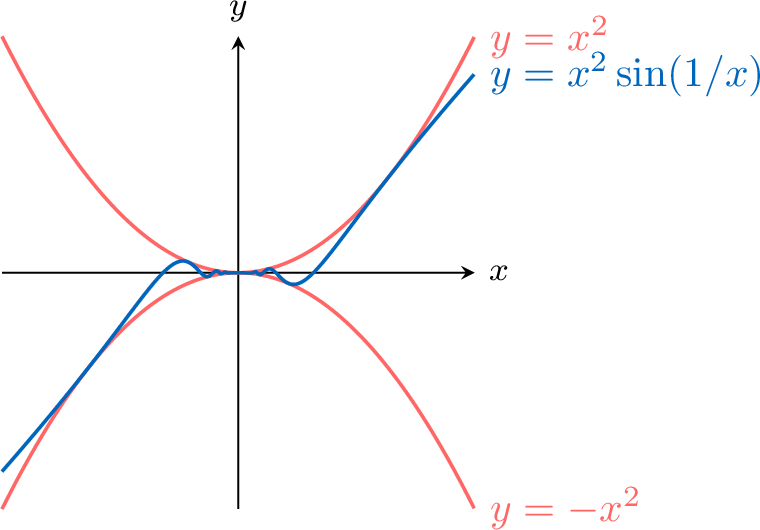
We start with the known range of the sine function:$$ -1 \le \sin\left(\dfrac{1}{x}\right) \le 1. $$Since \(x^2 \ge 0\), we can multiply the entire inequality by \(x^2\) without changing the direction of the inequality signs:$$ -x^2 \le x^2 \sin\left(\dfrac{1}{x}\right) \le x^2. $$We have now "squeezed" our function between \(g(x)=-x^2\) and \(h(x)=x^2\). Next, we find the limits of these outer functions as \(x \to 0\):$$ \lim_{x \to 0} (-x^2) = 0 \quad \text{and} \quad \lim_{x \to 0} (x^2) = 0. $$Since our function is trapped between two functions that both approach the limit \(0\), by the Squeeze Theorem, our limit must also be \(0\):$$ \lim_{x \to 0} x^2 \sin\left(\dfrac{1}{x}\right) = 0. $$